
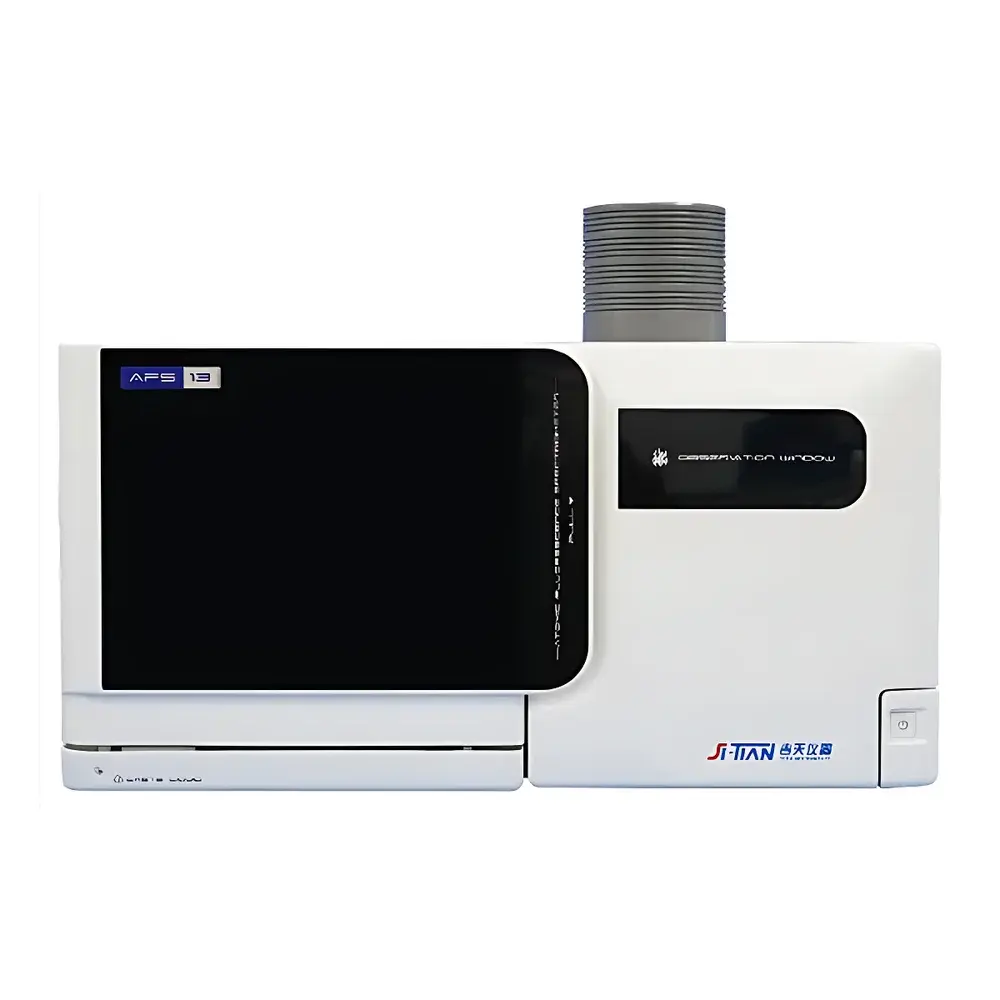
Titan Instruments AFS-13U Multi-Channel Intelligent Atomic Fluorescence Spectrometer
| Brand | Titan Instruments |
|---|---|
| Origin | Beijing, China |
| Manufacturer Type | Original Equipment Manufacturer (OEM) |
| Instrument Type | Multi-channel Atomic Fluorescence Spectrometer |
| Model | AFS-13U |
| Configuration | Triple-channel, fixed-lamp-position optical system |
| Sample Introduction Options | Dual sequential injection, single syringe pump + peristaltic pump, or single peristaltic pump |
| Hydride Generation | Gradient-temperature-controlled vapor generation system |
| Atomization | High-stability quartz tube atomizer with intelligent ignition (voltage-adjustable) |
| Monitoring | Real-time pressure (gas inlet/outlet), lamp current, atomic cell video feed, sample loop & reaction block temperature, waste volume, ambient pressure |
| Safety | Integrated tail-gas trapping and activated carbon exhaust adsorption |
| Connectivity | Wi-Fi, USB 2.0, LAN (RJ45), RS-232 |
| Optional Modules | Refrigerated reagent organizer, LC-AFS hyphenation interface, online acid digestion upgrade |
Overview
The Titan Instruments AFS-13U Multi-Channel Intelligent Atomic Fluorescence Spectrometer is a purpose-engineered analytical platform for trace-level quantification of hydride-forming elements—including As, Se, Bi, Sb, Te, Pb, Sn, Ge, Cd, and Hg—using cold vapor atomic fluorescence spectroscopy (CV-AFS). It operates on the principle of hydride generation coupled with quartz tube atomization and pulsed xenon lamp excitation, followed by wavelength-selective fluorescence detection at sub-picogram-per-milliliter sensitivity levels. Designed for laboratories requiring high throughput without compromise in precision or regulatory compliance, the AFS-13U integrates hardware-level intelligence into core subsystems: optical alignment, vapor generation kinetics, atomization stability, and real-time operational diagnostics. Its triple-channel architecture enables simultaneous determination of three elements within a single run—reducing analysis time by up to 67% compared to sequential single-channel systems—while maintaining independent calibration and signal processing per channel.
Key Features
- Triple-channel fixed-lamp-position optical system with pre-aligned, maintenance-free light paths—eliminates manual lamp alignment drift and ensures long-term photometric reproducibility across As, Se, and Hg channels.
- Integrated lamp current stabilization and mercury-specific drift compensation algorithm, delivering <±1.5% RSD over 8-hour continuous operation for Hg quantification—a critical requirement for environmental water and clinical urine matrix validation.
- Three configurable sample introduction modes: dual sequential injection (for highest precision in regulated testing), syringe-pump–peristaltic hybrid (for viscous or particulate-containing samples), and single peristaltic-only (for routine screening workflows).
- Gradient-temperature-controlled hydride generation system: independently regulated heating zones (40–95 °C range) for the reaction coil and gas–liquid separator, minimizing memory effects in high-concentration standards and enabling robust recovery (>95%) in complex matrices such as soil digests and biological tissues.
- Voltage-adjustable quartz-tube ignition system: dynamically modulates discharge voltage based on ambient humidity and gas flow rate, sustaining stable plasma initiation without manual recalibration—even under variable lab conditions (20–80% RH, 15–30 °C).
- Comprehensive real-time sensor network: monitors gas supply pressure (0–0.6 MPa), lamp operating current (0–20 mA), atomic cell surface temperature (±0.5 °C resolution), reaction block thermal profile, waste reservoir fill level, and local barometric pressure—feeding data directly into instrument self-diagnostics and audit-ready event logs.
Sample Compatibility & Compliance
The AFS-13U accommodates aqueous samples, microwave-digested plant/soil extracts, acid-leached sediments, and enzymatically treated biological fluids. It complies with ISO 17025:2017 method validation requirements for elemental speciation labs and supports full traceability per FDA 21 CFR Part 11 when operated with Titan’s validated AFS Control Suite v4.x software. The system meets ASTM D6722-22 (As in drinking water), EPA Method 1631E (Hg in wastewater), and GB/T 22105.2–2008 (Se in agricultural products) out-of-the-box. Built-in tail-gas scrubbing (activated carbon + NaOH impregnated filter) and sealed waste containment satisfy OSHA 29 CFR 1910.1200 and EU Directive 2004/37/EC for carcinogen handling.
Software & Data Management
AFS Control Suite v4.x provides method-driven workflow automation, including auto-calibration curve generation (linear/log-linear), QC check integration (spike recovery, duplicate analysis, blank monitoring), and GLP-compliant electronic signatures. All sensor telemetry, spectral acquisitions, and user actions are timestamped and stored in encrypted SQLite databases with immutable audit trails. Raw data export supports .csv, .xlsx, and ASTM E1382-compliant .afm formats. Remote access via secure HTTPS portal enables cross-site method sharing and centralized instrument fleet management.
Applications
Validated use cases include: quantification of inorganic arsenic in rice flour per EU Commission Regulation (EU) No 2023/915; speciation of methylmercury in fish tissue following EPA Method 1630; total selenium in infant formula per AOAC 2013.02; antimony leaching from PET packaging per ISO 11885; and bismuth monitoring in pharmaceutical catalyst residues under ICH Q2(R2) guidelines. The optional LC-AFS interface enables separation-based species identification (e.g., As(III)/As(V)/MMA/DMA), while the online digestion module automates closed-vessel HNO₃/H₂O₂ digestion for soils and sludges—reducing hands-on time by >50%.
FAQ
What hydride-forming elements can be measured simultaneously on the AFS-13U?
As, Se, and Hg can be quantified concurrently using the triple-channel configuration. Other combinations (e.g., Sb/Bi/Pb) are supported via method reconfiguration.
Is the AFS-13U compliant with USP / for elemental impurities in pharmaceuticals?
Yes—when operated with certified reference materials, validated sample preparation protocols, and the optional online digestion module, it meets detection limit and accuracy requirements for Class 1 and Class 2 elements.
Can existing hollow cathode lamps from other AFS platforms be used?
Yes—the modular lamp holder accepts standard 1/4-inch pin-base lamps, including legacy Titan, PSA, and GBC units, with automatic current optimization.
How does the gradient-temperature vapor generation improve inter-laboratory reproducibility?
By decoupling reaction kinetics from ambient lab temperature fluctuations, it reduces relative standard deviation between replicate runs across different facilities from >8% to <3.2% (n=12, CRMs NIST SRM 1643f and BCR-715).
What cybersecurity measures are implemented for network-connected operation?
All remote interfaces enforce TLS 1.2+ encryption, role-based access control (RBAC), and session timeout after 15 minutes of inactivity—aligned with NIST SP 800-53 Rev. 5 AC-17 and IA-2 controls.
Related Products




