
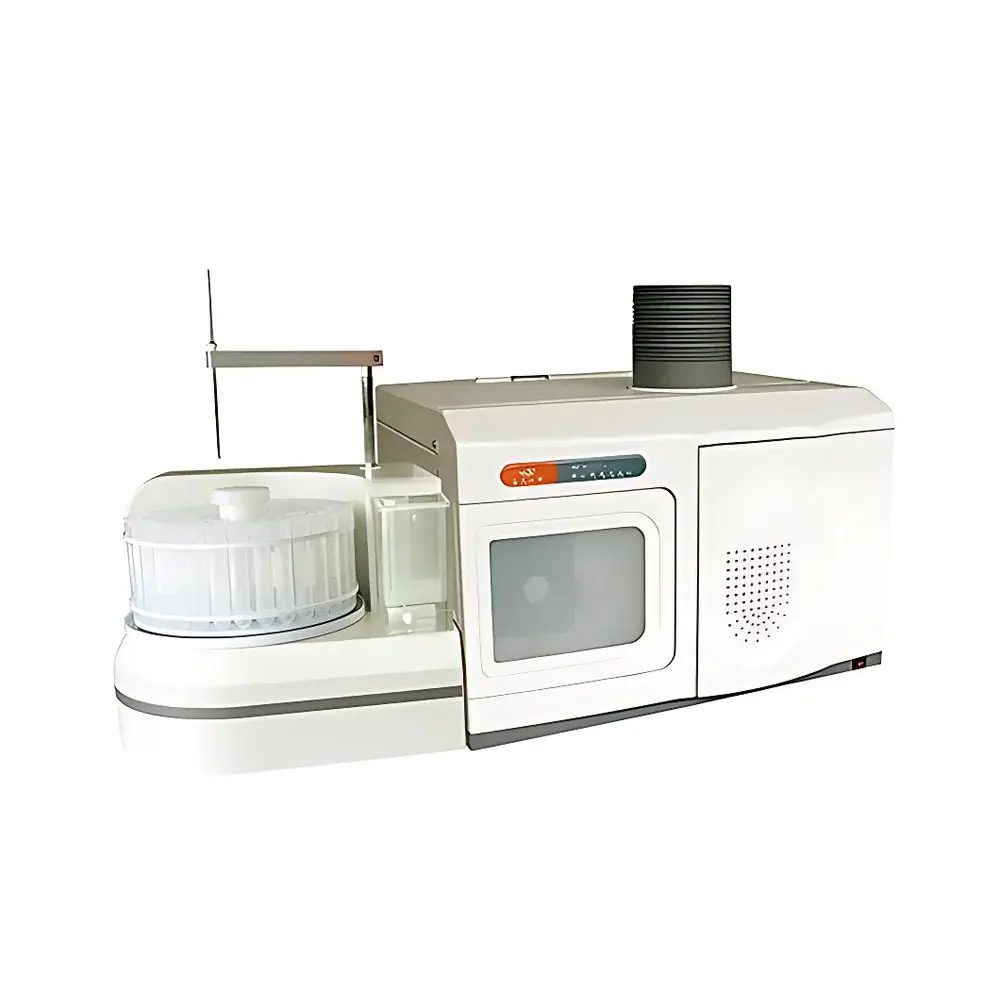
Titan Instruments AFS-8 Series Sequential Injection Atomic Fluorescence Spectrometer
| Brand | Titan Instruments |
|---|---|
| Origin | Beijing, China |
| Model | AFS-8 Series |
| Instrument Type | Hydride Generation Atomic Fluorescence Spectrometer (HG-AFS) |
| Sample Introduction | Sequential injection with peristaltic pump |
| Waste Disposal | Peristaltic pump–driven extraction |
| Vapor Generation Mode | Hydride generation (for As, Sb, Bi, Hg, Se, Te, Sn, Ge, Pb, Zn, Cd, Au) |
| Gas Flow Control | Mass flow controller (MFC) |
| Optional hyphenated modules | Speciation analysis (As, Hg, Se, Sb), Direct solid/liquid Hg–Cd co-determination |
Overview
The Titan Instruments AFS-8 Series Sequential Injection Atomic Fluorescence Spectrometer is a high-performance, laboratory-grade analytical instrument engineered for trace-level quantification of hydride-forming elements in environmental, clinical, food, and industrial matrices. Based on the principle of atomic fluorescence spectroscopy (AFS), the system employs hydride generation (HG) coupled with quartz-trap atomic absorption or flame-in-gas-shield atomization to convert target analytes—such as arsenic (As), antimony (Sb), bismuth (Bi), mercury (Hg), selenium (Se), tellurium (Te), tin (Sn), germanium (Ge), lead (Pb), zinc (Zn), cadmium (Cd), and gold (Au)—into volatile hydride species. These species are swept into a high-temperature quartz cell where atomization occurs, followed by excitation using element-specific hollow cathode lamp radiation and subsequent fluorescence emission detection. The sequential injection architecture enables precise, reproducible reagent and sample metering, minimizing carryover and improving analytical throughput compared to conventional continuous-flow systems.
Key Features
- Sequential injection manifold with high-precision peristaltic pumping—enabling rapid, programmable sample/reagent delivery and reduced reagent consumption.
- Dual-element simultaneous detection capability across the full hydride-forming element suite, supporting multi-analyte screening without hardware modification.
- Integrated gas–liquid separation module with enhanced water removal efficiency and real-time bubble suppression during hydride evolution—critical for signal stability and baseline integrity.
- Optimized pulsed power supply for hollow cathode lamps—extending lamp lifetime while improving signal-to-noise ratio (SNR) and photometric linearity.
- Dual-function quartz observation window—allowing direct visual inspection of the atomization flame under ambient conditions or fully sealed operation for improved safety and interferences control.
- Modular design supporting optional hyphenated configurations: speciation analysis modules for As, Hg, Se, and Sb (e.g., HPLC–AFS coupling); and direct solid/liquid introduction kit for simultaneous Hg and Cd determination without acid digestion or pre-reduction steps.
Sample Compatibility & Compliance
The AFS-8 Series accommodates liquid samples (aqueous extracts, digests, filtrates) and, when equipped with the optional direct introduction module, untreated solids (e.g., soils, tissues, powders) and viscous liquids (e.g., oils, slurries). It complies with methodological frameworks referenced in EPA Method 1632 (Hg), ISO 17892-12 (As in soils), GB/T 5009.11–2014 (As in food), and USP / for elemental impurities in pharmaceuticals. Its design supports GLP-compliant workflows, including audit-trail-capable software logging, user-access controls, and electronic signature readiness aligned with FDA 21 CFR Part 11 requirements when operated with validated software packages.
Software & Data Management
Instrument control, method development, calibration, and report generation are managed via Titan’s proprietary AFS Control Suite—a Windows-based application featuring intuitive workflow wizards, customizable calibration protocols (including standard addition and matrix-matched calibration), real-time signal visualization, and automated QC flagging (e.g., drift, outlier rejection, curve fit residuals). Data files are stored in vendor-neutral formats (CSV, XML) and support integration with LIMS environments through ODBC or HL7 interfaces. All acquisition and processing parameters—including lamp current, delay time, read time, carrier gas flow rate, and reaction coil temperature—are fully traceable and exportable for regulatory review.
Applications
- Environmental Monitoring: Quantification of total As, Hg, and Se in wastewater, surface water, seawater, soil extracts, sediment pore water, and airborne particulate filters.
- Clinical & Public Health: Trace metal analysis in biological matrices including whole blood, urine, hair, herbal medicines, and dietary supplements—supporting biomonitoring and toxicity assessment.
- Food Safety: Routine testing of cereals, dairy products, seafood, tea, tobacco, and alcoholic beverages for regulated contaminants under EU Commission Regulation (EU) No 2023/915 and China’s GB 2762–2022.
- Industrial Quality Control: Elemental screening in petrochemical feedstocks, polymer additives, leather tanning agents, paint pigments, and catalyst residues.
- Academic & Government Research: Method development for novel hydride-generation chemistries, inter-laboratory validation studies, and reference material certification projects.
FAQ
What hydride-forming elements can be analyzed with the AFS-8 Series?
The system is optimized for As, Sb, Bi, Hg, Se, Te, Sn, Ge, Pb, Zn, Cd, and Au using standardized hydride generation chemistry. Detection of additional elements may require method optimization and validation.
Is the instrument compatible with regulatory data integrity standards?
Yes—when configured with compliant software and operational procedures, it meets core requirements of FDA 21 CFR Part 11, EU Annex 11, and ISO/IEC 17025 for electronic records and signatures.
Can the AFS-8 Series perform speciation analysis out of the box?
No—speciation requires coupling with an external HPLC or CE system and dedicated interface hardware; Titan offers validated speciation kits as optional accessories.
What autosampler options are supported?
The system integrates seamlessly with 160-position and 212-position polar-coordinate autosamplers, enabling unattended calibration curve preparation, replicate analysis, and intelligent dilution of out-of-range samples.
Does the instrument require external cooling or exhaust ventilation?
A standard laboratory fume hood is recommended for routine hydride generation operations; no cryogenic cooling or dedicated chiller is required—the quartz atomizer operates at ambient-to-moderate temperatures.





