
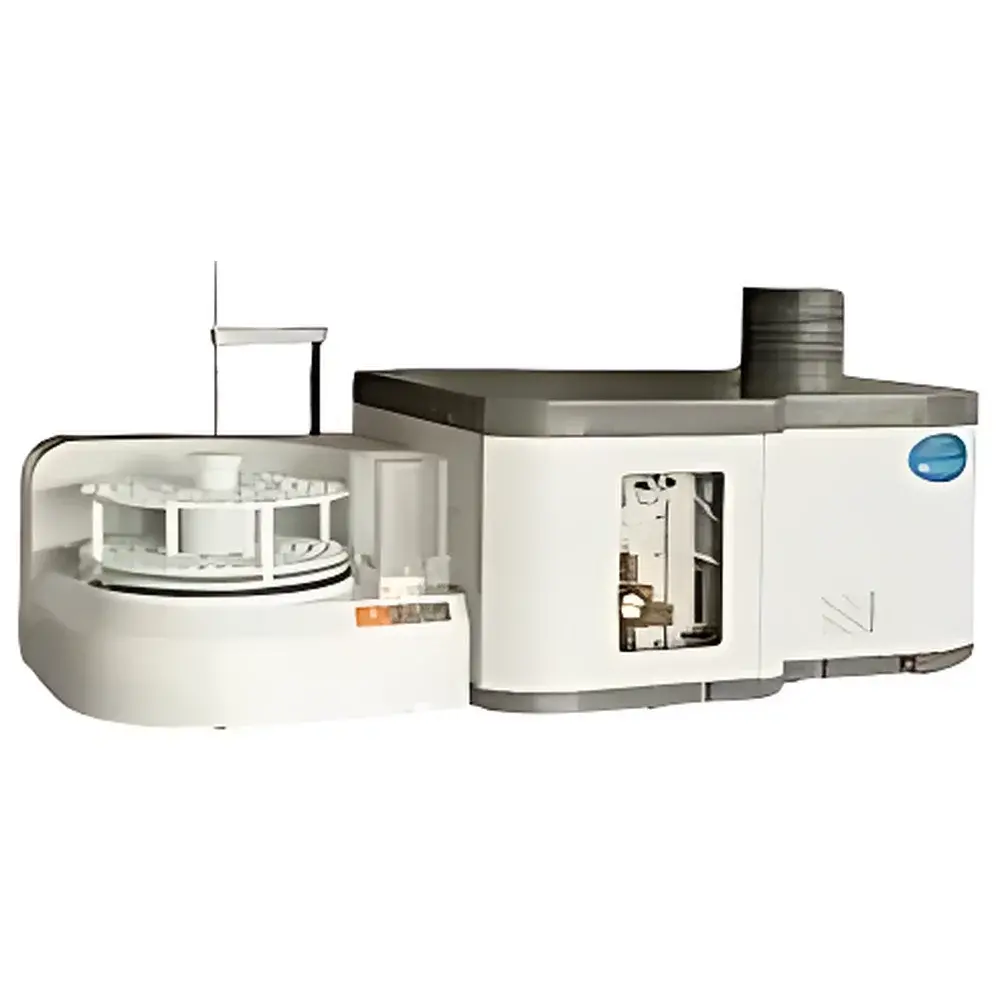
Titan Instruments AFS-921 Fully Automated Integrated Dual-Sequential-Injection Atomic Fluorescence Spectrometer
| Brand | Titan Instruments |
|---|---|
| Origin | Beijing, China |
| Manufacturer Type | Direct Manufacturer |
| Instrument Type | Multi-channel Atomic Fluorescence Spectrometer |
| Sample Introduction | Dual Sequential Injection Pump |
| Waste Disposal | Rear Exhaust Configuration |
| Sample Introduction Mode | Vapor Generation / Hydride Generation |
| Gas Flow Control | Valve Island System |
| Detectable Elements | As, Se, Bi, Hg, Te, Sn, Ge, Pb, Zn, Cd, Au |
| Relative Standard Deviation (RSD) | < 0.8% |
| Linear Dynamic Range | > 3 orders of magnitude |
| Detection Limits | As, Bi, Sb < 0.01 µg/L |
| PMT Wavelength Range | 160–320 nm |
| Atomizer Temperature Control | Precise Integrated Thermal Regulation |
Overview
The Titan Instruments AFS-921 is a fully automated, integrated dual-sequential-injection atomic fluorescence spectrometer engineered for high-sensitivity, multi-element trace metal analysis in environmental, food safety, clinical, and regulatory laboratories. It operates on the principle of hydride vapor generation atomic fluorescence spectroscopy (HG-AFS), where analyte elements—such as arsenic, mercury, selenium, antimony, and bismuth—are chemically reduced to volatile hydride species (or cold vapor for Hg) in acidic medium, swept into a low-temperature argon-hydrogen flame, atomized, and excited by a high-intensity hollow cathode lamp. The resulting atomic fluorescence emission is measured at characteristic wavelengths using a dual-beam, dual-detector optical architecture that continuously monitors source intensity drift and compensates in real time—ensuring long-term photometric stability and measurement reproducibility. Designed to meet the rigorous demands of ISO/IEC 17025-accredited labs and GLP-compliant workflows, the AFS-921 delivers robust performance across complex matrices without sacrificing precision or operational efficiency.
Key Features
- Dual-channel simultaneous detection enables concurrent quantification of two elements (e.g., As and Se), significantly increasing sample throughput while maintaining independent calibration and signal processing per channel.
- Six-position automatic lamp turret with computer-controlled lamp selection ensures seamless switching between elemental lamps without manual intervention—critical for multi-analyte batch analysis.
- Integrated dual sequential injection pump system replaces conventional peristaltic pumping, delivering superior volumetric accuracy (±0.2% RSD), reduced carryover (<0.05%), and enhanced long-term baseline stability over extended operation cycles.
- On-line reagent handling includes automated standard dilution, dynamic addition of KBH4 (with integrated bubble removal), masking agents, and acid modifiers—minimizing manual preparation errors and improving method robustness.
- Sealed, optimized light source housing with bundled pulsed power supply extends lamp lifetime (>5,000 h for As/Hg lamps) and improves signal-to-noise ratio by reducing background emission and thermal drift.
- Low-power argon-hydrogen flame ignition and shielded quartz atomizer provide stable atomization at controlled temperatures (room temperature to 1,000 °C), enabling precise thermal management for volatile and refractory species alike.
- Mass flow controller-based gas regulation ensures repeatable, programmable, and auto-shutoff gas delivery—compliant with OSHA and IEC 61010-1 safety standards for laboratory instrumentation.
- Self-diagnostic startup sequence validates pneumatic integrity, lamp status, detector response, and fluidic path continuity prior to analysis—reducing operator dependency and downtime.
Sample Compatibility & Compliance
The AFS-921 supports direct analysis of aqueous digests (microwave-, hot-block-, or open-vessel–prepared) from soils, sediments, biological tissues, foodstuffs, cosmetics, pharmaceuticals, and clinical specimens. Its integrated chemical vapor generation interface accommodates both hydride-forming elements (As, Sb, Bi, Se, Te, Sn, Pb, Ge) and cold-vapor elements (Hg, Cd). The system complies with key international and national regulatory methods, including GB 5009.11–2014, GB 5009.17–2014, HJ 694–2014, HJ 702–2014, and HJ 542–2010. Optional hardware modules enable expansion into speciation analysis (As(III)/As(V), Se(IV)/Se(VI), Hg(II)/MeHg) and solid-sample direct analysis (Hg/Cd), supporting method development aligned with EPA Method 1631E and ISO 17294-2 requirements.
Software & Data Management
The AFS-921 is operated via a bilingual (English/Chinese) Windows-based software platform compliant with FDA 21 CFR Part 11 requirements—including full audit trail, electronic signature support, role-based access control, and data integrity safeguards. The software provides automated system diagnostics, multi-point calibration (including single-standard curve generation), kinetic measurement modes, and customizable reporting templates compatible with LIMS integration. All raw spectra, peak area integrations, and instrument parameter logs are timestamped and stored in encrypted binary format. Data export options include CSV, PDF, and XML, with embedded metadata for traceability in ISO/IEC 17025 audits.
Applications
The AFS-921 serves as a primary analytical tool in accredited environmental testing labs (water, soil, air particulates), food safety monitoring programs (rice, seafood, infant formula), public health surveillance (urine/blood Hg, As), pharmaceutical quality control (catalyst residue screening), and academic research (biogeochemical cycling, metallomics). Its sensitivity and selectivity make it particularly suited for compliance testing against WHO drinking water guidelines (As ≤ 10 µg/L, Hg ≤ 1 µg/L), EU Commission Regulation (EC) No 1881/2006 (inorganic As in rice), and USP / elemental impurities protocols.
FAQ
What elements can be quantified using the AFS-921?
The instrument is validated for As, Se, Bi, Hg, Te, Sn, Ge, Pb, Zn, Cd, and Au—covering all major hydride-forming and cold-vapor elements specified in global regulatory frameworks.
Does the system support method validation per ISO 17025?
Yes—the dual-beam optical design, integrated calibration verification standards, and full 21 CFR Part 11–compliant software enable documented method validation for precision, accuracy, LOD/LOQ, linearity, and robustness.
Can the AFS-921 perform speciation analysis out of the box?
Speciation capability requires optional hardware modules (HPLC-AFS interface, post-column derivatization unit) and dedicated software modules—not included in base configuration but fully supported via factory upgrade.
Is remote monitoring or network deployment possible?
The instrument supports TCP/IP communication and can be integrated into enterprise networks via secure VLAN configuration, enabling centralized instrument monitoring and data aggregation across multi-site laboratories.




