
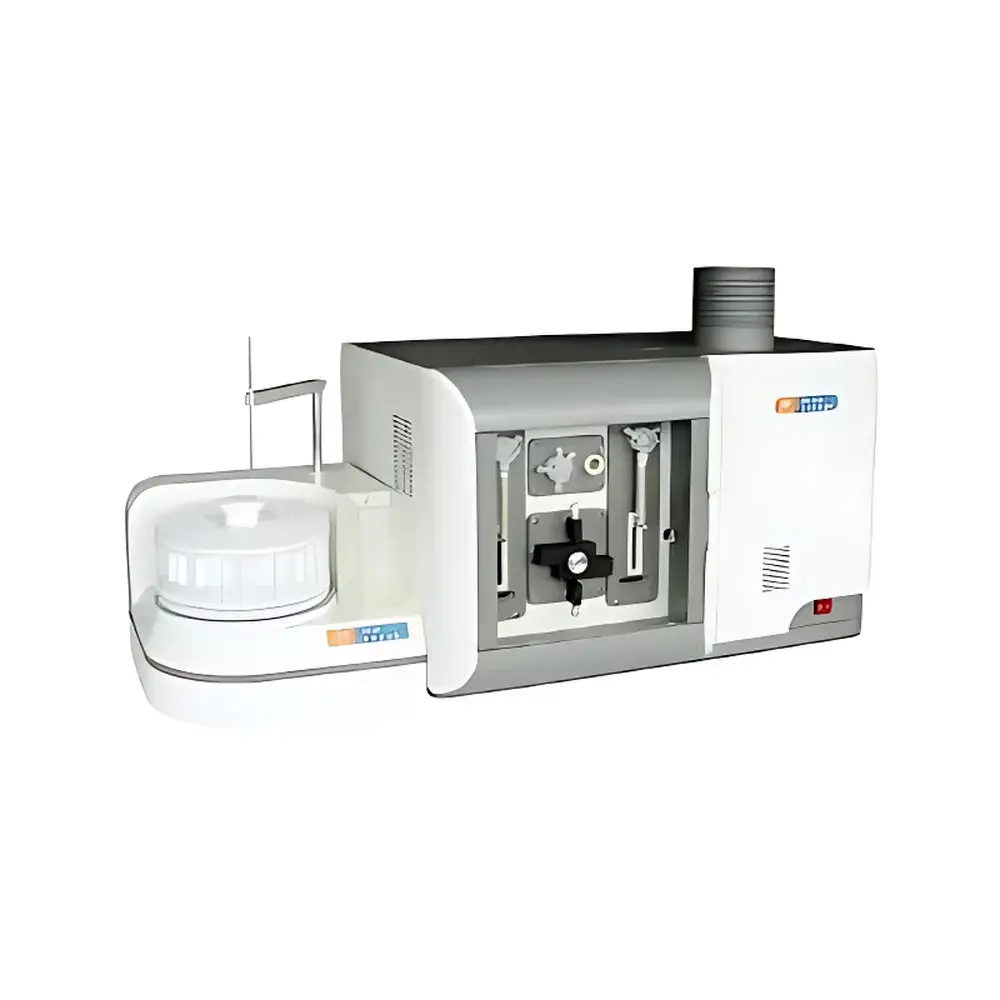
Titan Instruments AFS-9230 Fully Automated Dual-Flow Sequential Injection Atomic Fluorescence Spectrometer
| Brand | Titan Instruments |
|---|---|
| Origin | Beijing, China |
| Manufacturer Type | Direct Manufacturer |
| Instrument Type | Multi-channel Atomic Fluorescence Spectrometer |
| Sample Introduction | Dual Sequential Injection Pumps |
| Waste Disposal | Peristaltic Pump Extraction |
| Hydride Generation Mode | Vapor Generation / Hydride Generation |
| Gas Control System | Valve Island |
| Detectable Elements | As, Se, Bi, Hg, Te, Sn, Ge, Pb, Zn, Cd, Au |
| RSD | < 0.8% |
| Linear Dynamic Range | > 3 orders of magnitude |
| Detection Limits | As, Bi, Sb < 0.01 µg/L |
| PMT Wavelength Range | 160–320 nm |
| Atomizer Temperature Control Range | Ambient to 1,000 °C (programmable) |
Overview
The Titan Instruments AFS-9230 is a fully automated, dual-channel atomic fluorescence spectrometer engineered for high-sensitivity, trace-level elemental analysis via hydride generation and cold vapor atomic fluorescence (HG-AFS/CV-AFS). It operates on the principle of atomic fluorescence spectroscopy—where analyte atoms, generated in situ by chemical reduction (e.g., NaBH₄ for As, Sb, Bi, Se) or thermal reduction (e.g., SnCl₂ for Hg), are atomized in an argon-hydrogen flame or quartz tube furnace and excited by a high-intensity hollow cathode lamp (HCL). The resulting fluorescence emission at characteristic wavelengths is detected by a low-noise photomultiplier tube (PMT) within the 160–320 nm spectral window. Designed for regulatory compliance and routine laboratory throughput, the AFS-9230 delivers sub-part-per-trillion detection capability for priority toxic elements—including arsenic, mercury, selenium, antimony, bismuth, and lead—making it suitable for environmental monitoring, food safety testing, clinical toxicology, and geological resource assessment.
Key Features
- Dual-channel simultaneous detection architecture enables concurrent quantification of two elements (e.g., As and Hg), reducing analysis time and improving lab efficiency without cross-talk or signal interference.
- Six-position automated lamp turret with software-controlled lamp selection ensures rapid method switching and optimal spectral line selection for each target element.
- Fully integrated sequential injection manifold with dual independent syringe pumps provides precise, reproducible reagent metering, online standard dilution, automatic reductant (e.g., KBH₄) and masking agent addition, and programmable reaction timing.
- Double-beam, dual-detector optical design continuously monitors primary HCL intensity and compensates for source drift in real time—enhancing long-term signal stability and measurement reproducibility (RSD < 0.8%).
- Sealed, low-noise light source housing with bundled pulsed power supply extends lamp lifetime (> 5,000 h typical), improves peak-to-background ratio, and minimizes spectral noise during mercury cold-vapor measurements.
- Programmable quartz atomizer with temperature control (ambient to 1,000 °C) supports both flame-on and flame-off atomization modes, enabling optimized sensitivity for volatile and non-volatile species.
- Integrated gas management system featuring mass flow controllers (MFCs), valve island architecture, and auto-shutoff logic ensures consistent Ar/H₂ flow rates, leak-tight operation, and fail-safe shutdown during power loss or pressure anomaly.
- 160-position polar-coordinate autosampler with wash station and collision avoidance logic supports unattended overnight operation and full sample batch processing.
Sample Compatibility & Compliance
The AFS-9230 accommodates aqueous samples across diverse matrices—including drinking water, wastewater, soil digests (HNO₃-HCl-HF or microwave-assisted), biological tissues (acid-digested), food extracts, pharmaceutical excipients, and cosmetic emulsions. Its hydride generation interface is compatible with EPA Method 200.9, ISO 17294-2:2016, and Chinese national standards including GB 5009.11–2014 (total inorganic As in food), GB 5009.17–2014 (total/organic Hg), HJ 694–2014 (water), and HJ 680–2013 (soil/sediment). The instrument meets GLP and GMP documentation requirements through audit-trail-enabled software, electronic signature support, and secure user access levels. Optional hardware modules allow expansion into speciation analysis (As(III)/As(V), methylmercury, SeMet) per EPA 1638 and ISO/IEC 17025-compliant workflows.
Software & Data Management
Titan’s proprietary AFS Control Suite (v5.x) offers bilingual (English/Chinese) GUI with intuitive workflow navigation. It supports automated system diagnostics (lamp alignment, gas pressure verification, pump priming status), method-driven sequence programming, multi-point calibration with forced zero and outlier rejection, and dynamic range extension via auto-dilution. Data handling includes customizable report templates (PDF, Excel, CSV), embedded expert guidance (recommended digestion protocols, reagent purity thresholds, interference mitigation strategies), and full traceability: every measurement logs operator ID, timestamp, instrument parameters, raw spectra, and QC flagging. All data files are digitally signed and stored in encrypted SQLite databases compliant with FDA 21 CFR Part 11 requirements for electronic records and signatures.
Applications
The AFS-9230 is routinely deployed in accredited environmental laboratories for monitoring As and Hg in groundwater per WHO guidelines; in food safety labs for screening rice, seafood, and infant formula against EU Commission Regulation (EC) No 1881/2006 limits; in public health institutions for biomonitoring urinary As metabolites and blood Hg levels; and in agricultural research centers for assessing heavy metal uptake in crops and fertilizers. Its robustness supports high-volume testing in municipal water utilities (per ISO 10566), mining site remediation projects (ASTM D6729), and pharmaceutical quality control (ICH Q2(R2)-aligned validation studies). The optional direct solid sampling module enables rapid Hg/Cd screening in soils, sediments, and plastics without acid digestion—reducing turnaround time and contamination risk.
FAQ
What elements can be measured with the AFS-9230, and which require hydride generation versus cold vapor?
As, Sb, Bi, Se, Te, Sn, and Pb are measured via hydride generation using NaBH₄; Hg is measured via cold vapor atomic fluorescence using SnCl₂ reduction; Cd and Zn require specialized pre-concentration or modified chemistry and are supported with optional accessories.
Does the system comply with U.S. EPA or ISO methods for mercury analysis in water?
Yes—the AFS-9230 meets performance criteria outlined in EPA Method 1631E (Mercury in Water by Oxidation, Purge and Trap, and CVAFS) when configured with appropriate sample introduction and calibration protocols.
Can the instrument be validated for GLP/GMP environments?
Yes—software includes 21 CFR Part 11 compliance features (audit trail, role-based access, electronic signatures), and hardware design supports IQ/OQ/PQ documentation per ASTM E2500 and ISO/IEC 17025.
Is remote monitoring or network integration supported?
The AFS Control Suite supports LAN-based instrument sharing, centralized data archiving via SQL Server, and OPC UA-compatible data export for LIMS integration.
What maintenance intervals are recommended for the sequential injection system and gas control module?
Per manufacturer guidelines: syringe pump tubing replacement every 3 months under continuous use; MFC calibration verification quarterly; quartz atomizer cleaning after every 200 samples or upon visible residue accumulation.





