
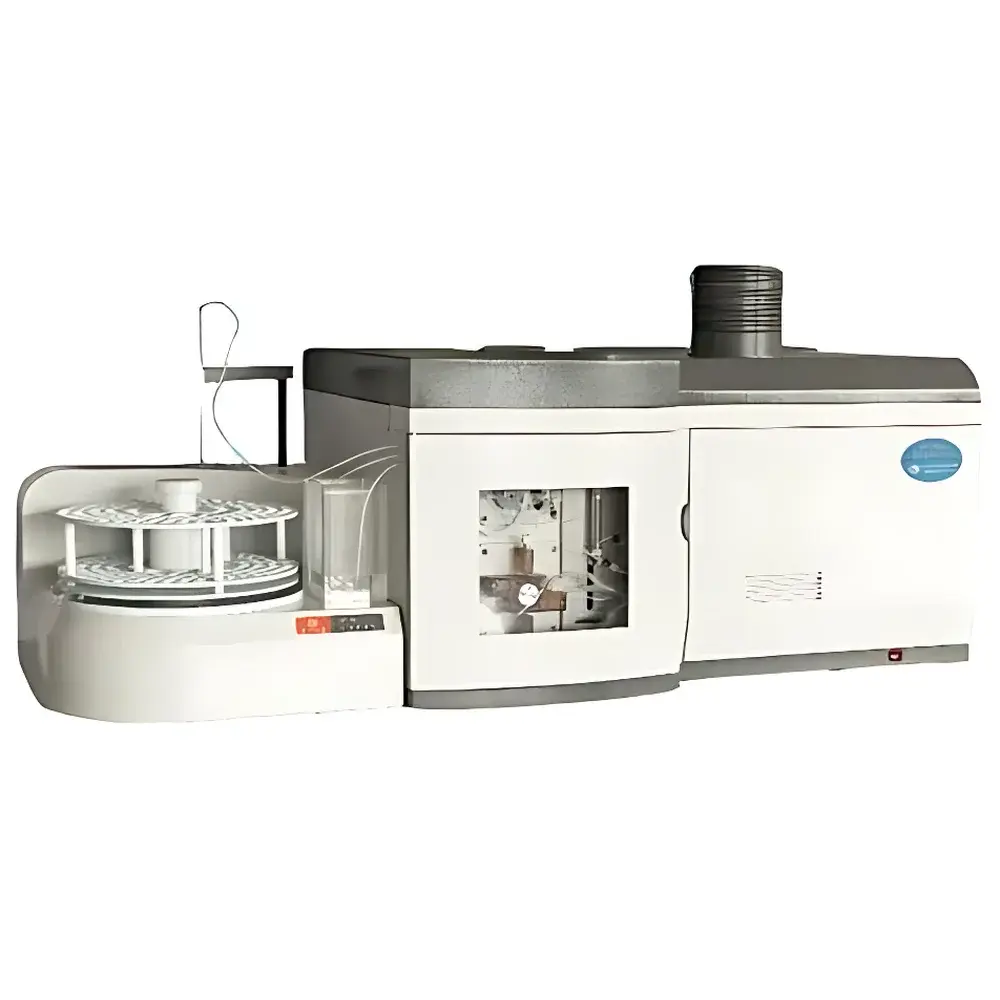
Titan Instruments AFS-9320 Fully Automated Six-Lamp Dual Sequential Injection Atomic Fluorescence Spectrometer
| Brand | Titan Instruments |
|---|---|
| Origin | Beijing, China |
| Manufacturer Type | Direct Manufacturer |
| Instrument Type | Multi-channel Atomic Fluorescence Spectrometer |
| Sample Introduction | Dual Sequential Injection Pump |
| Waste Disposal | Rear Exhaust Configuration |
| Hydride Generation Mode | Vapor Generation / Hydride Generation |
| Gas Control System | Valve Island |
| Detectable Elements | As, Se, Bi, Hg, Te, Sn, Ge, Pb, Zn, Cd, Au |
| RSD | <0.8% |
| Linear Dynamic Range | >3 orders of magnitude |
| Detection Limits | As, Bi, Sb < 0.01 µg/L |
| PMT Wavelength Range | 160–320 nm |
| Atomizer Temperature Control | Yes |
Overview
The Titan Instruments AFS-9320 is a fully automated, six-lamp multi-channel atomic fluorescence spectrometer engineered for high-sensitivity, trace-level quantification of hydride-forming and cold-vapor elements in complex environmental, food, clinical, and industrial matrices. It operates on the principle of atomic fluorescence spectroscopy (AFS), where analyte atoms—generated in situ via hydride vapor generation (HVG) or cold vapor atomic fluorescence (CV-AFS)—are excited by element-specific hollow cathode lamp (HCL) radiation and emit characteristic fluorescent photons detected by a solar-blind photomultiplier tube (PMT). The dual sequential injection system enables precise, reproducible reagent and sample metering with minimized memory effect and carryover, while the integrated valve island ensures stable, programmable gas flow control essential for consistent hydride formation and atomization efficiency. Designed for routine compliance testing and research-grade analysis, the AFS-9320 meets the instrumental performance requirements specified in major international and national standards including ISO 17294-2, ASTM D5673, and US EPA Method 1631E for mercury.
Key Features
- Fully automated six-lamp turret with independent power control, enabling rapid method switching and simultaneous multi-element analysis without manual lamp replacement.
- Dual sequential injection pump architecture delivering sub-microliter precision, long-term volumetric stability (>8 hours continuous operation), and programmable reaction timing for optimized hydride generation kinetics.
- Low-temperature argon-hydrogen flame quartz atomizer with double-shielded quartz furnace design, minimizing background emission and enhancing atomization efficiency for volatile hydride elements.
- Solar-blind photomultiplier tube (160–320 nm spectral response) with low dark current and high quantum efficiency, significantly reducing interference from ambient visible light and improving signal-to-noise ratio.
- High-intensity, pulse-driven hollow cathode lamps (As, Sb, Bi, Hg, Se, etc.) utilizing short-pulse, high-current excitation to extend lamp lifetime (>5,000 h) and maintain spectral stability over extended analytical runs.
- Integrated valve island gas control system with real-time pressure monitoring and feedback regulation, ensuring repeatable hydrogen/argon flow ratios critical for stoichiometric hydride formation and flame stability.
- Rear-exhaust waste management configuration compliant with laboratory fume hood integration and minimizing cross-contamination risk during high-throughput operation.
Sample Compatibility & Compliance
The AFS-9320 supports aqueous liquid samples following standard acid digestion (e.g., HNO₃/HCl microwave-assisted digestion per EPA 3052 or GB/T 22105-2008) and direct analysis of mercury and cadmium in solid/liquid matrices using optional direct-injection modules. It is validated for use in laboratories operating under GLP and GMP frameworks, with full audit trail capability in optional software packages compliant with FDA 21 CFR Part 11 requirements. The instrument satisfies detection limit and precision criteria outlined in key regulatory methods: GB 5009.11-2014 and GB 5009.17-2014 (food), HJ 694-2014 and HJ 542-2010 (water and air), HJ 680-2013 and HJ 702-2014 (soil/sediment/waste), and ISO 11969 for arsenic in drinking water.
Software & Data Management
Titan’s proprietary AFS Control Suite provides intuitive method development, real-time signal visualization, automatic calibration curve generation (linear and quadratic), and integrated QC checks (blanks, duplicates, spikes, CRM verification). Data files are stored in vendor-neutral formats (CSV, XML) with embedded metadata including instrument parameters, operator ID, timestamp, and environmental conditions. Optional LIMS connectivity supports automated result transfer to laboratory information management systems. Software validation documentation—including IQ/OQ protocols and electronic signature implementation—is available for regulated environments requiring full traceability.
Applications
The AFS-9320 delivers robust performance across diverse application domains: quantification of total and inorganic arsenic in rice and seafood per Codex Alimentarius guidelines; speciation-ready mercury analysis in fish tissue and wastewater effluents; routine monitoring of selenium and antimony in geological survey samples; quality control of heavy metals in pharmaceutical excipients and herbal products; and research-scale investigation of metal bioavailability in soil-plant systems. Its low detection limits and high RSD reproducibility make it suitable for accreditation to ISO/IEC 17025:2017 in accredited testing laboratories.
FAQ
What elements can be measured with the AFS-9320?
The instrument is optimized for As, Se, Bi, Hg, Te, Sn, Ge, Pb, Zn, Cd, and Au using hydride generation or cold vapor techniques.
Is the system compatible with existing laboratory informatics infrastructure?
Yes—optional OPC UA and ASTM E1384-compliant interfaces enable seamless integration with LIMS, ELN, and enterprise data platforms.
Does the AFS-9320 support method validation per ICH Q2(R2)?
The platform provides all necessary raw data, calibration logs, and system suitability records required for analytical method validation studies.
Can the instrument perform simultaneous dual-element analysis?
While configured as a multi-channel single-beam system, sequential multi-element analysis is achieved within a single run via automated lamp switching and synchronized injection cycles.
What maintenance intervals are recommended for the sequential injection pumps?
Pump tubing and valves are rated for ≥10,000 injections; preventive maintenance is scheduled every 6 months or after 5,000 analytical cycles, whichever occurs first.




