
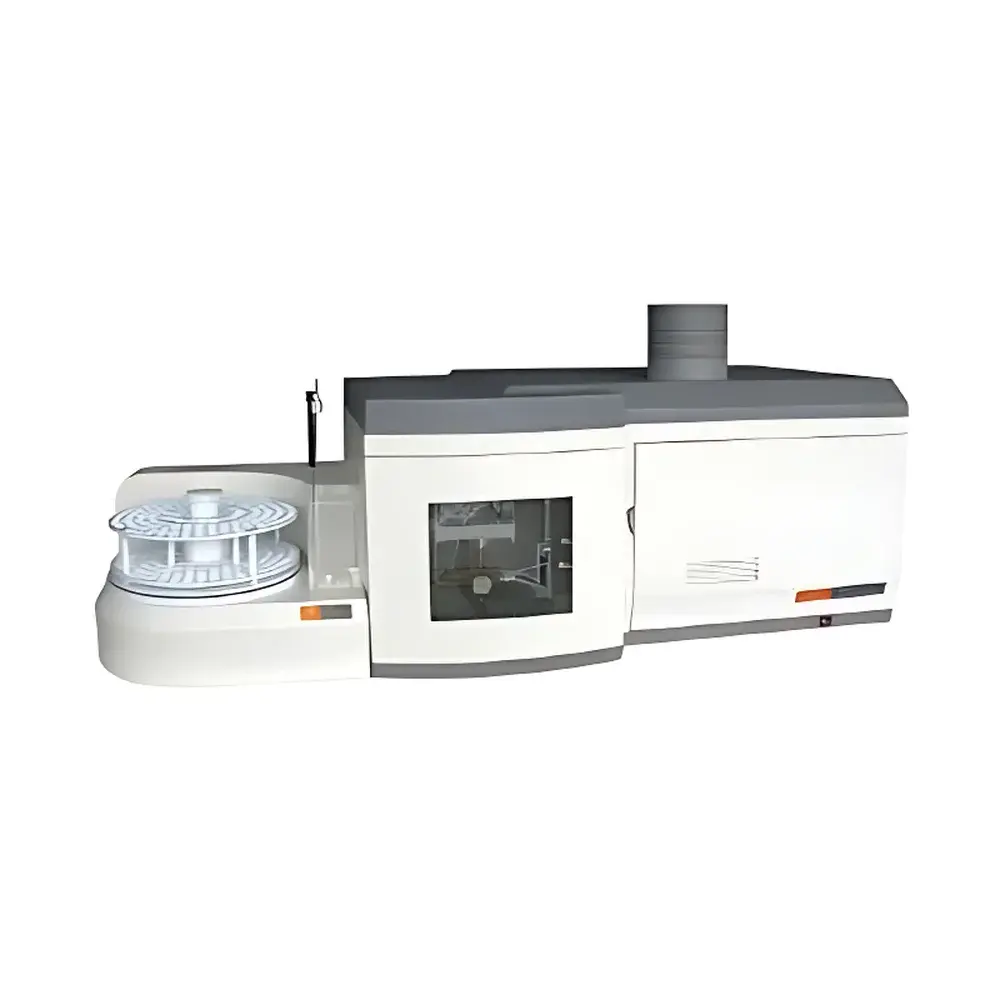
Titan Instruments AFS-9330 Fully Automated Six-Lamp Dual Sequential Injection Atomic Fluorescence Spectrometer
| Brand | Titan Instruments |
|---|---|
| Origin | Beijing, China |
| Manufacturer Type | Direct Manufacturer |
| Instrument Type | Multi-channel Atomic Fluorescence Spectrometer |
| Sample Introduction | Dual Sequential Injection Pump |
| Waste Disposal | Rear Exhaust Design |
| Hydride Generation Mode | Vapor Generation / Hydride Generation |
| Gas Flow Control | Mass Flow Controller (MFC) |
| Detectable Elements | As, Se, Bi, Hg, Te, Sn, Ge, Pb, Zn, Cd, Au |
| RSD | < 0.8% |
| Linear Dynamic Range | > 3 orders of magnitude |
| Detection Limits | As, Bi, Sb < 0.01 µg/L |
| PMT Wavelength Range | 160–320 nm |
| Atomizer Temperature Control | Yes |
Overview
The Titan Instruments AFS-9330 is a fully automated, high-performance atomic fluorescence spectrometer engineered for ultra-trace elemental analysis in complex matrices. It operates on the principle of hydride generation–atomic fluorescence spectroscopy (HG-AFS), where analyte elements (e.g., As, Se, Bi, Hg, Sb) are chemically reduced to volatile hydride species or cold vapor (for Hg), transported into a quartz atomizer, and excited by a high-intensity hollow cathode lamp. The resulting atomic fluorescence emission—measured at right angles to the excitation beam—is quantified using a low-noise photomultiplier tube (PMT) with spectral response optimized from 160 nm to 320 nm. This dual-optical-path, dual-detector architecture enables real-time monitoring of lamp intensity drift and background fluctuations, significantly enhancing signal stability and long-term reproducibility. Designed for routine compliance testing in regulated laboratories, the AFS-9330 meets core performance requirements outlined in ISO/IEC 17025-accredited methods and supports method validation per USP , EPA Method 1631E, and relevant Chinese national standards (e.g., GB 5009.11–2014, GB 5009.17–2014, HJ 694–2014).
Key Features
- Fully automated six-lamp turret with computer-controlled lamp selection and auto-alignment—enabling rapid multi-element method switching without manual intervention.
- Dual-channel sequential injection system with independent syringe pumps for precise, programmable reagent delivery—including online standard dilution, automatic reductant (e.g., KBH4) addition, masking agent dosing, and blank correction.
- Integrated 160-position polar-coordinate autosampler with temperature-controlled sample tray, supporting unattended operation for up to 24 hours.
- Mass flow controller (MFC)-based gas regulation system ensures stable, continuously adjustable Ar–H2 flow (±0.5% repeatability), with automatic shut-off upon power loss or system fault.
- Sealed, low-noise hollow cathode lamp housing with bundled pulsed power supply—extending lamp lifetime by ≥40%, improving S/N ratio, and minimizing spectral interference during mercury analysis.
- Cold-vapor atomic fluorescence (CV-AFS) mode for sub-ppt Hg detection, coupled with a low-temperature Ar–H2 flame ignition system and shielded quartz atomizer for enhanced atomization efficiency and reduced memory effects.
- Onboard chemical vapor generation gas–liquid separator with active bubble removal—eliminating carryover artifacts caused by KBH4 foaming during hydride formation.
- Integrated hazardous vapor trapping module for post-measurement capture of As, Hg, and Se species—ensuring operator safety and environmental compliance per OSHA and EU Directive 2004/37/EC.
Sample Compatibility & Compliance
The AFS-9330 accommodates aqueous samples across diverse regulatory domains—including drinking water (EPA 1631E), soil and sediment digests (HJ 680–2013), biological tissues (GB/T 5009.17), food extracts (GB 5009.11), clinical urine/plasma (CLSI C38-A2), and pharmaceutical excipients (USP ). Its hydride generation interface is compatible with microwave-assisted digestion systems (e.g., Milestone ETHOS UP, CEM MARS 6) and supports direct solid sampling via optional Hg/Cd direct-injection module (no acid digestion required). All operational parameters—including lamp current, gas flow, reaction coil temperature, and delay time—are fully traceable and audit-ready, satisfying FDA 21 CFR Part 11 requirements when used with validated software configurations. Instrument qualification follows IQ/OQ/PQ protocols aligned with ASTM D5673 and ISO 11885.
Software & Data Management
The AFS-9330 runs Titan’s proprietary TitanAFS v4.2 software—a bilingual (English/Chinese), GLP-compliant platform certified for 21 CFR Part 11 compliance with electronic signatures, role-based access control, and full audit trail logging. Key capabilities include: automated system diagnostics (lamp energy check, gas leak test, pump calibration), multi-curve regression (linear, quadratic, weighted), dynamic range extension via auto-dilution flagging, customizable report templates (PDF/Excel), and embedded expert guidance modules with pre-validated method libraries for food, environmental, and clinical applications. Data integrity is reinforced through encrypted local storage, automatic backup to network drives, and timestamped metadata capture for every measurement event—including raw signal traces, integration parameters, and QC flag status.
Applications
The AFS-9330 delivers robust performance in high-throughput trace metal laboratories requiring regulatory-grade data for arsenic speciation in rice flour, mercury monitoring in fish tissue, antimony quantification in PET packaging, selenium profiling in dietary supplements, and bismuth screening in catalyst residues. Its dual-channel architecture allows simultaneous As/Sb or Se/Te determination—reducing analysis time by 40% versus single-channel alternatives. In environmental labs, it supports routine compliance with HJ 702–2014 (solid waste), HJ 542–2010 (ambient air), and ISO 17294-2 for wastewater. In quality control settings, it enables rapid screening of heavy metals in cosmetics (GB/T 29666), textiles (GB/T 17593), and fertilizers (NY/T 1976), with demonstrated recovery rates of 92–105% across spiked matrixes.
FAQ
What elements can be quantified with the AFS-9330, and what are the typical detection limits?
The instrument detects As, Se, Bi, Hg, Te, Sn, Ge, Pb, Zn, Cd, and Au via hydride generation or cold vapor modes. Typical detection limits are ≤0.01 µg/L for As, Bi, Sb; ≤0.001 µg/L for Hg (cold vapor); and ≤0.03 µg/L for Se and Te.
Does the system support hyphenated techniques such as speciation analysis?
Yes—optional HPLC-AFS coupling modules enable As(III)/DMA/MMA, Se(IV)/Se(VI), and Hg(II)/MeHg speciation per EPA 1638 and ISO 17294-2. Dual-channel configuration permits concurrent As and Se species separation.
Is the AFS-9330 compatible with existing laboratory information management systems (LIMS)?
The software exports ASCII, CSV, and XML formats compliant with ASTM E1461 and ASTM E1394 standards, enabling seamless integration with major LIMS platforms including LabWare, STARLIMS, and Thermo Fisher SampleManager.
How is instrument calibration verified during routine use?
Built-in calibration verification includes daily lamp energy checks, peak-area stability tests using certified reference materials (e.g., NIST SRM 1640a, GBW(E) 080396), and automated bracketing with CRMs before and after each batch.
What maintenance intervals are recommended for optimal performance?
Pump tubing replacement every 3 months, quartz atomizer cleaning weekly, PMT voltage recalibration quarterly, and annual MFC calibration using certified mass flow standards (NIST-traceable).




