
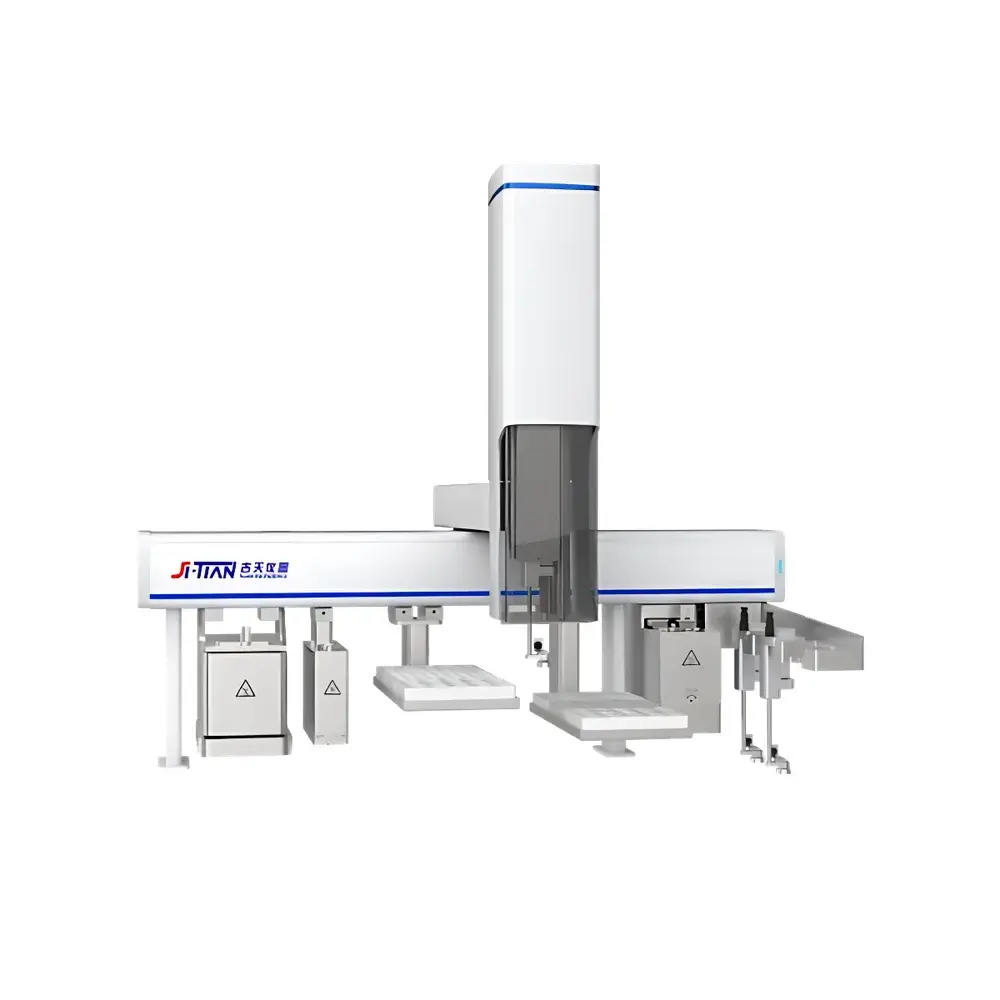
Titan Instruments AMSP-100 Automated Multi-Mode Sample Introduction Platform
| Brand | Titan Instruments |
|---|---|
| Origin | Beijing, China |
| Model | AMSP-100 |
| Sample Introduction Modes | Headspace, Liquid Injection, SPME (Solid-Phase Microextraction) |
| Auto-Needle Exchange | Yes |
| Vial Bottom Detection | Yes (enables ≤10 µL residual sampling) |
| Collision Detection | Yes |
| Agitation Method | Oscillatory (stir-bar-free) mixing |
| GC/GC-MS Compatibility | Universal (vendor-neutral interface) |
| Regulatory Alignment | Designed for GLP-compliant workflows |
Overview
The Titan Instruments AMSP-100 Automated Multi-Mode Sample Introduction Platform is an integrated front-end automation solution engineered for gas chromatography (GC) and gas chromatography–mass spectrometry (GC-MS) laboratories requiring high-throughput, reproducible, and method-flexible sample introduction. Unlike conventional single-mode autosamplers, the AMSP-100 implements a modular mechanical architecture that natively supports three primary introduction modalities—static headspace analysis, direct liquid-phase injection, and solid-phase microextraction (SPME)—within a single instrument footprint. Its operation is governed by a closed-loop stepper motor control system with real-time positional feedback, ensuring sub-microliter volumetric precision during syringe actuation and fiber positioning. The platform’s core design philosophy centers on minimizing manual intervention while maximizing analytical robustness across diverse sample matrices—from aqueous environmental extracts to viscous food homogenates—without compromising method integrity or instrument uptime.
Key Features
- Multi-Modal Introduction Architecture: Seamless switching between headspace vial pressurization and transfer, direct liquid injection (with programmable wash cycles), and SPME fiber exposure/desorption—all under unified software control.
- Vendor-Neutral GC Interface: Equipped with standardized mechanical and electrical interfaces compliant with ASTM D6866-22 and ISO/IEC 17025–aligned installation protocols, enabling plug-and-play integration with Agilent, Thermo Fisher, Shimadzu, PerkinElmer, and other major GC/GC-MS platforms.
- Intelligent Needle Management: Automatic needle rack exchange mechanism accommodates up to four distinct syringe or SPME fiber holders; selection is triggered by method-defined sequence logic, eliminating manual reconfiguration.
- Sub-Microliter Residual Sampling: Integrated capacitive vial-bottom detection ensures precise depth calibration of the sampling probe, enabling reliable aspiration of final 10 µL from standard 20 mL headspace vials—even with low-volume or particulate-laden samples.
- Collision-Avoidance Safety System: Dual-axis inertial measurement units (IMUs) continuously monitor translational acceleration; upon detecting unintended physical obstruction, motion halts within <15 ms and triggers audible/visual alert without requiring firmware reset.
- Oscillatory Mixing Mechanism: Replaces magnetic stir bars with controlled lateral oscillation (0.5–3 Hz, amplitude ±2 mm), delivering homogeneous matrix agitation for SPME equilibration while preventing mechanical stress on fragile fused-silica fiber coatings.
Sample Compatibility & Compliance
The AMSP-100 handles standard 10–22 mL crimp-top or screw-cap vials (including ASTM D7011-compliant headspace vials) and accepts both aqueous and organic solvent-based matrices. It supports EPA Methods 502.2, 524.4, 8260D, and 8270E; ISO 11464:2021 for textile VOC screening; and USP residual solvents testing. All motion sequences, method parameters, and user actions are timestamped and logged in a tamper-evident binary file structure, fulfilling data integrity requirements under FDA 21 CFR Part 11 Subpart B (electronic records) and EU Annex 11 (computerized systems). Routine IQ/OQ documentation packages are provided for GMP/GLP validation.
Software & Data Management
Controlled via TitanControl™ v3.2 desktop application (Windows 10/11, 64-bit), the AMSP-100 supports method cloning, multi-user role-based access (administrator, analyst, reviewer), and export of structured CSV/JSON logs compatible with LIMS ingestion. Audit trails record every parameter change—including dwell times, temperature setpoints, and needle position offsets—with SHA-256 hash verification. Raw sequence files embed embedded metadata per IUPAC JCAMP-DX v6.00 specification, enabling traceable reprocessing in third-party chromatographic data systems (CDS) such as OpenLab CDS or Chromeleon.
Applications
- Environmental Monitoring: Quantification of volatile organic compounds (VOCs) and semi-volatile organic compounds (SVOCs) in groundwater, soil leachates, and ambient air canisters per EPA SW-846 methods.
- Public Health & Drinking Water: Analysis of trihalomethanes (THMs), haloacetic acids (HAAs), and pesticides in compliance with WHO Guidelines for Drinking-water Quality and China’s GB 5749–2022.
- Food Safety: Screening of flavor compounds, mycotoxin derivatives, veterinary drug residues (e.g., chloramphenicol), and packaging migrants (e.g., BADGE, NOGE) using SPME-GC-MS workflows.
- Industrial Chemistry: Batch consistency verification of fragrance oils, polymer additives, and surfactant formulations via headspace fingerprinting.
- Academic Research: Method development platform for novel extraction kinetics studies, fiber coating optimization, and automated derivatization reaction staging (optional module).
FAQ
Does the AMSP-100 require vendor-specific drivers to operate with non-Titan GC systems?
No. It communicates via RS-232/USB virtual COM port using ASCII command protocol compliant with ASTM E1948-20, eliminating proprietary driver dependencies.
Can the oscillatory mixing function be disabled for applications requiring static incubation?
Yes. Mixing activation is method-parameterized and may be omitted per sample group or individual vial position.
Is the collision detection system calibrated during factory acceptance testing (FAT)?
Yes. Each unit undergoes IMU bias and sensitivity validation against NIST-traceable acceleration standards; calibration certificates accompany shipment.
What is the maximum allowable sample viscosity for reliable SPME fiber immersion?
Up to 250 cP at 25 °C—verified using glycerol/water reference mixtures per ISO 2555:2019.
How is data integrity maintained during power interruption?
Non-volatile FRAM memory retains current method state and position counters; resumption occurs at the last completed vial upon reboot without sequence corruption.



