
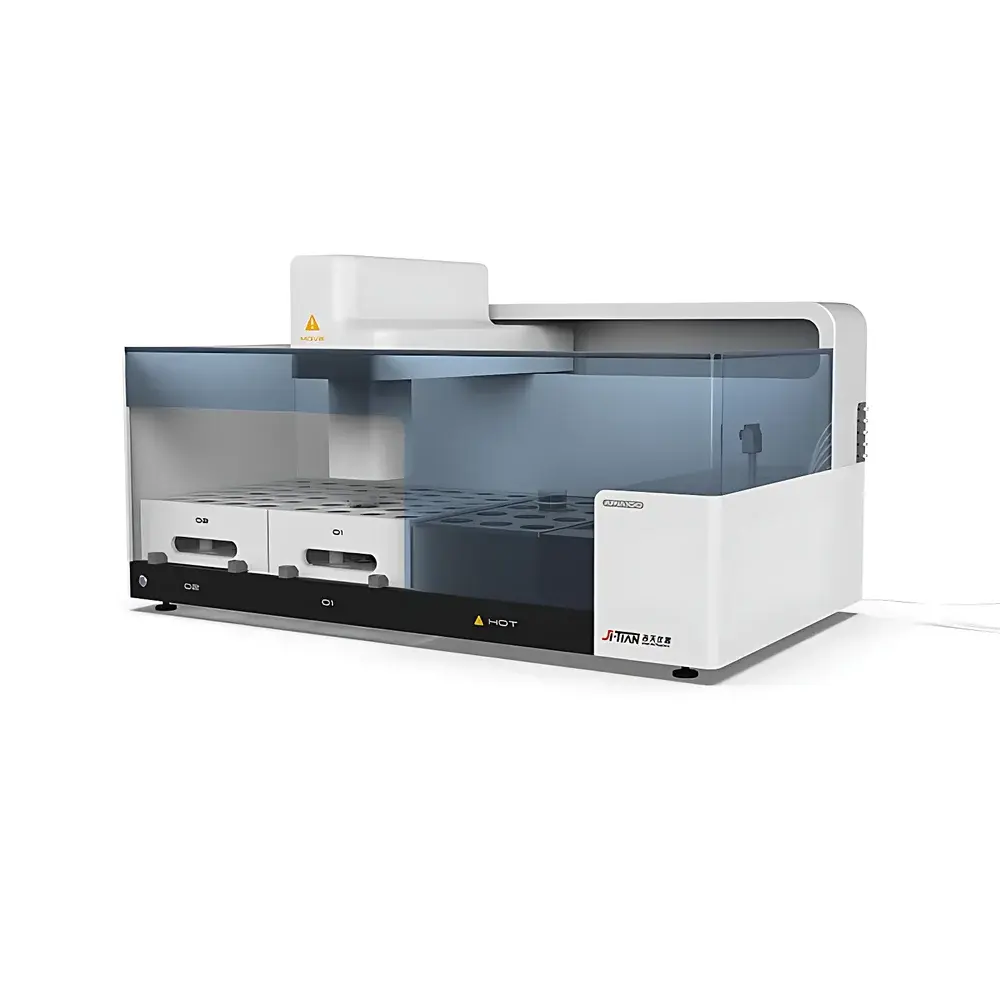
Titan Instruments APIA-100 Automated Permanganate Index Analyzer
| Brand | Titan Instruments |
|---|---|
| Origin | Beijing, China |
| Manufacturer Type | Direct Manufacturer |
| Product Category | Domestic (China-made) |
| Model | APIA-100 |
| Pricing | Available Upon Request |
| Measurement Principle | Potassium Permanganate Oxidation with ORP Endpoint Detection |
| Instrument Type | Laboratory Benchtop Analyzer |
| Repeatability | RSD ≤ 3.0% |
| Limit of Detection | ≤ 0.05 mg/L |
Overview
The Titan Instruments APIA-100 Automated Permanganate Index Analyzer is a laboratory-grade benchtop system engineered for precise, reproducible, and fully automated determination of the permanganate index (CODMn) in water samples—aligned with regulatory requirements defined in China’s national standards GB 11892–1989 “Water Quality — Determination of Permanganate Index” and GB/T 5750.7 “Standard Examination Methods for Drinking Water”. The instrument implements the classical potassium permanganate oxidation method under controlled acidic or alkaline conditions, with endpoint detection based on real-time redox potential (ORP) monitoring. Unlike manual titration or semi-automated approaches, the APIA-100 integrates sample handling, reagent dispensing, temperature-controlled micro-boiling water bath oxidation, endpoint recognition, and data calculation into a single unattended workflow—minimizing operator intervention while ensuring analytical consistency across batched analyses.
Key Features
- Fully automated dual-channel architecture enabling simultaneous analysis of two independent samples—doubling throughput without compromising precision.
- Dedicated, isolated fluidic pathways for acidic and alkaline digestion protocols, eliminating cross-contamination and supporting method flexibility per GB/T 5750.7 and GB 11892 requirements.
- Micro-boiling water bath module with precise thermal regulation (±0.5 °C), designed to maintain consistent oxidation kinetics while suppressing excessive evaporation or bumping during the 30-minute reflux step.
- Integrated ORP sensor with adaptive signal filtering for robust endpoint detection—calibrated against NIST-traceable redox standards and validated across matrix ranges (0.05–10.0 mg/L MnO4− equivalent).
- Self-diagnostic startup sequence verifying syringe pump integrity, valve actuation, sensor responsiveness, and thermal stability prior to sample processing.
- Smart sample-handling subsystem featuring motorized gripper with force-sensing feedback and optical barcode recognition—ensuring accurate vial positioning and preventing misloading or collision events.
- Remote operation capability via embedded Ethernet interface and web-based dashboard; optional integration with third-party LIMS through ASTM E1384-compliant data export (CSV/JSON).
Sample Compatibility & Compliance
The APIA-100 accepts standard 50 mL borosilicate glass sample vials and accommodates raw, filtered, or preserved water matrices—including potable water, source water, groundwater, surface water, and low-salinity wastewater. Chloride interference mitigation is implemented algorithmically: the system quantifies chloride concentration spectrophotometrically (via mercuric thiocyanate method per GB/T 5750.7 Annex B) and automatically selects between acid or alkaline digestion pathways to suppress Cl−-induced over-oxidation. All operational parameters—including reagent volumes, heating profiles, titrant addition rates, and endpoint thresholds—are configurable to meet internal QA/QC protocols and external audit readiness. The system supports GLP-compliant audit trails with timestamped event logging (including user logins, method changes, calibration records, and error flags), satisfying documentation expectations under ISO/IEC 17025 and China’s CNAS-CL01 requirements.
Software & Data Management
The embedded control software provides intuitive method setup, real-time reaction monitoring (ORP vs. time curves), and automatic report generation compliant with GB/T 5750.7 formatting conventions. Data files include raw sensor outputs, intermediate calculations (e.g., blank correction, dilution factor application), and final CODMn values with uncertainty estimates derived from RSD ≤ 3.0% performance validation. Export options include PDF analytical reports, CSV datasets for statistical review, and XML metadata bundles compatible with enterprise-level laboratory informatics systems. Audit trail records are write-once, non-erasable, and digitally signed—meeting traceability criteria analogous to FDA 21 CFR Part 11 electronic record controls where locally adopted.
Applications
- Routine compliance monitoring of drinking water treatment plants and distribution systems.
- Environmental surveillance of river, lake, and reservoir water quality by municipal and provincial environmental monitoring centers.
- Source water vulnerability assessment and seasonal trend analysis in watershed management programs.
- Validation of oxidation pretreatment efficiency in advanced water reuse facilities.
- Research applications requiring high-throughput screening of organic load variations across large sample sets (e.g., ecological studies, climate impact modeling).
FAQ
Does the APIA-100 comply with international standards such as ISO 8467?
The APIA-100 implements the core chemical principle of ISO 8467 (potassium permanganate oxidation at boiling point), though its firmware and reporting structure are optimized for Chinese national standards. Method equivalence validation data can be provided upon request.
Can the system handle high-chloride samples like seawater-influenced estuaries?
No—the APIA-100 is validated for chloride concentrations up to 300 mg/L. Samples exceeding this require pre-dilution or alternative methods (e.g., dichromate-based COD).
Is remote software update supported?
Yes—secure OTA updates are delivered via HTTPS-encrypted channel with SHA-256 signature verification and rollback capability.
What maintenance intervals are recommended?
Daily: rinse lines with deionized water; Weekly: calibrate ORP sensor and verify pipetting accuracy; Annually: replace tubing, valves, and thermal bath fluid per maintenance logbook.
Is GLP audit support included out-of-the-box?
Yes—full electronic audit trail, user role-based access control, and electronic signature functionality are enabled by default and documented in the System Validation Package (SVP).
Related Products







