
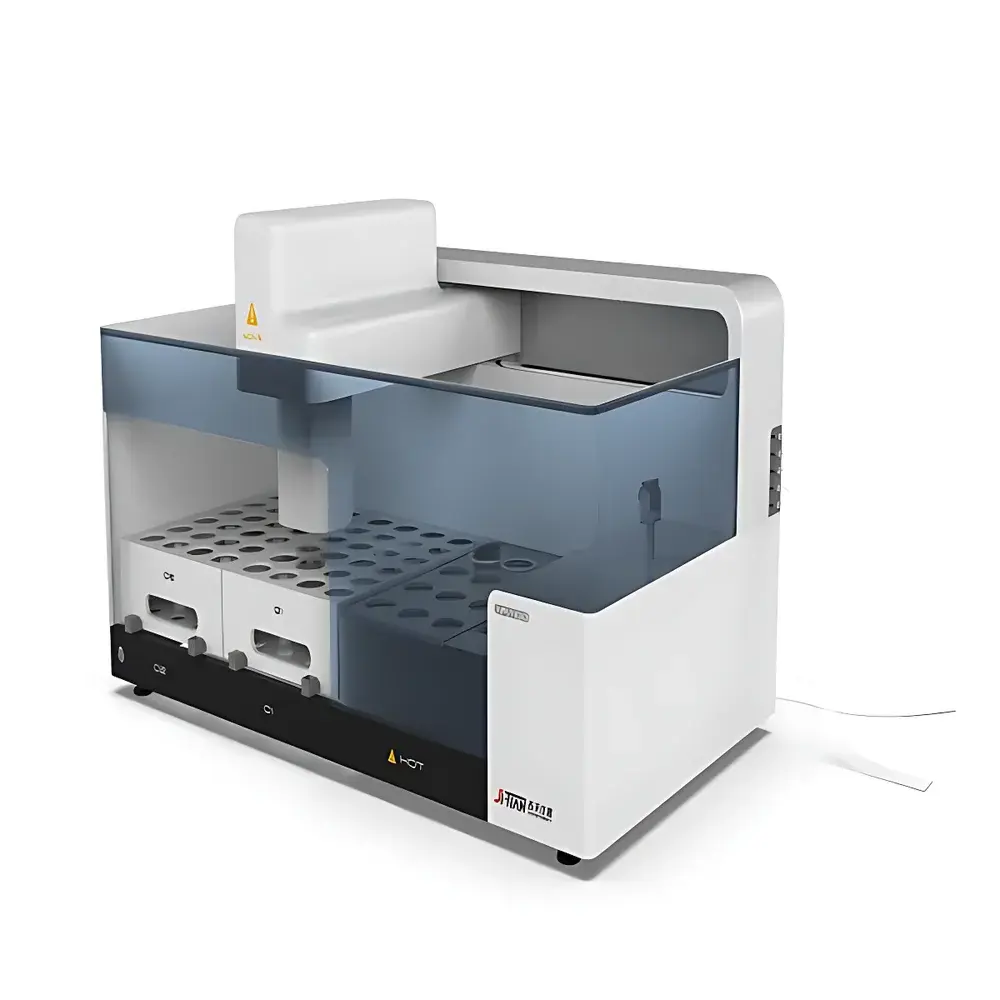
Titan Instruments APIA-100 Fully Automated Permanganate Index Analyzer
| Brand | Titan Instruments |
|---|---|
| Origin | Beijing, China |
| Manufacturer Type | Authorized Distributor |
| Origin Category | Domestic (China) |
| Model | APIA-100 |
| Pricing | Available Upon Request |
Overview
The Titan Instruments APIA-100 Fully Automated Permanganate Index Analyzer is a dedicated benchtop system engineered for precise, reproducible determination of the permanganate index (CODMn) in aqueous environmental and potable water samples. It implements the standardized oxidation–titration principle defined in GB 11892–1989 “Water Quality — Determination of Permanganate Index” and GB/T 5750.7 “Standard Examination Methods for Drinking Water”, where potassium permanganate serves as the oxidant under controlled acidic or alkaline conditions at elevated temperature. The analyzer automates the entire analytical sequence—including sample aspiration, reagent dispensing, micro-boiling water bath oxidation (maintained at precise reflux temperature without violent boiling), cooling, back-titration with sodium oxalate, and endpoint detection via potentiometric or colorimetric means—eliminating manual intervention while ensuring strict adherence to regulatory procedural requirements.
Key Features
- Fully automated dual-channel architecture enabling parallel analysis of two independent samples, effectively doubling throughput without compromising method integrity.
- Dedicated, isolated fluidic pathways for acid and alkaline digestion methods—preventing cross-contamination and supporting simultaneous compliance with both GB 11892–1989 (acidic method) and GB/T 5750.7 (alkaline method for low-salinity or chloride-sensitive matrices).
- Micro-boiling water bath module with PID-controlled thermal regulation and anti-bumping design, minimizing sample evaporation and ensuring consistent oxidation kinetics across batches.
- Integrated chloride interference assessment: real-time estimation of chloride concentration prior to analysis, followed by automatic selection between acid and alkaline protocols per GB/T 5750.7 guidelines.
- Self-diagnostic startup sequence with hardware status verification (pump integrity, valve actuation, sensor calibration, temperature stability) and on-screen fault logging for rapid troubleshooting.
- Motorized adaptive gripper arm with position feedback for reliable vial handling, coupled with optical barcode/QR code recognition to validate sample identity and prevent misloading.
- Remote video monitoring interface accessible via secure HTTPS connection, providing live camera feed and instrument status dashboard for unattended operation in centralized lab environments.
Sample Compatibility & Compliance
The APIA-100 is validated for use with raw water, finished drinking water, groundwater, surface water, and treated effluent matrices within the typical permanganate index range of 0.5–10.0 mg/L O2. Its operational workflow aligns with national standard methodologies and supports traceability requirements under GLP-compliant laboratories. While not certified to ISO/IEC 17025 out-of-the-box, the system’s audit trail functionality—including timestamped method logs, reagent lot tracking, operator ID tagging, and electronic signature support—facilitates integration into quality management systems aligned with ISO 17025 clause 7.7 and US FDA 21 CFR Part 11 when deployed with validated software configuration.
Software & Data Management
The embedded control software provides intuitive method setup, real-time run monitoring, and automated report generation compliant with GB/T 5750.7 reporting templates. All measurement data—including raw titration curves, calculated CODMn values, intermediate parameters (e.g., blank correction, oxidation time, temperature profile), and diagnostic events—are stored in encrypted SQLite databases with configurable backup intervals. Export options include CSV, PDF, and XML formats suitable for LIMS integration. Audit trails record every user action, parameter change, and instrument event with immutable timestamps—supporting retrospective review during internal audits or regulatory inspections.
Applications
- Routine monitoring of permanganate index in municipal drinking water treatment plants for process control and regulatory reporting.
- Environmental surveillance of rivers, lakes, and reservoirs to assess organic pollution load and seasonal variation trends.
- Groundwater quality assessment in agricultural or industrial catchment zones where low-level organic contamination is suspected.
- Validation of advanced oxidation processes (AOPs) and membrane filtration efficiency by quantifying residual biodegradable organics.
- Reference laboratory participation in inter-laboratory comparison studies requiring high repeatability and documented procedural fidelity.
FAQ
Does the APIA-100 comply with international standards such as ISO 8467?
The APIA-100 implements methodology equivalent to ISO 8467:1993 “Water quality — Determination of permanganate index”, though formal ISO 8467 certification requires third-party validation under specific laboratory accreditation scopes.
Can the system handle samples with high chloride concentrations?
Yes—the integrated chloride estimation algorithm triggers automatic method switching to the alkaline protocol per GB/T 5750.7, mitigating chloride interference and avoiding false-high results.
Is remote software update supported?
Firmware and software updates are delivered via authenticated USB media or secure SFTP upload; over-the-air updates are disabled by default to maintain regulatory compliance and system stability.
What maintenance routines are required for long-term reliability?
Scheduled maintenance includes quarterly calibration verification using certified reference materials, semiannual tubing replacement in fluidic manifolds, and annual inspection of heating elements and titration electrodes.
How is data integrity ensured during power interruption?
The system features non-volatile memory with auto-save at each critical step; interrupted runs can be resumed from the last completed stage after power restoration, with full audit trail continuity preserved.




