
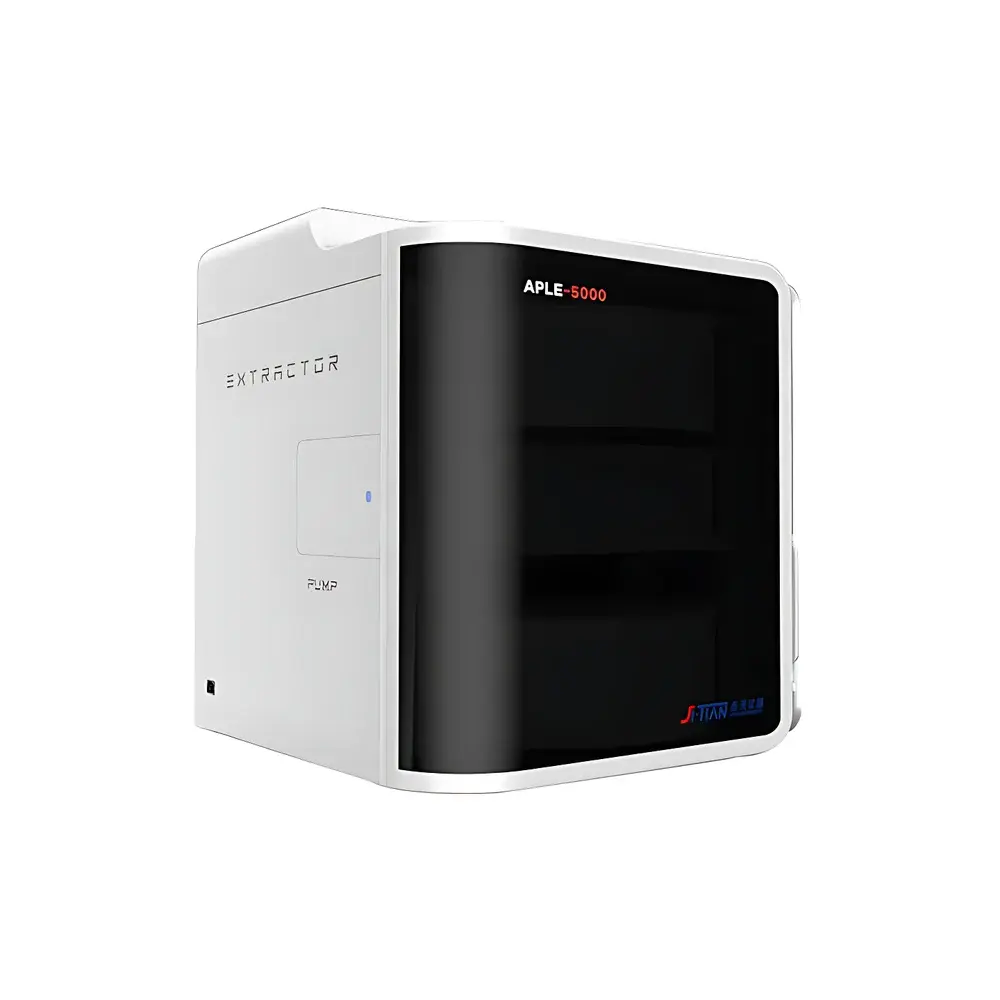
Titan Instruments APLE-5000 Automated Accelerated Solvent Extractor
| Brand | Titan Instruments |
|---|---|
| Origin | Beijing, China |
| Manufacturer Type | Original Equipment Manufacturer (OEM) |
| Instrument Type | Solid-Liquid Extraction |
| Temperature Range | Ambient to 200 °C |
| Pressure Range | Atmospheric to 20 MPa |
| Extract Cell Volumes | 1, 5, 11, 22, 34, 46, 66, and 100 mL (8 options) |
| Extraction Cycle Time | 10–20 min per 2 samples |
| Dimensions | 655 × 720 × 725 mm (W × D × H) |
| Sample Capacity | 26 positions (24 sample + 2 rinse) |
Overview
The Titan Instruments APLE-5000 Automated Accelerated Solvent Extractor is an engineered solution for high-throughput, method-compliant solid and semi-solid sample preparation in regulated analytical laboratories. It implements pressurized fluid extraction (PFE), also known as accelerated solvent extraction (ASE®-compatible methodology), where elevated temperature and pressure are applied simultaneously to enhance solute solubility and mass transfer kinetics—enabling rapid, reproducible recovery of analytes from complex matrices such as soil, sediment, food, and biological tissues. Unlike conventional Soxhlet extraction—which requires hours and large solvent volumes—the APLE-5000 achieves complete extractions in under 20 minutes per dual-sample batch, with significantly reduced solvent consumption and improved extraction efficiency. Its dual-channel parallel/serial architecture supports uninterrupted processing of up to 24 samples unattended, making it suitable for routine environmental monitoring, food safety testing, and pharmaceutical quality control workflows.
Key Features
- Dual-Channel Automation: Simultaneous extraction of two samples per cycle; fully programmable sequence control for 24 sample positions plus two dedicated rinse stations ensures continuous operation without manual intervention.
- Modular Extract Cell System: Eight standardized cell volumes (1–100 mL) accommodate diverse sample masses and matrix types; all cells feature robust O-ring sealing and quick-release mechanisms for rapid loading and maintenance.
- Precise Thermal & Pressure Control: Programmable heating from ambient to 200 °C with ±1 °C accuracy; pressure regulation up to 20 MPa ensures stable supercritical-like conditions during extraction; integrated active cooling accelerates thermal equilibration between runs.
- Smart Fluid Delivery Architecture: Custom-designed high-pressure solvent pump delivers consistent flow rates and pulse-free delivery across variable viscosity solvents (e.g., hexane, acetone, methanol, and their mixtures); system includes real-time pressure monitoring and overpressure cutoff protection.
- Remote Operation & Safety Integration: Built-in Wi-Fi module enables secure remote access via standard web browser or dedicated client interface; emergency stop, solvent leak detection, and temperature/pressure interlocks comply with IEC 61010-1 laboratory safety standards.
- Optimized Collection Interface: Precision-guided collection needle ensures accurate alignment with vial rims, minimizing splashing, cross-contamination, and solvent loss—reducing consumables cost and improving method reproducibility.
Sample Compatibility & Compliance
The APLE-5000 is validated for use with heterogeneous solid and semi-solid matrices including soils, sediments, sludges, plant tissues, animal feed, grains, dairy products, and polymer composites. It meets the operational requirements of multiple international and national regulatory methods, including U.S. EPA Method 3545A (Pressurized Fluid Extraction), China’s HJ 782–2016, HJ 783–2016, HJ 805–2016, HJ 834–2017, and HJ 835–2017 for environmental analysis, as well as GB 23200.9–2016, GB 5009.6–2016, GB 5009.205–2013, and GB/T 14553–2003 for food and agricultural testing. All hardware and software components are designed to support GLP/GMP-aligned workflows, with audit-trail-enabled method storage, user authentication, and electronic signature readiness per FDA 21 CFR Part 11 guidelines.
Software & Data Management
Controlled via a native Windows-based application, the APLE-5000 software provides intuitive method development, real-time status monitoring, and comprehensive data logging. Users define temperature ramps, pressure profiles, static/dynamic extraction phases, flush volumes, and collection sequences through a graphical workflow editor. Methods are stored wirelessly on network drives or local SSDs with version control and timestamped metadata. The software generates compliant audit reports—including operator ID, start/end times, parameter deviations, and error logs—for internal review or regulatory submission. Export formats include CSV, PDF, and XML for seamless integration with LIMS platforms and chromatographic data systems (CDS).
Applications
- Environmental Testing: Extraction of PAHs, PCBs, organochlorine pesticides, dioxins, and petroleum hydrocarbons from soil, sediment, and wastewater sludge per EPA and HJ standards.
- Food Safety & Agriculture: Residue analysis of organophosphorus, carbamate, and neonicotinoid pesticides in fruits, vegetables, cereals, and animal feed; fat determination in dairy and meat products per GB 5009.6–2016.
- Pharmaceutical & Biotech: Recovery of active pharmaceutical ingredients (APIs) and excipients from solid dosage forms; lipid extraction from microbial biomass or botanical materials.
- Industrial Materials: Leaching studies of additives from plastics and elastomers; contaminant profiling in catalysts, coal, and refinery sludges.
FAQ
What extraction solvents are compatible with the APLE-5000?
The system supports common organic solvents including hexane, dichloromethane, acetone, methanol, ethyl acetate, and their binary or ternary mixtures—provided they remain chemically stable below 200 °C and at pressures up to 20 MPa.
Is method validation documentation available for regulatory submissions?
Yes—Titan Instruments provides IQ/OQ documentation templates, performance qualification protocols, and raw data export tools aligned with ISO/IEC 17025 and FDA 21 CFR Part 11 requirements.
Can the APLE-5000 be integrated into an automated sample preparation line?
It features RS-232, Ethernet, and optional digital I/O interfaces for synchronization with robotic autosamplers, fraction collectors, or downstream GC/LC systems.
How often does the system require preventive maintenance?
Recommended service intervals are every 6 months or after 500 extraction cycles, focusing on seal inspection, pump calibration, and pressure transducer verification.
Does the instrument support gradient temperature programming during extraction?
Yes—the software allows multi-step temperature ramping within a single run, enabling staged extraction of compounds with differing polarities or volatilities.



