
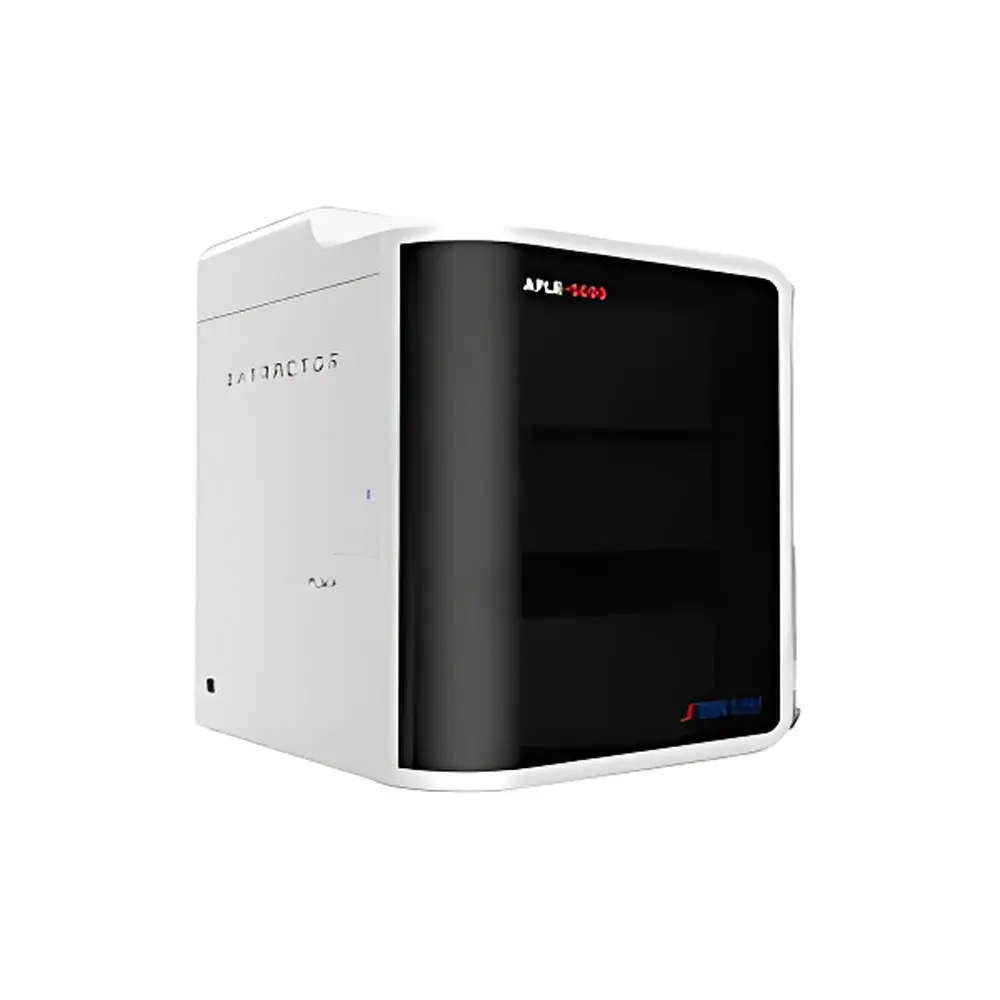
Titan Instruments APLE-5000 Automated Accelerated Solvent Extractor
| Brand | Titan Instruments |
|---|---|
| Origin | Beijing, China |
| Model | APLE-5000 |
| Extraction Type | Solid-Liquid Extraction |
| Temperature Range | Ambient to 200 °C |
| Pressure Range | Atmospheric to 20 MPa |
| Extraction Cell Volumes | 1 mL, 5 mL, 11 mL, 22 mL, 34 mL, 46 mL |
| Extraction Time | 10–20 min per 2 samples |
| Dimensions (W×D×H) | 655 × 720 × 725 mm |
| Sample Capacity | 26 positions (24 sample + 2 cleaning) |
Overview
The Titan Instruments APLE-5000 is a fully automated accelerated solvent extractor engineered for high-throughput, reproducible solid and semi-solid sample preparation in regulated analytical laboratories. It operates on the principle of pressurized fluid extraction (PFE), also known as accelerated solvent extraction (ASE®), where analytes are extracted from solid matrices using organic solvents at elevated temperatures and pressures—conditions that enhance solubility, mass transfer kinetics, and diffusion rates while minimizing thermal degradation. Unlike conventional Soxhlet extraction—which requires hours and large solvent volumes—the APLE-5000 achieves complete extractions in under 20 minutes per dual-sample batch, significantly reducing operational time, solvent consumption, and labor input. Its dual-channel serial/parallel architecture enables continuous processing without manual intervention, supporting unattended overnight operation and seamless integration into routine QC/QA workflows across environmental, food safety, agricultural, pharmaceutical, and industrial testing laboratories.
Key Features
- Dual-Channel Automation: Simultaneous extraction of two samples per cycle with full automation across 24 sample positions plus two dedicated cleaning stations—enabling walk-away operation and consistent method execution.
- Modular Extraction Cells: Six standardized cell volumes (1–46 mL) with patented sealing geometry ensure leak-free performance, rapid cell exchange, and compatibility with diverse sample masses—from milligram-scale reference standards to gram-level environmental solids.
- Precision Thermal & Pressure Control: Programmable temperature range from ambient to 200 °C (±1 °C accuracy) and pressure up to 20 MPa (±0.2 MPa), with proprietary active cooling design to minimize cooldown intervals between runs and maintain thermal stability during sequential extractions.
- High-Integrity Fluid Delivery: Custom-engineered dual-piston solvent delivery pump provides pulse-free, high-accuracy flow control, ensuring precise solvent volume metering and eliminating over-pressurization risks during cell filling and static/dynamic extraction phases.
- Remote Operation & Safety Integration: Built-in Wi-Fi connectivity enables secure remote monitoring and method initiation via encrypted web interface or desktop client—reducing analyst exposure to volatile solvents and high-temperature hardware.
- Optimized Collection Architecture: Patented needle-guided collection system ensures sub-millimeter positioning accuracy relative to vial centers, preventing cross-contamination, solvent splashing, and vial rim wetting—thereby improving recovery consistency and reducing consumable waste.
Sample Compatibility & Compliance
The APLE-5000 is validated for use with heterogeneous solid and semi-solid matrices including soils, sediments, sludges, plant tissues, animal feed, cereals, edible oils, polymer composites, and pharmaceutical excipients. It meets the operational requirements of multiple internationally recognized standard methods, including U.S. EPA Method 3545A (Pressurized Fluid Extraction), China’s HJ 782–2016, HJ 783–2016, HJ 805–2016, HJ 834–2017, and HJ 835–2017 for environmental and food matrices, as well as GB 5009.6–2016 (fat determination), GB 5009.205–2013 (dioxins), GB 23200.9–2016 (pesticide residues), and GB/T 14553–2003 (organophosphorus pesticides). All extraction protocols support GLP- and GMP-aligned documentation practices, including electronic audit trails, user authentication, and method version control.
Software & Data Management
Controlled via a native Windows-based application, the APLE-5000 software supports intuitive method development, real-time run monitoring, and comprehensive data logging. Methods—including temperature ramp profiles, pressure setpoints, static/dynamic extraction times, flush volumes, and purge parameters—are stored wirelessly on networked servers or local drives with SHA-256 hash verification. The system generates timestamped, digitally signed audit reports compliant with FDA 21 CFR Part 11 requirements—featuring operator ID, instrument ID, calibration status, and deviation flags. Export formats include CSV, PDF, and XML for LIMS integration and regulatory submission.
Applications
- Environmental Analysis: Extraction of PAHs, PCBs, organochlorine pesticides, dioxins/furans, and emerging contaminants (e.g., PFAS precursors) from soil, sediment, and airborne particulate filters.
- Food & Feed Safety: Quantitative recovery of pesticide residues, mycotoxins, fat-soluble vitamins, antioxidants, and adulterants from fruits, vegetables, grains, dairy powders, and infant formula.
- Agricultural Research: High-yield lipid extraction from oilseeds (e.g., soybean, rapeseed), analysis of phytochemicals in herbal materials, and residue profiling in treated crop biomass.
- Pharmaceutical & Polymer Industries: Active pharmaceutical ingredient (API) recovery from solid dosage forms, leachable studies in packaging materials, and additive extraction from thermoplastics and elastomers.
FAQ
What solvent types are compatible with the APLE-5000?
Commonly used solvents include hexane, acetone, dichloromethane, ethyl acetate, methanol, and their mixtures—provided they are chemically compatible with stainless steel, PEEK, and Kalrez® seals at operating temperatures and pressures.
Is method validation support available?
Yes—Titan Instruments provides application notes, certified reference material (CRM) extraction protocols, and IQ/OQ documentation templates aligned with ISO/IEC 17025 and ASTM D7213 for laboratory accreditation readiness.
Can the APLE-5000 be integrated into an automated sample prep line?
The instrument features RS-232, Ethernet, and optional digital I/O ports for synchronization with robotic autosamplers, fraction collectors, or LC/GC autosystem controllers.
How often does the system require maintenance?
Routine maintenance includes quarterly seal inspection, annual pump calibration, and biannual pressure transducer verification—documented in the onboard maintenance log with service reminders.



