
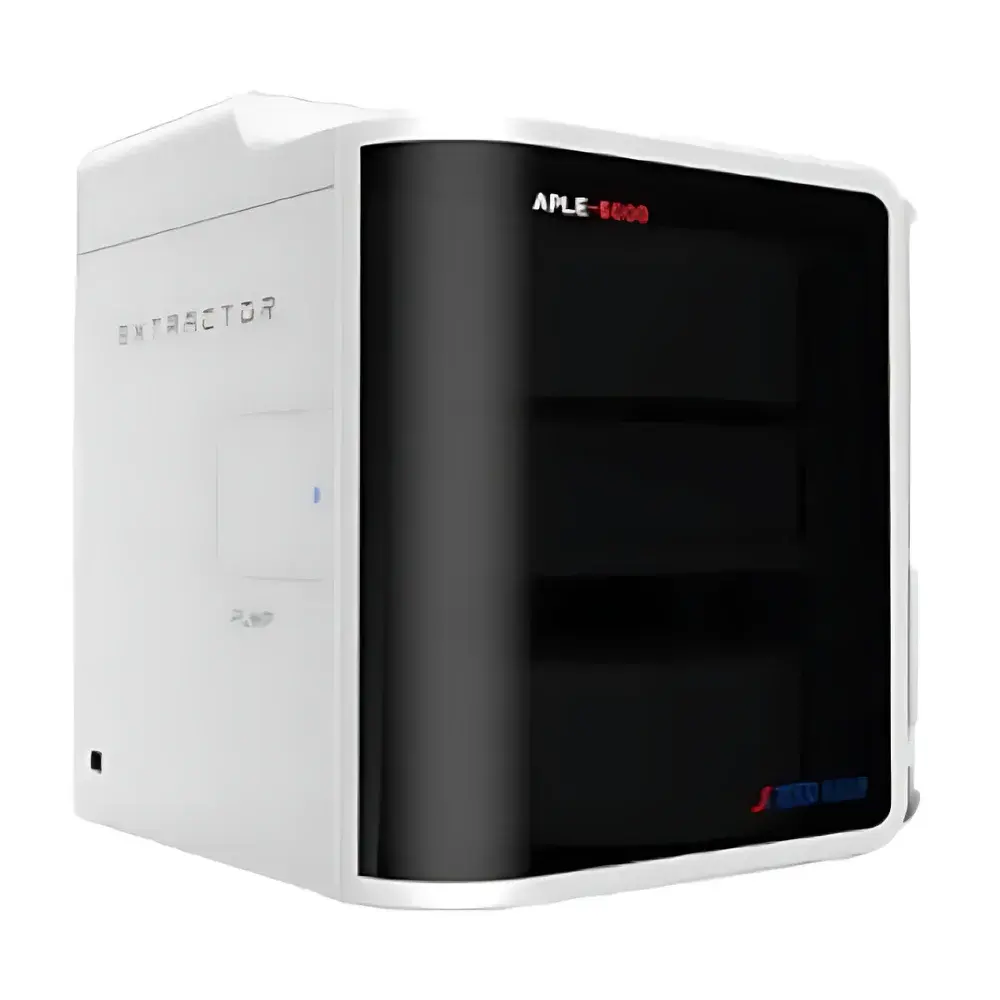
Titan Instruments APLE-5000 Automated Pressurized Liquid Extractor
| Brand | Titan Instruments |
|---|---|
| Origin | Beijing, China |
| Model | APLE-5000 |
| Extraction Mode | Parallel & Sequential Dual-Channel |
| Sample Capacity | 24 positions (unattended) |
| Solvent Compatibility | Common organic solvents (e.g., acetone, dichloromethane, hexane, methanol, ethyl acetate) |
| Operating Pressure | Up to 20 MPa |
| Temperature Range | Ambient to 200 °C |
| Extraction Cell Options | 1, 5, 10, 22, 34, 66, and 100 mL |
| Collection Precision | ±0.1 mL |
| Control Interface | Windows-based software with Wi-Fi remote access |
| Data Integrity | Audit trail, user authentication, method versioning, and electronic signature support compliant with GLP/GMP requirements |
Overview
The Titan Instruments APLE-5000 Automated Pressurized Liquid Extractor is an engineered solution for high-throughput, reproducible solid and semi-solid sample extraction in modern analytical laboratories. Based on the principle of pressurized liquid extraction (PLE), also known as accelerated solvent extraction (ASE®), the system applies elevated temperature and pressure to enhance solvent penetration and analyte desorption kinetics—significantly reducing extraction time while improving recovery efficiency compared to conventional Soxhlet or ultrasonic methods. The APLE-5000 operates under programmable thermal and pressure profiles, enabling precise control over thermodynamic conditions critical for method robustness and inter-laboratory comparability. Its dual-channel architecture supports both parallel and sequential operation modes, allowing uninterrupted processing of up to 24 samples without manual intervention—a design feature aligned with ISO/IEC 17025 requirements for unattended operation validation.
Key Features
- Dual-channel extraction capability: Simultaneous processing of two samples per cycle, with configurable parallel or sequential workflows to optimize throughput and method flexibility.
- Modular extraction cell system: Interchangeable cells ranging from 1 mL to 100 mL accommodate diverse sample masses and matrix types—from trace-level environmental soils to high-fat agricultural commodities.
- High-integrity sealing mechanism: Patented cell lid design ensures leak-free operation at pressures up to 20 MPa, minimizing solvent loss and ensuring operator safety during high-temperature extractions.
- Precision fluid handling: Custom-engineered dual-piston solvent delivery pump delivers accurate, pulse-free flow with ≤1% volumetric accuracy across full solvent viscosity range (0.3–2.5 cP).
- Automated collection positioning: Servo-controlled needle alignment achieves ±0.1 mL positional repeatability, eliminating cross-contamination risk and reducing vial waste by >30% versus manual alignment systems.
- Remote operational interface: Integrated Wi-Fi module enables secure, role-based remote monitoring and method initiation via encrypted TLS 1.2 connection—reducing analyst exposure to volatile solvents and fume hood dependency.
Sample Compatibility & Compliance
The APLE-5000 is validated for use with heterogeneous matrices including soil, sediment, plant tissue, animal feed, pharmaceutical tablets, polymer pellets, and crude oil-contaminated solids. It complies with key regulatory method frameworks: EPA Method 3545A (for organochlorine pesticides, PAHs, PCBs), ASTM D7699-14 (for hydrocarbon extraction from soils), and AOAC Official Method 2007.02 (for pesticide residue analysis in food). All hardware and software components meet IEC 61000-6-3 (EMC) and IEC 61010-1 (safety) standards. The embedded control software supports 21 CFR Part 11 compliance through electronic signatures, audit trail logging (including parameter changes, run history, and user logins), and immutable method archiving—enabling readiness for FDA, EMA, or ISO 17025 laboratory audits.
Software & Data Management
The APLE-5000 runs on a dedicated Windows 10 IoT Enterprise platform with TitanControl™ v3.2 software. This application provides intuitive workflow-driven method building, real-time pressure/temperature graphing, and automated pass/fail evaluation against user-defined acceptance criteria. Methods are stored wirelessly in AES-256 encrypted cloud storage or local NAS, with version control and rollback capability. Reporting modules generate PDF-formatted extraction reports—including instrument metadata, calibration logs, raw chromatographic integration links (via optional LIMS API), and GLP-compliant audit trails exportable in CSV or XML format for regulatory submission.
Applications
- Environmental analysis: Quantification of organophosphate insecticides, triazine herbicides, polycyclic aromatic hydrocarbons (PAHs), and dioxin-like compounds in soil, sludge, and airborne particulate matter.
- Food safety testing: Multi-residue screening of veterinary drugs, mycotoxins, and synthetic antioxidants in fruits, vegetables, cereals, and dairy powders.
- Agricultural research: Lipid extraction from oilseed crops (e.g., soybean, rapeseed) for fatty acid profiling; phytochemical isolation from medicinal herbs under GRAS-compliant solvents.
- Pharmaceutical development: Active pharmaceutical ingredient (API) recovery from excipient blends and dissolution matrix interference studies.
- Industrial materials: Additive leaching assessment in plastics, plasticizer quantification in PVC, and hydrocarbon fingerprinting in refinery catalysts.
FAQ
What extraction solvents are compatible with the APLE-5000?
The system supports all common HPLC- and GC-grade organic solvents, including acetone, acetonitrile, dichloromethane, ethyl acetate, hexane, methanol, and mixtures thereof. Solvent selection must conform to thermal stability limits below 200 °C and vapor pressure constraints at operating pressure.
Can the APLE-5000 be integrated into an existing LIMS environment?
Yes—via optional RESTful API and ASTM E1384-compliant data exchange protocols, enabling bidirectional transfer of sample IDs, method parameters, and extraction reports.
Is method validation documentation provided?
Titan Instruments supplies IQ/OQ documentation templates, system suitability test procedures, and a comprehensive validation guide aligned with USP and ISO/IEC 17025 Annex A.3 requirements.
How is maintenance tracked and scheduled?
The onboard diagnostics engine logs cumulative pump strokes, cell seal cycles, and heater duty cycles, triggering automated service alerts at predefined thresholds—and exporting maintenance history to CMMS platforms via CSV.
Does the system support gradient solvent programming?
No—solvent composition must be pre-mixed prior to loading; however, multi-step temperature/pressure gradients are fully supported within a single extraction cycle.



