
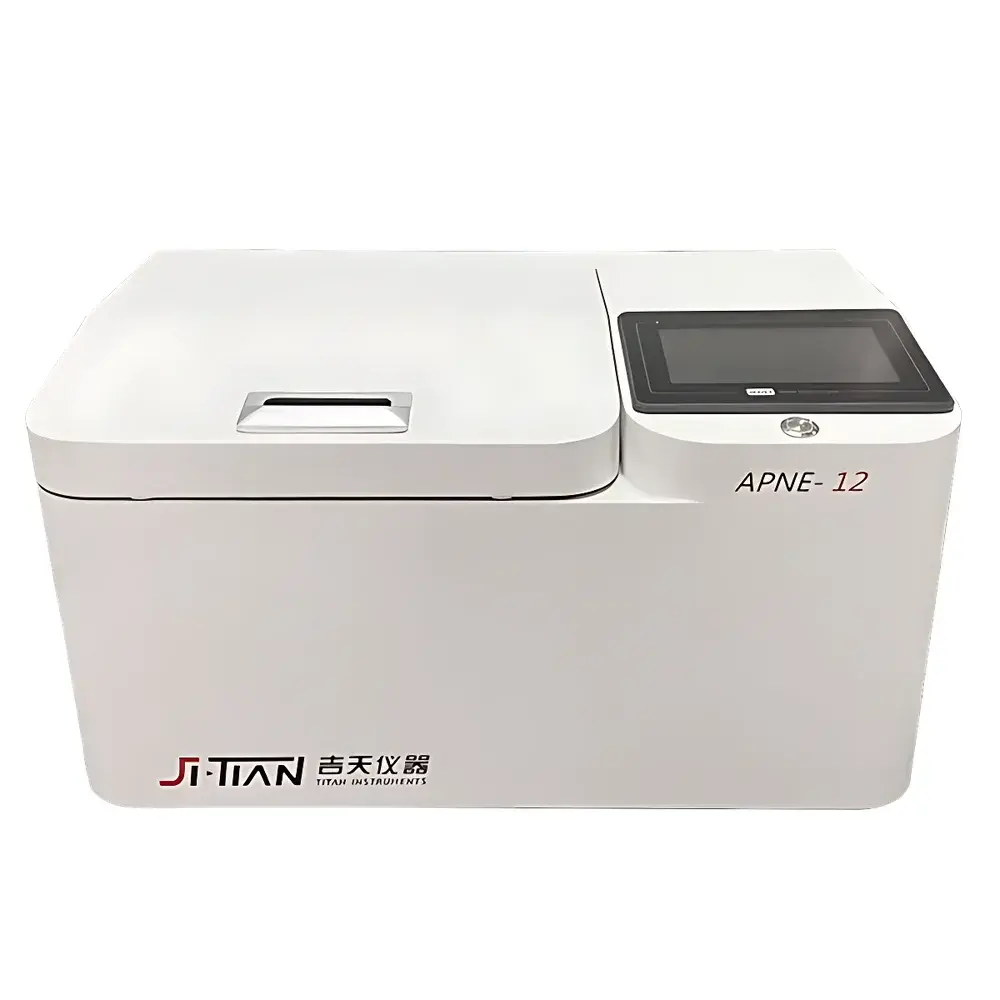
Titan Instruments APNE-12 Automated Parallel Nitrogen Evaporator
| Brand | Titan Instruments |
|---|---|
| Origin | Beijing, China |
| Manufacturer Type | Direct Manufacturer |
| Instrument Category | Domestic |
| Model | APNE-12 |
| Pricing | Available Upon Request |
| Instrument Type | Automated Quantitative Concentrator |
| Temperature Range | Ambient to 70 °C |
| Temperature Control Accuracy | ±0.1 °C |
| Maximum Sample Volume per Vial | ≤200 mL |
Overview
The Titan Instruments APNE-12 Automated Parallel Nitrogen Evaporator is an engineered solution for high-throughput, reproducible solvent removal in analytical sample preparation workflows. It operates on the principle of inert gas-assisted evaporation—using precisely regulated nitrogen flow to accelerate solvent volatilization while minimizing analyte degradation, oxidation, or cross-contamination. Designed for laboratories performing routine extraction and concentration steps prior to GC, GC-MS, LC-MS, or ICP-MS analysis, the APNE-12 replaces manual, labor-intensive nitrogen blow-down methods with a fully automated, parallel-processing platform. Its dry-block heating architecture eliminates water bath maintenance and condensation risks, while optical endpoint detection ensures consistent final volumes across all 12 channels—critical for quantitative recovery in regulated environments.
Key Features
- 12-channel parallel operation with independent pneumatic control per channel, enabling simultaneous or staggered concentration of heterogeneous sample sets.
- Dry-heating block constructed from aerospace-grade aluminum alloy, offering rapid thermal response, uniform heat distribution, and compatibility with interchangeable modular blocks (e.g., for 13 mm, 16 mm, or 20 mm vial formats).
- Optical liquid-level sensing technology integrated into each channel—non-contact, calibration-free, and insensitive to solvent refractive index variations—ensuring reliable endpoint detection at user-defined residual volumes (e.g., 0.5 mL, 1.0 mL, or dry-down).
- Adjustable nitrogen needle angle and laminar-flow nozzle design to optimize solvent surface agitation while suppressing splashing, foaming, and nitrogen overconsumption—validated to reduce average N₂ consumption by up to 35% compared to conventional vertical-blow configurations.
- Triple-mode operation: volume-based termination (quantitative), time-based termination (process standardization), or hybrid mode (e.g., run for 15 min then hold until optical endpoint is reached).
- Hermetically sealed chamber with integrated centrifugal exhaust and internal thermal recirculation system—maintains stable ambient conditions inside the unit and prevents external lab air infiltration during concentration.
- Configurable endpoint detection height across all 12 positions to accommodate varied vial geometries and method-specific final volume requirements.
- Automated shutdown sequence triggered upon endpoint confirmation: nitrogen flow ceases immediately, heating halts, and audible/visual alerts notify the operator—supporting unattended overnight operation under validated SOPs.
Sample Compatibility & Compliance
The APNE-12 accommodates standard screw-thread or crimp-top vials (10–200 mL capacity), including borosilicate glass and compatible polypropylene formats. It supports common organic solvents (e.g., hexane, acetone, ethyl acetate, dichloromethane, methanol) and aqueous mixtures with moderate volatility. The instrument’s design aligns with Good Laboratory Practice (GLP) and current Good Manufacturing Practice (cGMP) expectations for trace-level analysis: full audit trail logging (via optional software integration), hardware-based temperature and pressure stability monitoring, and absence of moving parts in contact with samples. While not certified to ISO/IEC 17025 or ASTM D5291 out-of-the-box, its performance characteristics meet method validation criteria outlined in EPA Methods 508.1, 8081B, 8270D, and USP for residual solvent determination.
Software & Data Management
The APNE-12 operates via an embedded touchscreen HMI with onboard parameter storage (≥100 method profiles). Optional Ethernet or USB-C connectivity enables integration with LIMS or ELN systems using Modbus TCP or CSV export protocols. All run logs—including start/stop timestamps, actual temperature profiles per channel, nitrogen pressure traces, and endpoint confirmation events—are timestamped and stored locally for ≥30 days. When paired with Titan’s optional TitSoft Concentration Suite, users gain FDA 21 CFR Part 11-compliant electronic signatures, role-based access control, and automated report generation compliant with ISO 17025 clause 7.8.2 (result reporting).
Applications
- Environmental Analysis: Concentration of extractable organic compounds (PAHs, PCBs, OCPs, phthalates) from soil, sediment, sludge, and wastewater extracts prior to instrumental analysis.
- Food Safety Testing: Cleanup and concentration steps in multi-residue pesticide analysis (e.g., QuEChERS extracts from cereals, tea, meat, and seafood matrices).
- Pharmaceutical & Nutraceutical QC: Residual solvent removal in API purification workflows and herbal extract standardization per ICH Q3C guidelines.
- Petrochemical & Polymer Characterization: Solvent exchange and concentration of polymer dissolution fractions for GPC/SEC or FTIR quantification.
FAQ
Does the APNE-12 support method validation for regulated laboratories?
Yes—its temperature stability (±0.1 °C), optical endpoint repeatability (<±2% RSD across 12 channels), and deterministic shutdown logic enable full IQ/OQ/PQ documentation per laboratory SOPs.
Can the heating block be replaced for different vial sizes?
Yes—the unit accepts field-swappable aluminum modules calibrated for 10–15 mL, 30–50 mL, and 100–200 mL vial formats, with pre-programmed thermal profiles stored per module ID.
Is nitrogen consumption monitored in real time?
While the APNE-12 does not include a built-in mass flow meter, it features programmable pressure setpoints (0.1–1.2 bar) and proportional valve control per channel; external MFC integration is supported via 4–20 mA analog input.
What safety certifications does the instrument carry?
It complies with IEC 61010-1:2010 (Safety Requirements for Electrical Equipment for Measurement, Control, and Laboratory Use) and bears CE marking for EMC and Low Voltage Directive conformity.
How is carryover prevented between runs?
The optical sensor detects only liquid presence—not residue—and the closed-loop exhaust system routes vapors through activated carbon filtration; routine cleaning of the needle array and chamber interior is recommended per 200 runs.



