
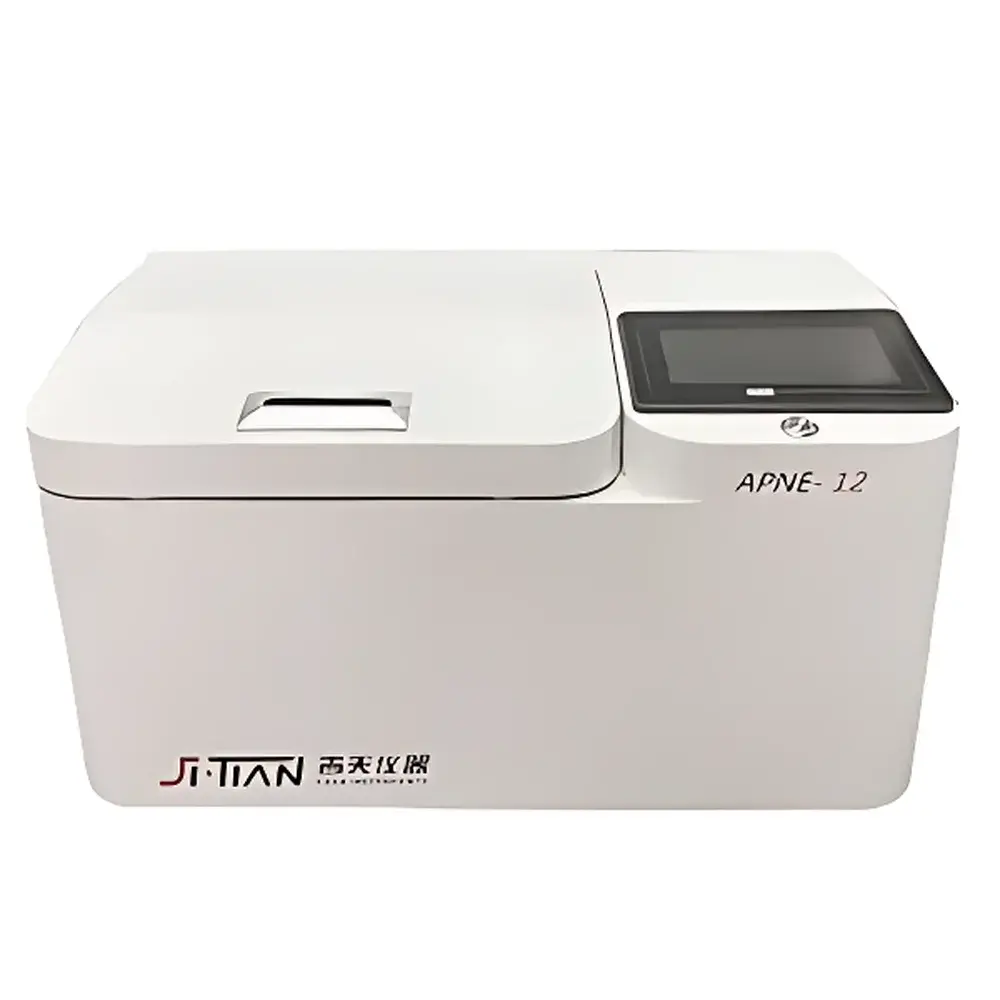
Titan Instruments APNE-12 Automated Parallel Nitrogen Evaporator
| Brand | Titan Instruments |
|---|---|
| Origin | Beijing, China |
| Manufacturer Type | Authorized Distributor |
| Country of Origin | China |
| Model | APNE-12 |
| Instrument Type | Automated Quantitative Nitrogen Concentrator |
| Temperature Range | Ambient to 70 °C |
| Temperature Control Accuracy | ±0.1 °C |
| Maximum Sample Volume per Vial | ≤200 mL |
Overview
The Titan Instruments APNE-12 Automated Parallel Nitrogen Evaporator is an engineered solution for high-throughput, reproducible solvent removal in analytical laboratories performing organic contaminant analysis. It operates on the principle of controlled nitrogen gas flow combined with precise dry-block heating to accelerate solvent evaporation while minimizing analyte loss, oxidation, or thermal degradation. Unlike traditional water-bath evaporators, the APNE-12 employs a sealed, dry-heating architecture—eliminating cross-contamination risks from water vapor and enabling stable temperature gradients across all 12 positions. Designed specifically for integration into standardized sample preparation workflows (e.g., EPA Method 3510C, ISO 18393:2015, and USP residual solvents), it supports quantitative concentration to defined endpoints without manual intervention—ensuring compliance with GLP and GMP documentation requirements.
Key Features
- 12-channel parallel operation with independent pressure regulation per channel, ensuring uniform nitrogen flow distribution and eliminating inter-channel variability.
- Dry-block heating system using aerospace-grade aluminum modules—offering rapid thermal response, exceptional thermal conductivity, and compatibility with interchangeable block configurations (e.g., 13 mm, 16 mm, or 18 mm tube diameters).
- Optical liquid-level detection at each position: non-contact infrared sensors monitor meniscus height in real time, enabling precise endpoint determination down to ±0.1 mL tolerance.
- Three programmable operating modes: volume-based termination (auto-stop at user-defined final volume), time-based run duration, or hybrid mode combining both criteria for method flexibility.
- Adjustable nitrogen needle geometry and laminar gas delivery profile—optimized to maximize surface agitation while suppressing droplet splashing and minimizing nitrogen consumption by up to 35% versus conventional designs.
- Integrated thermal management: closed-loop hot-air circulation system ensures axial and radial temperature uniformity within ±0.3 °C across the entire heating block—critical for multi-vial reproducibility.
- Configurable endpoint detection height: users can define stop points at multiple levels (e.g., 0.5 mL, 1.0 mL, or 2.0 mL) to accommodate varying downstream analytical requirements (e.g., GC-MS injection volume vs. LC-MS reconstitution volume).
- Automated shutdown protocol: upon reaching the set endpoint, the system simultaneously terminates nitrogen flow and deactivates heating—reducing energy use and preventing over-evaporation or sample charring.
Sample Compatibility & Compliance
The APNE-12 accommodates standard borosilicate glass test tubes and conical-bottom vials (up to 200 mL capacity), including those compliant with ASTM D5291, EPA 8270/8330, and ISO 17025-accredited methods. Its dry-heating design avoids condensation-related contamination—making it suitable for moisture-sensitive analytes such as PCBs, PAHs, organochlorine pesticides, and volatile pharmaceutical impurities. The instrument meets electromagnetic compatibility (EMC) standards per IEC 61326-1 and operates within Class II laboratory safety guidelines. Full audit trail functionality—including operator ID, method name, start/end timestamps, final volumes, and temperature logs—is exportable in CSV format for regulatory review under FDA 21 CFR Part 11-compliant data integrity frameworks.
Software & Data Management
Controlled via an intuitive touchscreen interface with embedded firmware, the APNE-12 stores up to 50 customizable methods with password-protected access levels. All operational parameters—including target temperature, gas pressure setpoints, sensor thresholds, and run history—are timestamped and retained onboard for ≥12 months. Data export is supported via USB 2.0 port; no proprietary software installation is required. For enterprise integration, optional RS-232 or Ethernet connectivity enables remote monitoring and synchronization with LIMS platforms supporting HL7 or ASTM E1384 messaging protocols.
Applications
The APNE-12 is routinely deployed in accredited environmental testing labs for post-extraction concentration of soil, sediment, and wastewater extracts prior to GC-MS analysis. In food safety laboratories, it supports residue monitoring in cereals, tea, meat, and seafood matrices per EU Commission Regulation (EU) No 2021/2008. Pharmaceutical QC units apply it for residual solvent removal in API purification workflows aligned with ICH Q3C guidelines. Petrochemical and polymer characterization labs utilize its robust thermal stability for concentrating complex hydrocarbon fractions prior to FTIR or GPC analysis.
FAQ
What types of solvents are compatible with the APNE-12?
Common organic solvents including hexane, acetone, ethyl acetate, dichloromethane, methanol, and acetonitrile—provided their boiling points fall below 70 °C under nitrogen purge conditions.
Can the APNE-12 be used for aqueous samples?
Yes, but only when co-solvents or salting-out agents are added to reduce water activity; pure aqueous solutions require extended run times and may necessitate lower temperature settings to prevent bumping.
Is calibration traceable to national standards?
Temperature sensors are factory-calibrated against NIST-traceable references; users may perform periodic verification using certified RTD probes per ISO/IEC 17025 Section 6.5.
Does the system support 21 CFR Part 11 compliance?
While the base unit provides full electronic records, formal Part 11 compliance requires implementation of supplementary controls (e.g., electronic signatures, role-based access, and backup validation)—available through Titan’s validated software package (APNE-SW-V2.1).
How often does the optical sensor require maintenance?
No routine cleaning or recalibration is needed; the infrared emitter/detector array is sealed and rated for >50,000 cycles under normal laboratory conditions.
Related Products



