
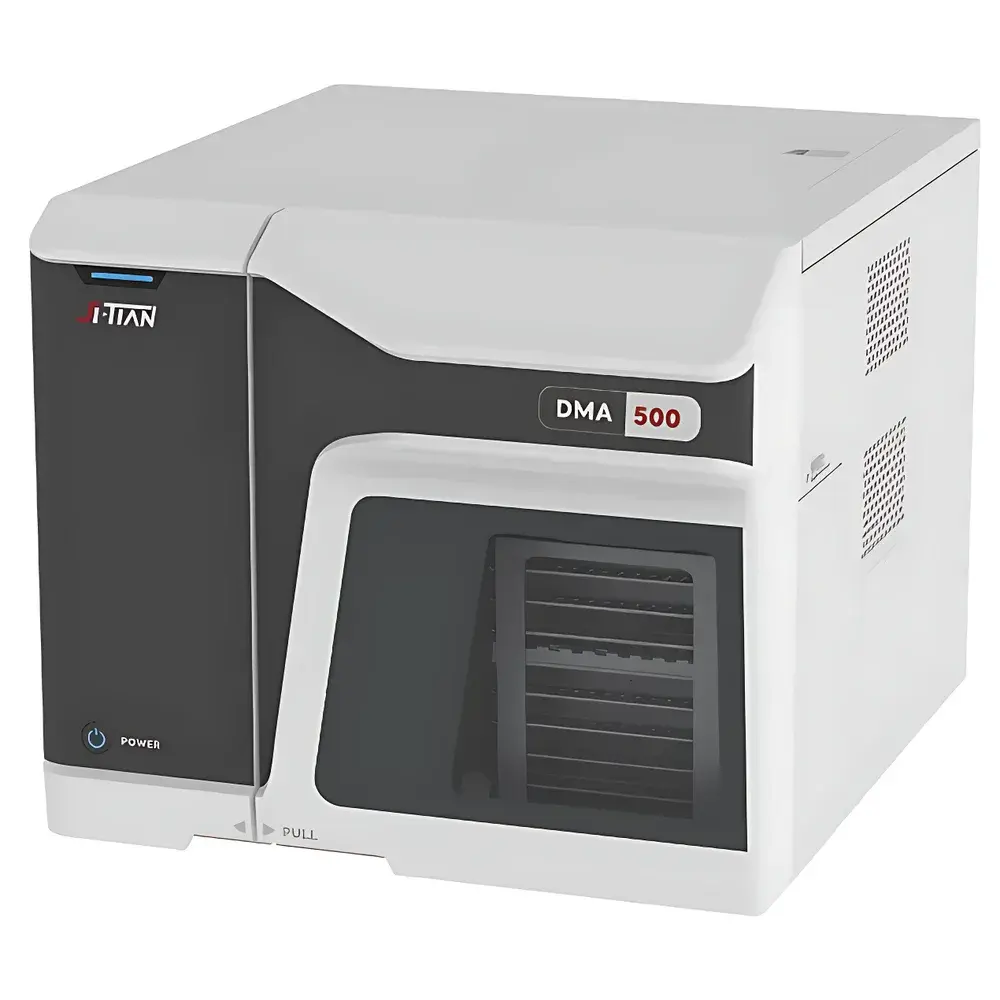
Titan Instruments DMA-500 Direct Mercury Analyzer
| Brand | Titan Instruments |
|---|---|
| Origin | Beijing, China |
| Manufacturer Type | Original Equipment Manufacturer (OEM) |
| Instrument Type | Benchtop Laboratory Analyzer |
| Model | DMA-500 |
| Pricing | Upon Request |
| Measurement Principle | Cold Vapor Atomic Absorption Spectrometry (CVAAS) |
| Sample Introduction | Direct Solid/Liquid/Gas Injection (No Acid Digestion Required) |
| Automation | 100-Position 4-Axis Robotic Autosampler |
| Thermal Treatment | Dual-Zone PID-Controlled Ashing & Catalytic Combustion Furnace |
| Trapping System | Constant-Power Heated Mercury Trap with Rapid Thermal Ramp |
| Detection Architecture | Tandem Dual-Absorption Cells + Dual-Beam Light Source Correction |
Overview
The Titan Instruments DMA-500 Direct Mercury Analyzer is a benchtop laboratory instrument engineered for trace-level mercury quantification in solid, liquid, and gaseous matrices—without acid digestion, chemical reduction, or carrier-gas purging. It operates on the principle of Cold Vapor Atomic Absorption Spectrometry (CVAAS), where mercury is thermally liberated from the sample matrix in a controlled oxidative environment, reduced to elemental vapor, and transported directly into a quartz absorption cell illuminated by a low-pressure mercury hollow cathode lamp. The instrument’s fully integrated thermal program—comprising ashing, catalytic oxidation, amalgamation, and thermal desorption—ensures quantitative release and selective trapping of mercury across diverse sample types, including soils, biological tissues, pharmaceutical excipients, drinking water, air filters, and cosmetic emulsions. Designed for compliance-driven laboratories, the DMA-500 delivers high reproducibility (RSD < 3% at 10 ng Hg), sub-part-per-trillion (ppt) detection capability, and full analytical traceability.
Key Features
- Direct injection architecture eliminates wet chemistry steps—no HNO₃/H₂SO₄ digestion, no SnCl₂/KMnO₄ reduction, no argon/nitrogen purge gas consumption.
- 4-axis robotic autosampler supports up to 100 positions with programmable vial recognition, weight-based sample validation, and automatic crucible handling for solids.
- Dual-zone thermal module: Independent PID-controlled ashing furnace (up to 900 °C) and catalytic combustion tube (600–850 °C) ensure complete organic matrix destruction and consistent Hg⁰ generation, minimizing interferences from halogens, sulfur, or chloride.
- Constant-power heated mercury trap enables rapid thermal ramping (≤ 30 s to 750 °C), precise temperature hold stability (±0.5 °C), and effective memory-effect suppression through thermal desorption and inert gas flush cycles.
- Tandem dual-absorption cell design accommodates wide dynamic range: primary cell for low-concentration analysis (0.01–50 ng), secondary cell for high-load samples (10–500 ng), avoiding signal saturation or dilution errors.
- Dual-beam optical system continuously monitors lamp intensity drift and corrects absorbance readings in real time, ensuring long-term baseline stability and reducing recalibration frequency.
Sample Compatibility & Compliance
The DMA-500 accepts native samples—including powders (soil, sediment, coal), slurries (sludge, tissue homogenates), liquids (urine, serum, surface water, leachates), and gas-phase collection media (quartz fiber filters, sorbent tubes). No derivatization or pre-concentration is required. Method performance aligns with ASTM D6722-22 (Standard Test Method for Total Mercury in Solid Waste by Direct Combustion), EPA Method 7473 (Mercury in Solids and Solutions by Thermal Decomposition, Amalgamation, and Atomic Absorption Spectrophotometry), and ISO 16595:2016 (Water Quality — Determination of Mercury — Direct Thermal Decomposition–Atomic Absorption Spectrometric Method). Instrument firmware supports 21 CFR Part 11-compliant audit trails, electronic signatures, and user-access level management for GLP/GMP-regulated environments.
Software & Data Management
Controlled via Titan Analytical Suite v4.x, the software provides method editor with multi-step thermal programming, real-time spectral visualization, peak integration with baseline correction algorithms, and automated calibration curve generation (linear, quadratic, or weighted least-squares). All raw data—including furnace temperature profiles, absorbance time traces, and trap desorption signals—are stored in vendor-neutral .csv and .xml formats. Built-in reporting templates meet ISO/IEC 17025 documentation requirements, including uncertainty estimation per GUM (Guide to the Expression of Uncertainty in Measurement). Data export supports LIMS integration via ASTM E1384-compliant HL7 or direct ODBC connectivity.
Applications
- Environmental monitoring: Total mercury in wastewater effluents, river sediments, landfill leachate, and ambient air particulate matter (PM₂.₅/PM₁₀).
- Public health laboratories: Quantification of urinary mercury (U-Hg) and blood mercury (B-Hg) in occupational exposure assessment and biomonitoring programs.
- Food & drug safety: Screening of mercury in fish tissue, infant formula, herbal supplements, and active pharmaceutical ingredients (APIs) per USP /.
- Regulatory testing: Customs and border protection labs performing rapid screening of imported cosmetics, toys, and electronic waste under RoHS and China GB/T 26572–2011.
- Clinical toxicology: Support for forensic pathology investigations involving acute/chronic mercury poisoning and postmortem tissue analysis.
FAQ
Does the DMA-500 require carrier gas or external vacuum systems?
No. The instrument uses internal pressure-controlled gas flow management; no external argon, nitrogen, or vacuum pump is needed.
Can it analyze mercury in high-salt or high-fat matrices without clogging?
Yes. The catalytic combustion zone and ceramic-lined reaction tube are resistant to salt deposition and carbon buildup; routine maintenance intervals exceed 2000 injections under typical environmental lab use.
Is method validation support available for ISO 17025 accreditation?
Yes. Titan Instruments provides documented IQ/OQ/PQ protocols, certified reference material (CRM) test reports (e.g., NIST SRM 2710a, ERM-CC580), and uncertainty budget templates aligned with EURACHEM/CITAC guidelines.
What sample mass or volume ranges are supported?
Solids: 0.01–0.5 g; Liquids: 10–200 µL; Gas filters: 1–47 mm diameter; maximum mercury load per run: 500 ng.
How is cross-contamination prevented between high- and low-level samples?
Through automated trap bake-out cycles, dual-stage quartz wool filtration, and software-enforced cleaning sequences that trigger after every 10th high-concentration sample or upon user-defined threshold exceedance.
Related Products






