
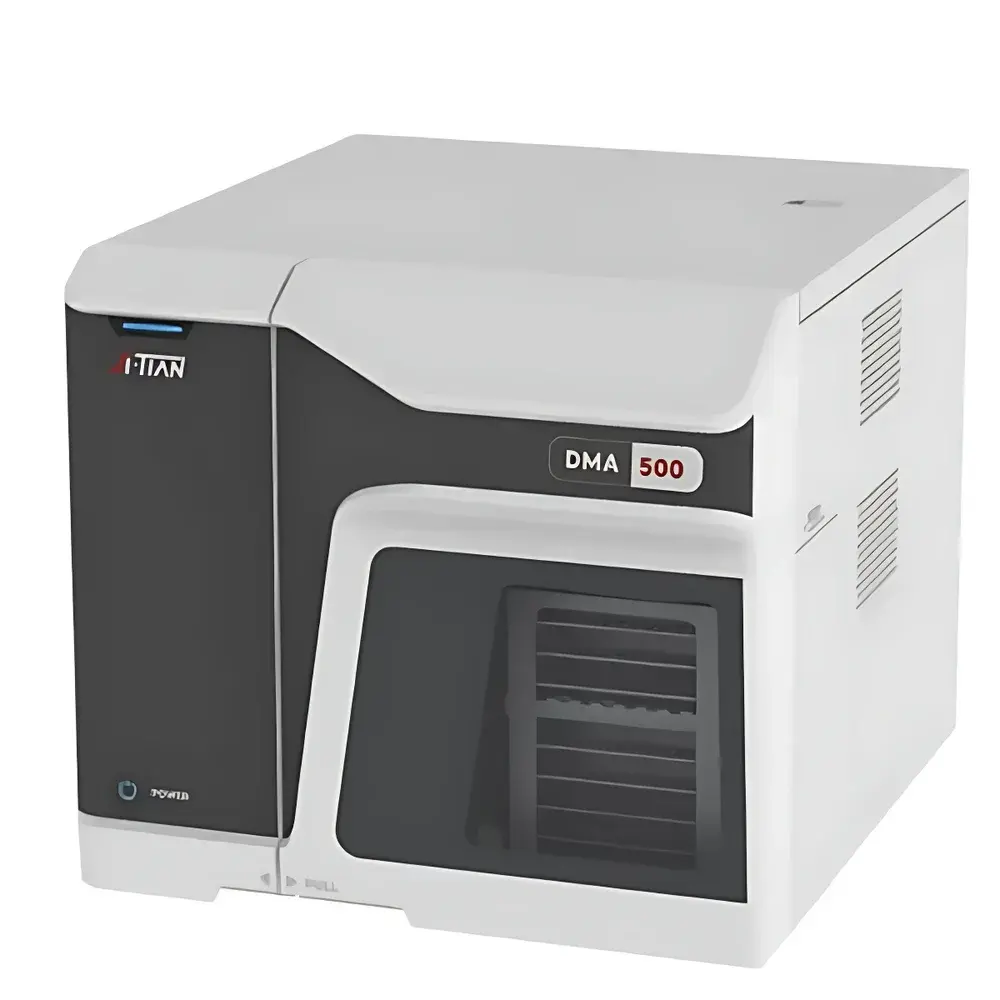
Titan Instruments DMA-500 Direct Mercury Analyzer
| Brand | Titan Instruments |
|---|---|
| Origin | Beijing, China |
| Model | DMA-500 |
| Sample Introduction | Solid, Liquid, Gas (Direct Analysis, No Digestion Required) |
| Detection Principle | Cold Vapor Atomic Absorption Spectrometry (CVAAS) with Thermal Release and Dual-Absorption-Cell Optical Path |
| Automation | 4-Axis Robotic Autosampler (100-position) |
| Temperature Control | PID-Controlled Ashing & Catalytic Combustion Furnaces |
| Mercury Trap | Constant-Power Heated Trap (Rapid Thermal Response, Zero Memory Effect) |
| Optical System | Dual-Beam Light Source with Real-Time Drift Compensation |
| Compliance | Designed for ISO 17025-accredited laboratories |
Overview
The Titan Instruments DMA-500 Direct Mercury Analyzer is a benchtop thermal decomposition–cold vapor atomic absorption spectrometry (CVAAS) system engineered for trace-level mercury quantification in solid, liquid, and gaseous matrices—without acid digestion, chemical reduction, or distillation. Operating on the principle of controlled thermal release followed by selective atomic absorption measurement at 253.7 nm, the DMA-500 thermally decomposes samples in an oxygen-rich environment, catalytically oxidizes organic-bound mercury to elemental Hg⁰, traps and concentrates vapor-phase mercury on a gold-coated quartz trap, then rapidly thermally desorbs it into a dual-absorption-cell optical path. This fully integrated workflow eliminates reagent consumption, reduces analyst exposure risk, and avoids secondary waste generation—making it compliant with green analytical chemistry principles (IUPAC Guidelines on Sustainable Analytical Methods). The instrument is designed for routine operation in high-throughput regulatory and research laboratories where method robustness, inter-laboratory reproducibility, and minimal operator intervention are critical performance criteria.
Key Features
- 4-axis robotic autosampler capable of unattended analysis of up to 100 samples per run, with programmable sample weight/position calibration and vial recognition logic.
- Dual-stage thermal treatment module: independently PID-controlled ashing furnace (ambient–900 °C, ±1 °C stability) and catalytic combustion furnace (400–750 °C), ensuring complete mercury liberation from refractory matrices including soils, sediments, and biological tissues.
- Constant-power heated gold amalgamation trap: achieves stable operating temperature (≥750 °C) within <15 seconds, minimizing carryover and memory effects—validated per EPA Method 7473 protocols.
- Dual-absorption-cell optical configuration: primary cell for low-concentration detection (0.001–10 ng Hg), secondary cell for high-load samples (up to 1000 ng Hg), enabling linear dynamic range exceeding 6 orders of magnitude without manual dilution or cell switching.
- Dual-beam reference channel with deuterium lamp stabilization: continuously corrects for lamp intensity drift, optical misalignment, and cuvette fouling—ensuring absorbance precision better than ±0.5% RSD over 8-hour continuous operation.
- Integrated carrier gas management: mass-flow-controlled oxygen and argon streams with automatic leak detection and pressure regulation, meeting ASTM D6722-22 requirements for inert atmosphere purity during thermal release.
Sample Compatibility & Compliance
The DMA-500 accepts certified reference materials (CRMs) and real-world samples across diverse physical states: solids (≤500 mg, particle size <1 mm), liquids (0.1–2 mL aqueous/organic extracts), and gases (via Tedlar bag or direct line coupling, 10–500 mL volume). It is validated for use with EPA Method 7473, ISO 12846:2012, and EN 1483:2007 for total mercury in environmental and biological matrices. Instrument firmware and data handling architecture support audit-trail logging, user access control, and electronic signature implementation—fully aligned with FDA 21 CFR Part 11 and EU Annex 11 expectations for regulated environments. All thermal and optical subsystems undergo factory calibration traceable to NIST SRM 3133 (Mercury in Aqueous Solution).
Software & Data Management
Titan MercurySuite™ v4.2 provides full method development, sequence scheduling, real-time spectral visualization, and compliance-ready reporting. Raw absorbance/time profiles, peak integration parameters, and thermal event logs are stored in encrypted SQLite databases with immutable timestamps. Software modules include automated limit-of-detection (LOD) calculation per ICH Q2(R2), spike recovery tracking, and batch-level uncertainty propagation based on CRM-certified values. Export formats include CSV, PDF (with digital signature), and XML for LIMS integration (ASTM E1467-compliant schema). Audit trail records capture all user actions—including method edits, calibration updates, and result overrides—with time-stamped identity verification.
Applications
The DMA-500 serves as a primary mercury screening platform in public health laboratories (CDC, provincial CDCs), food and drug safety agencies (CFDA/NMPA-aligned testing units), customs inspection facilities, and ISO/IEC 17025-accredited third-party labs. Routine applications include mercury speciation screening in drinking water (per WHO Guideline Limit: 6 ng/L), total Hg in rice and seafood (Codex Alimentarius Standard 193-1995), soil leachates (TCLP/SPLP extraction follow-up), ambient air particulate filters (EPA IO-3.3), clinical urine/blood specimens (clinical toxicology reference ranges), and cosmetic raw material screening (EU Cosmetics Regulation EC No. 1223/2009 Annex II). Its direct analysis capability significantly accelerates turnaround time for emergency response scenarios such as industrial spill investigations or outbreak-related biomonitoring.
FAQ
Does the DMA-500 require external acid digestion or chemical reagents for sample preparation?
No. The instrument performs complete thermal decomposition and catalytic oxidation in situ—eliminating need for HNO₃/H₂SO₄, KMnO₄, SnCl₂, or NaBH₄.
Can the system analyze volatile organic mercury compounds (e.g., methylmercury) directly?
The DMA-500 measures total mercury only. Speciation requires prior chromatographic separation (e.g., GC-CVAFS or LC-ICP-MS); however, its thermal profile can be optimized to preserve or cleave organomercury bonds per method validation.
What maintenance intervals are recommended for the gold trap and catalyst bed?
Gold trap lifetime exceeds 10,000 analyses under standard operating conditions; catalyst bed replacement is recommended every 6 months or after 2,000 high-matrix samples (e.g., sewage sludge, coal fly ash).
Is remote monitoring or networked operation supported?
Yes—Ethernet and USB connectivity enable centralized instrument status dashboards, email alerting for calibration expiry or error events, and secure remote diagnostics via TLS 1.2-encrypted connection.
How is method validation documented for regulatory submissions?
Titan MercurySuite™ generates IQ/OQ/PQ reports, linearity curves (r² ≥ 0.9995), repeatability datasets (n=6 at three concentration levels), and CRM recovery summaries—all exportable in ALCOA+ compliant format.





