
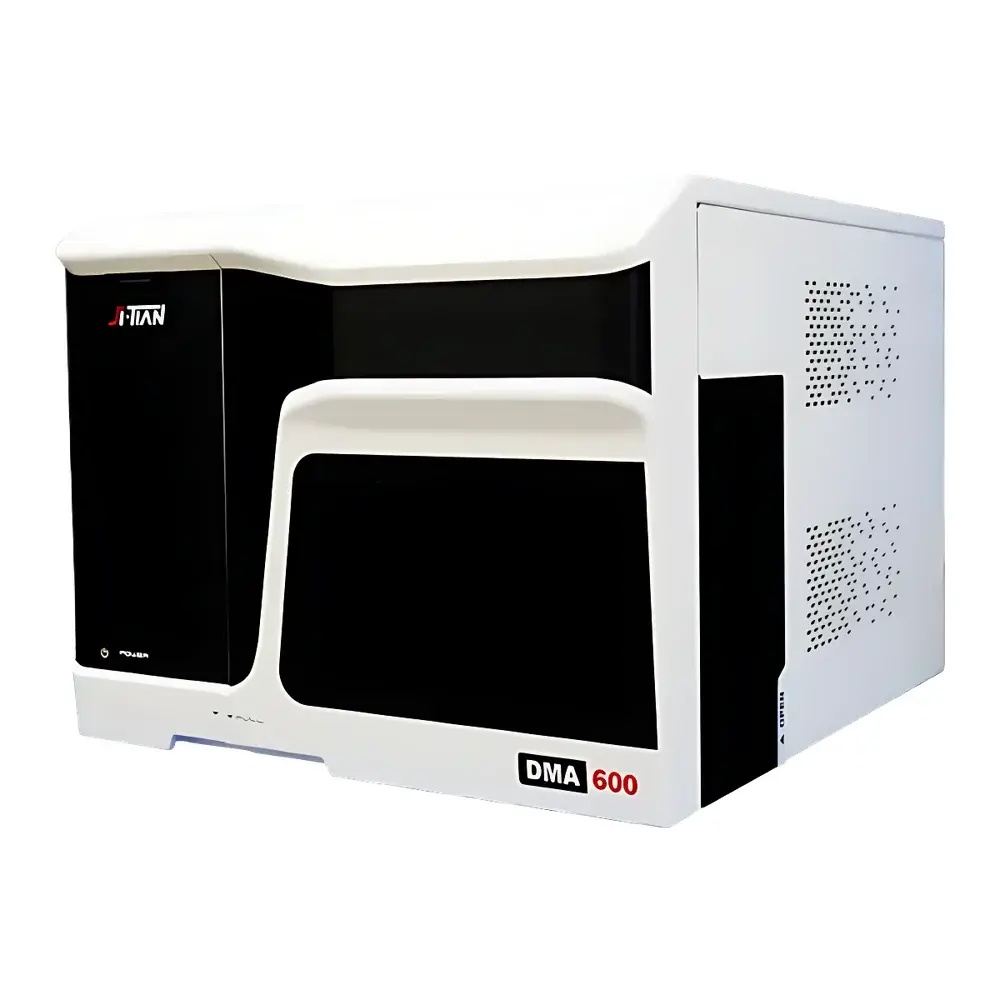
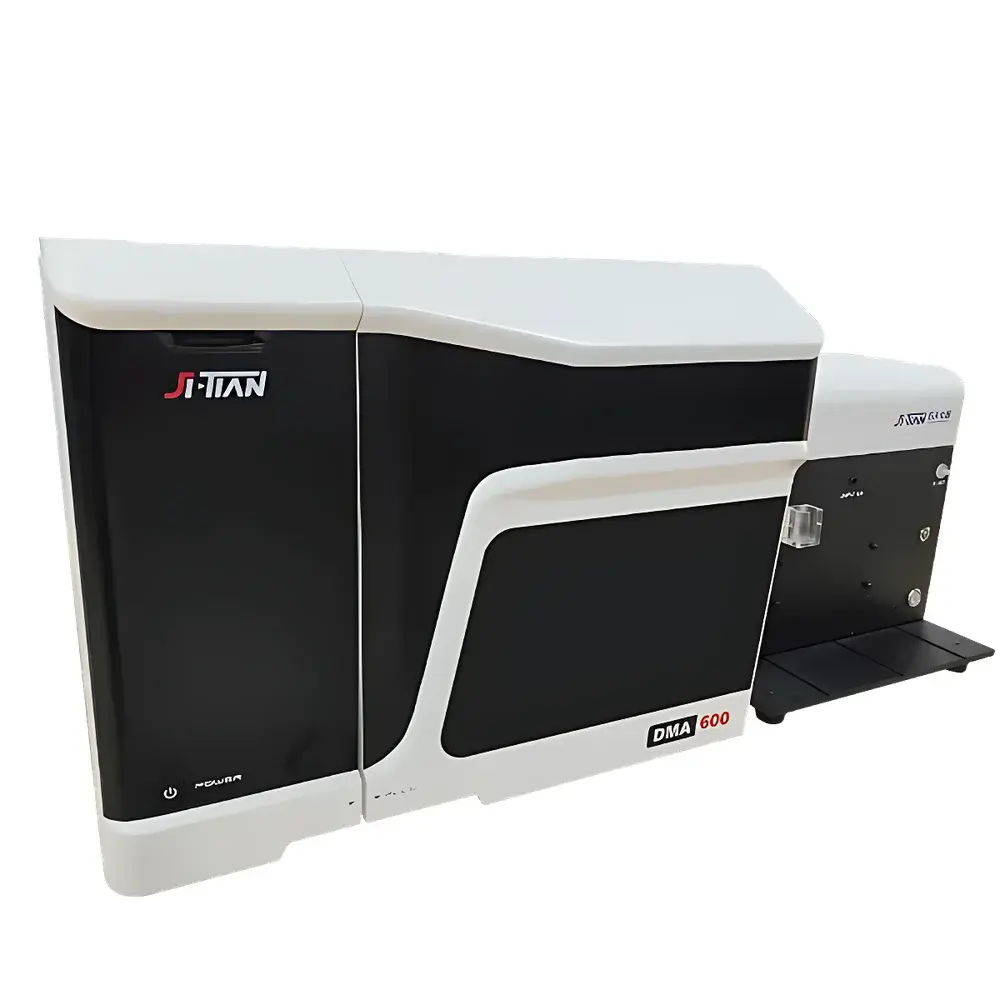
Titan Instruments DMA-600 Direct Mercury Analyzer
| Brand | Titan Instruments |
|---|---|
| Origin | Beijing, China |
| Manufacturer Type | OEM Manufacturer |
| Region of Origin | Domestic (China) |
| Model | DMA-600 |
| Instrument Type | Benchtop Laboratory Analyzer |
| Measurement Principle | Cold Vapor Atomic Absorption Spectrometry (CVAAS) |
| Sample Introduction | Direct Solid/Liquid/Gas Injection |
| Dual Sample Preparation Pathways | Catalytic Thermal Decomposition + Gold Amalgamation OR Stannous Chloride Reduction + Gold Amalgamation |
| Furnace Control | PID Temperature Regulation (Ashing & Catalytic Combustion Zones) |
| Mercury Trap | Constant-Power Heated Trap |
| Absorption Cell | Dual-Temperature-Controlled Flow-Through Cells (Heated to Maintain Hg⁰ in Vapor Phase) |
| Optical System | Dual-Beam Reference Compensation |
Overview
The Titan Instruments DMA-600 Direct Mercury Analyzer is a benchtop laboratory instrument engineered for the quantitative determination of total mercury (Hg) in solid, liquid, and gaseous samples without acid digestion or wet chemical pretreatment. It operates on the well-established principle of Cold Vapor Atomic Absorption Spectrometry (CVAAS), wherein elemental mercury vapor—generated quantitatively from the sample matrix—is transported through a carrier gas stream into a temperature-stabilized absorption cell. There, mercury atoms absorb light at the 253.7 nm resonance line emitted by a low-pressure mercury lamp. The degree of absorption is linearly proportional to mercury concentration over a wide dynamic range, enabling trace-level detection with high specificity and reproducibility. Unlike traditional hydride generation or digestion-based methods, the DMA-600 eliminates reagent consumption, minimizes analyst exposure, and avoids contamination risks associated with open-vessel chemistry. Its dual-path thermal–chemical sample conversion architecture ensures compliance with multiple international reference protocols—including ASTM D6722, EPA Method 7473, ISO 16772, and EN 1483—making it suitable for regulated environmental, food safety, and industrial quality control laboratories.
Key Features
- Dual-sample-introduction pathways: Selectable catalytic thermal decomposition (for organomercurials and refractory matrices) or stannous chloride (SnCl₂) reduction (for inorganic Hg²⁺ in aqueous solutions), configurable via software-controlled valve sequencing.
- PID-regulated high-precision furnaces: Independent temperature control of ashing and catalytic combustion zones (±0.5 °C stability) ensures consistent thermal decomposition efficiency and suppresses signal drift caused by ambient fluctuations.
- Constant-power heated mercury trap: Rapid thermal ramp-up and uniform heating profile minimize memory effects and cross-contamination between sequential analyses; trap regeneration is fully automated.
- Temperature-controlled absorption cells: Dual flow-through quartz cells maintained at 120–150 °C prevent condensation of water vapor and ensure stable Hg⁰ residence time and optical path integrity.
- Optical architecture with dual-beam compensation: A reference beam monitors lamp intensity in real time, correcting for source aging, power supply variation, and optical misalignment—critical for long-term measurement stability.
- Benchtop footprint with integrated carrier gas management: Built-in pressure regulation and flow control eliminate external gas manifolds; compatible with ultra-high-purity argon or oxygen as purge gas.
Sample Compatibility & Compliance
The DMA-600 accommodates heterogeneous sample types without homogenization or dilution: solids up to 1.5 g (e.g., soil, coal, tissue, polymer), liquids up to 2 mL (e.g., wastewater, blood serum, fuel oil), and gases via calibrated loop injection. Certified reference materials (CRMs) including NIST SRM 2710a (Montana Soil), BCR-482 (Human Hair), and ERM-CC580 (Sediment) are routinely validated per ISO/IEC 17025 requirements. The system supports audit-ready data handling aligned with GLP and GMP frameworks, including electronic signatures, user access levels, and full audit trail logging compliant with FDA 21 CFR Part 11 when operated with optional secure software modules.
Software & Data Management
Titan MercurySuite™ v3.x provides intuitive method setup, real-time spectral visualization, peak integration with baseline correction algorithms, and automated calibration curve generation (linear and quadratic). All raw absorbance traces, furnace temperature profiles, and gas flow logs are stored in vendor-neutral .csv and .xml formats. Data export supports LIMS integration via ASTM E1384-compliant interfaces. Software validation documentation (IQ/OQ/PQ templates) and electronic record retention policies are available upon request for regulated environments.
Applications
The DMA-600 serves as a primary mercury quantification platform across diverse sectors: environmental monitoring (soil, sediment, fly ash, municipal waste); food safety (fish tissue, rice, infant formula, dairy powders); clinical and toxicology labs (blood, urine, hair); energy industry (coal, flue gas scrubber sludge, transformer oil); and electronics manufacturing (RoHS-compliant screening of PCBs and solder alloys). Its direct analysis capability significantly reduces turnaround time—typical cycle time is under 8 minutes per sample—and eliminates interferences from chloride, sulfur, or organic carbon that compromise wet-chemistry alternatives.
FAQ
Does the DMA-600 require certified carrier gases?
Yes. Ultra-high-purity argon (≥99.999%) or oxygen (≥99.995%) is required to ensure baseline stability and prevent oxide formation during thermal decomposition.
Can the instrument be used for speciation analysis?
No. The DMA-600 measures total mercury only. Speciation (e.g., methylmercury, Hg⁰, Hg²⁺) requires coupling with GC or HPLC separation prior to CVAAS detection.
What maintenance intervals are recommended for routine operation?
Quartz tubes and gold traps should be inspected every 200–300 analyses; furnace insulation and optical windows require annual verification. Full preventive maintenance is advised every 12 months or after 1,000 runs.
Is method validation support provided?
Titan Instruments supplies application notes, CRM test reports, and method transfer protocols aligned with ISO 17025 and USP <232>/<233>. On-site validation assistance is available under service contract.
How is carryover addressed for high-Hg samples?
The heated mercury trap and post-analysis high-temperature purge cycle (up to 900 °C) ensure residual Hg removal; carryover is typically <0.5% for samples containing >100 ng Hg.






