
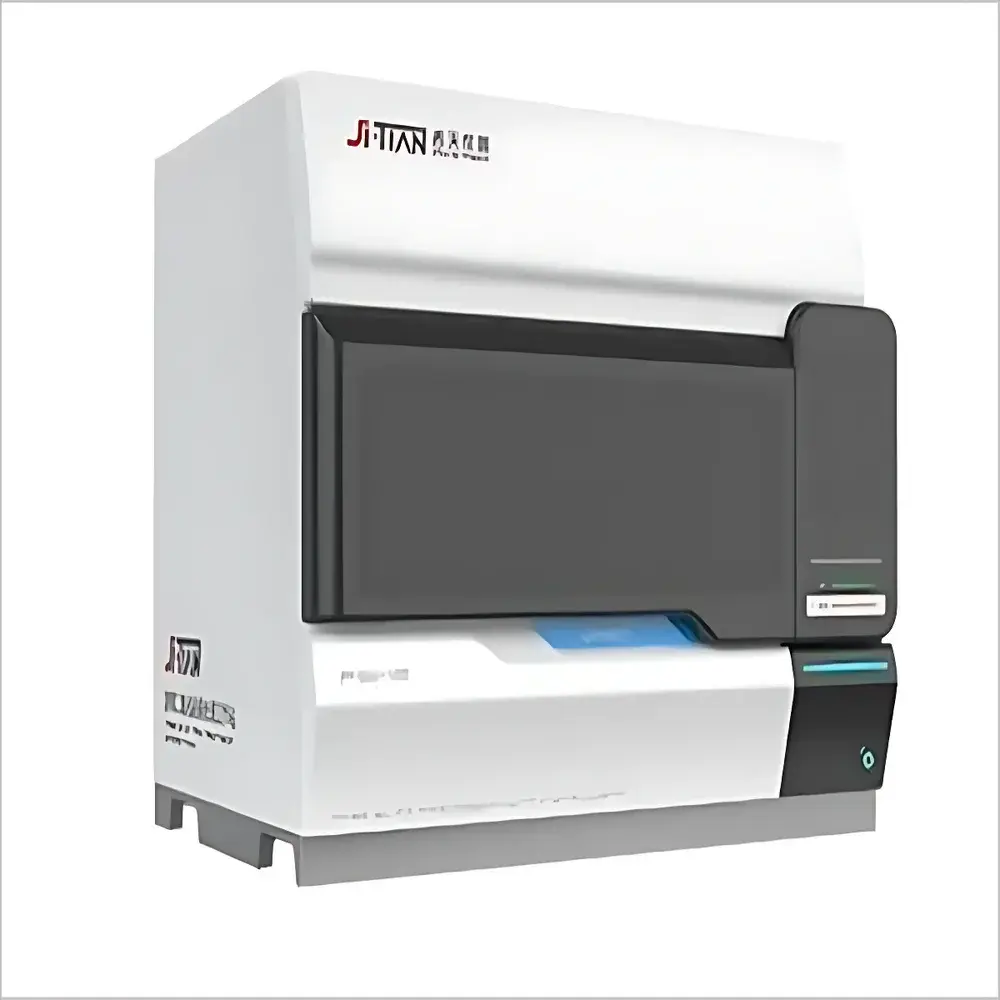
Titan Instruments FSI-12 Fully Automated Free Silica Pre-Treatment System
| Brand | Titan Instruments |
|---|---|
| Origin | Beijing, China |
| Model | FSI-12 |
| Application Standard | GBZ/T 192.4–2007 |
| Automation Level | Unattended Operation |
| Sample Throughput | 12-position high-throughput carousel |
| Reagent Handling | Automated pyrophosphoric acid dispensing |
| Digestion Control | Dual-sensor independent channel temperature regulation (±0.5 °C) |
| Stirring | Adjustable speed per channel |
| Filtration | Optimized funnel geometry with real-time liquid-level monitoring |
| Compliance | Designed for occupational hygiene laboratories requiring traceable, auditable sample preparation per Chinese national standards |
Overview
The Titan Instruments FSI-12 Fully Automated Free Silica Pre-Treatment System is an engineered solution for standardized, reproducible sample preparation in occupational health laboratories conducting quantitative analysis of crystalline silica (quartz, cristobalite, tridymite) in airborne dust samples. It implements the pyrophosphoric acid digestion method specified in GBZ/T 192.4–2007 — China’s national standard for determining free silica content in workplace air particulates. Unlike manual or semi-automated workflows, the FSI-12 executes the entire sequence — reagent addition, controlled thermal digestion, post-digestion filtration, and system rinsing — without operator intervention. The system operates on a robust carousel-based architecture with 12 independent processing positions, enabling batched analysis while maintaining inter-sample integrity through isolated thermal and fluidic pathways.
Key Features
- Automated Pyrophosphoric Acid Dispensing: Integrated precision pump delivers defined volumes of pyrophosphoric acid (H4P2O7) directly into each sample vial, minimizing exposure risk and ensuring stoichiometric consistency across runs.
- Independent Dual-Sensor Temperature Regulation: Each of the 12 digestion channels features two calibrated Pt100 sensors — one immersed in the heating block, one in the reaction medium — enabling closed-loop PID control within ±0.5 °C tolerance to prevent localized overheating and gelation.
- Programmable Mechanical Agitation: Variable-speed magnetic stirring (50–300 rpm) per channel ensures homogeneous heat transfer and prevents sediment adhesion during prolonged digestion (typically 120–180 min at 245–250 °C).
- Optimized Vacuum Filtration Module: Patented funnel geometry reduces flow resistance by ~50% compared to conventional Buchner-type setups; paired with optical liquid-level detection to terminate vacuum before filtrate overflow, eliminating cross-contamination risks.
- Self-Cleaning Protocol: Post-run automated rinse cycles use deionized water and ethanol to clear residual acid and particulate residue from tubing, filters, and vial holders — supporting GLP-aligned instrument maintenance logs.
Sample Compatibility & Compliance
The FSI-12 accepts standard 25-mm or 37-mm mixed cellulose ester (MCE), polyvinyl chloride (PVC), or polycarbonate (PC) filter cassettes collected via NIOSH/OSHA-approved air sampling pumps. It accommodates both gravimetrically pre-weighed filters and pre-loaded filter punches. All wet chemistry steps conform strictly to GBZ/T 192.4–2007 procedural requirements, including acid concentration (75% w/w pyrophosphoric acid), digestion time, cooling protocol, and filtration volume thresholds. While not certified to ISO/IEC 17025 or FDA 21 CFR Part 11 out-of-the-box, the system generates timestamped digital operation logs (start time, temperature profiles, reagent dispense volumes, filtration duration) compatible with laboratory information management systems (LIMS) for audit trail reconstruction.
Software & Data Management
The embedded control interface runs Titan’s proprietary PrePrep OS v3.2 — a deterministic real-time operating system with role-based access control (administrator, technician, auditor). Method templates are stored locally with versioned backups; users may modify digestion temperature ramp rates, hold durations, and agitation profiles within validated boundaries. All operational events — including sensor faults, reagent low warnings, and door-open interruptions — are logged with UTC timestamps and retained for ≥12 months. Export options include CSV-formatted run reports and PDF-certified method execution summaries, suitable for inclusion in QA documentation packages.
Applications
The FSI-12 serves core analytical workflows in occupational hygiene testing laboratories across coal mining, thermal power generation, construction materials manufacturing, foundry operations, and municipal public health institutes. Its primary output — digested, filtered, and neutralized silica suspensions — is directly compatible with downstream quantification techniques including X-ray diffraction (XRD), Fourier-transform infrared spectroscopy (FTIR), and polarized light microscopy (PLM). By eliminating manual handling variability, the system improves inter-laboratory comparability of silica results and supports compliance with China’s Work Safety Law (Article 36) and the Occupational Disease Prevention and Control Act.
FAQ
Does the FSI-12 support ASTM D7520 or ISO 16258-1 methods?
No — the FSI-12 is specifically designed and validated for GBZ/T 192.4–2007. Adaptation to ASTM or ISO protocols would require hardware and software modifications beyond current certification scope.
Can the system process samples collected on quartz fiber filters?
Not recommended — GBZ/T 192.4–2007 specifies MCE, PVC, or PC filters due to their acid stability; quartz fiber filters partially dissolve in hot pyrophosphoric acid, introducing analytical bias.
Is remote monitoring available via Ethernet or Wi-Fi?
Yes — the system includes a 10/100BASE-TX Ethernet port for integration into local lab networks; remote status viewing and emergency stop are supported via secure HTTPS interface (TLS 1.2), but full method editing requires local console access.
What maintenance intervals are required for the filtration module?
Filter membranes must be replaced after every 24 consecutive runs or upon visible clogging; vacuum pump oil should be changed every 6 months or 1,000 operating hours, whichever occurs first.
Does Titan Instruments provide IQ/OQ documentation?
Yes — factory-verified Installation Qualification (IQ) and Operational Qualification (OQ) protocols are supplied with each unit, aligned to GAMP 5 principles and customizable for site-specific User Requirement Specifications (URS).



