
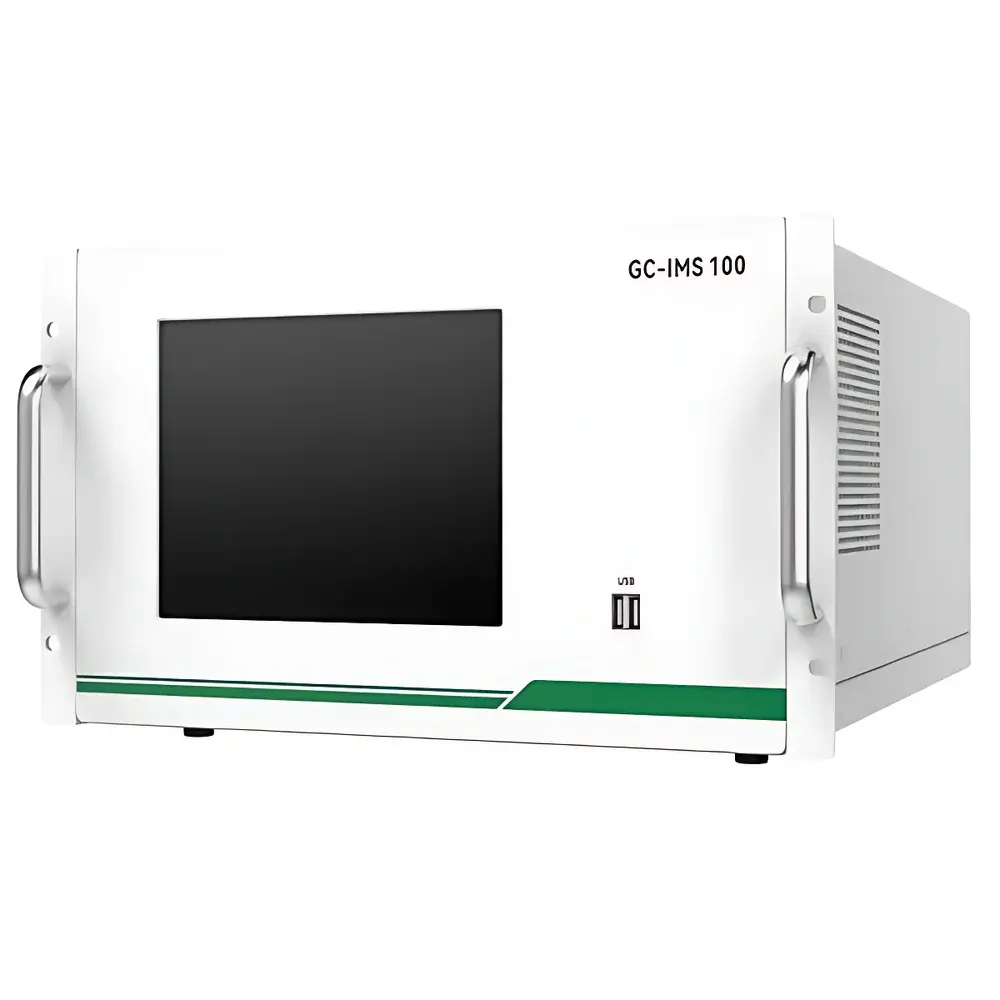
Titan Instruments GC-IMS 1000 Rack-Mounted Gas Chromatography–Ion Mobility Spectrometry System
| Brand | Titan Instruments |
|---|---|
| Origin | Beijing, China |
| Model | GC-IMS 1000 |
| Form Factor | 19-inch rack-mountable (4U height) |
| Ionization Source | Non-radioactive, low-power UV photoionization lamp (10.6 eV) |
| Polarity Mode | Dual-polarity (positive and negative ion detection) |
| Detection Limit | Sub-ppt (v/v) for selected volatile organic compounds |
| Sample Introduction | Negative-pressure direct draw sampling |
| Flow Path Materials | Fully inert (SilcoNert®-treated stainless steel, PFA, and fused silica) |
| Control Interface | Integrated industrial PC with native Chinese-language software suite |
| Compliance | Designed for GLP-compliant workflows |
Overview
The Titan Instruments GC-IMS 1000 is a rack-mounted, integrated analytical platform combining gas chromatography (GC) separation with high-resolution ion mobility spectrometry (IMS) detection. Unlike conventional mass spectrometry-based systems, this instrument leverages the orthogonal separation mechanisms of GC (based on volatility and polarity) and IMS (based on ion collision cross-section and charge state in a weak electric field), enabling rapid, selective, and highly reproducible identification and quantification of volatile and semi-volatile organic compounds (VOCs and SVOCs) at trace concentrations. Engineered for laboratory and field-deployable operation, the GC-IMS 1000 employs a compact, modular architecture housed in a standard 19-inch 4U chassis—compatible with benchtop installation or integration into centralized analytical cabinets. Its core measurement principle relies on drift-time-resolved ion signal generation under controlled nitrogen or synthetic air carrier gas flow, with retention time alignment between GC elution and IMS arrival time providing compound-specific two-dimensional fingerprints.
Key Features
- Rack-mountable 4U industrial design with front-access service panels and rear I/O interface bay for seamless system integration
- Dual-polarity IMS detector capable of simultaneous acquisition of positive- and negative-ion spectra from a single injection—enabling comprehensive redox-sensitive profiling without method reconfiguration
- Non-radioactive, solid-state UV photoionization source (10.6 eV) ensuring operator safety, zero regulatory licensing burden, and long-term operational stability (>10,000 h rated lifetime)
- Fully inert fluidic path constructed from SilcoNert®-passivated stainless steel tubing, electropolished valves, and PFA/Polyether ether ketone (PEEK) fittings—minimizing adsorption, memory effects, and catalytic degradation of reactive analytes
- Integrated fast GC module with programmable multi-step temperature ramping (0.1–30 °C/min), column oven range from 30–250 °C, and sub-second valve actuation for precise heart-cutting or backflushing
- Onboard industrial-grade PC running Titan IMSControl™ v3.x—featuring real-time spectral visualization, automated peak deconvolution, and built-in NIST-compatible IMS library matching
Sample Compatibility & Compliance
The GC-IMS 1000 accepts gaseous samples directly via negative-pressure draw-through sampling—eliminating the need for thermal desorption or pre-concentration for ambient air, Tedlar® gas bags, canister extracts, or headspace vials. It is validated for use with standard 0.53 mm ID fused-silica capillary columns (e.g., DB-5ms, Rxi-624Sil MS) and compatible with both packed and micro-packed GC columns for targeted screening applications. The system conforms to ISO 16000-6 for indoor air VOC analysis and supports method development aligned with EPA TO-15 and ASTM D5502 for odorant and hazardous air pollutant monitoring. When deployed with optional zero-air generator and dynamic dilution calibrator modules, it meets ISO/IEC 17025 traceability requirements for calibration gas delivery and concentration gradient generation. All firmware and software modules are configurable to enforce electronic signatures, role-based permissions, and full audit trails—ensuring compliance with GLP, GMP, and FDA 21 CFR Part 11 for regulated laboratories.
Software & Data Management
Titan IMSControl™ provides a fully localized Chinese graphical user interface while maintaining underlying data structures compliant with open formats (mzML-compatible IMS metadata schema, CSV export for GC retention indices and drift times). The software implements automated baseline correction, mobility-aligned peak integration, and multivariate statistical tools including PCA and hierarchical clustering for pattern recognition across sample cohorts. Raw IMS heatmaps (drift time vs. retention time) are stored in compressed HDF5 format with embedded instrument metadata (column type, temperature program, gate pulse width, drift voltage). Data archiving supports network-attached storage (NAS) mapping and scheduled backup to encrypted external drives. Optional LIMS integration kits enable bidirectional communication with Thermo Fisher SampleManager, LabVantage, or custom enterprise systems via RESTful API endpoints.
Applications
- Environmental Monitoring: Real-time detection of odorous sulfur compounds (e.g., H2S, mercaptans), halogenated hydrocarbons, and oxygenated VOCs in ambient air, landfill emissions, and wastewater treatment off-gases
- Food & Agriculture: Discrimination of cultivar-specific biogenic volatile organic compounds (BVOCs) in fruits, herbs, and fermented products; authentication of geographical origin and processing integrity
- Industrial Hygiene: Monitoring airborne molecular contaminants (AMCs) in semiconductor cleanrooms, off-gassing profiles of automotive interior materials, and natural gas odorant depletion studies
- Clinical & Translational Research: High-throughput profiling of exhaled breath volatiles for biomarker discovery in pulmonary diseases, metabolic disorders, and therapeutic drug monitoring
- Security & Defense: Field-deployable detection of chemical warfare agent simulants (e.g., DMMP, sarin analogs), narcotics vapors (e.g., cocaine, heroin metabolites), and fumigants (e.g., methyl bromide, sulfuryl fluoride)
FAQ
What carrier gases are supported for GC-IMS operation?
Nitrogen (≥99.999% purity) and synthetic air (N2/O2 mixture) are recommended as drift and carrier gases. Helium is not required, reducing operational cost and logistical complexity.
Can the system be operated remotely or integrated into an automated lab network?
Yes—the onboard industrial PC features dual Gigabit Ethernet ports, RS-232/485 serial interfaces, and Modbus TCP support for PLC-level coordination with autosamplers, environmental chambers, or central SCADA systems.
Is method transfer possible between different GC-IMS instruments?
Retention index normalization and drift time calibration using internal standards (e.g., acetone, chloroform) ensure cross-platform reproducibility when using identical column chemistries and temperature programs.
Does the system support quantitative analysis with certified reference standards?
Yes—external calibration curves generated from NIST-traceable gas standards (e.g., Scott-Marrin, AccuStandard) are fully supported, with linear dynamic ranges spanning 3–4 orders of magnitude for most target analytes.
What maintenance intervals are recommended for routine operation?
Ion shutter and gate electrode cleaning every 6 months; UV lamp output verification annually; GC column trimming and inlet liner replacement per manufacturer-recommended usage cycles (typically every 200–500 injections depending on matrix complexity).






