
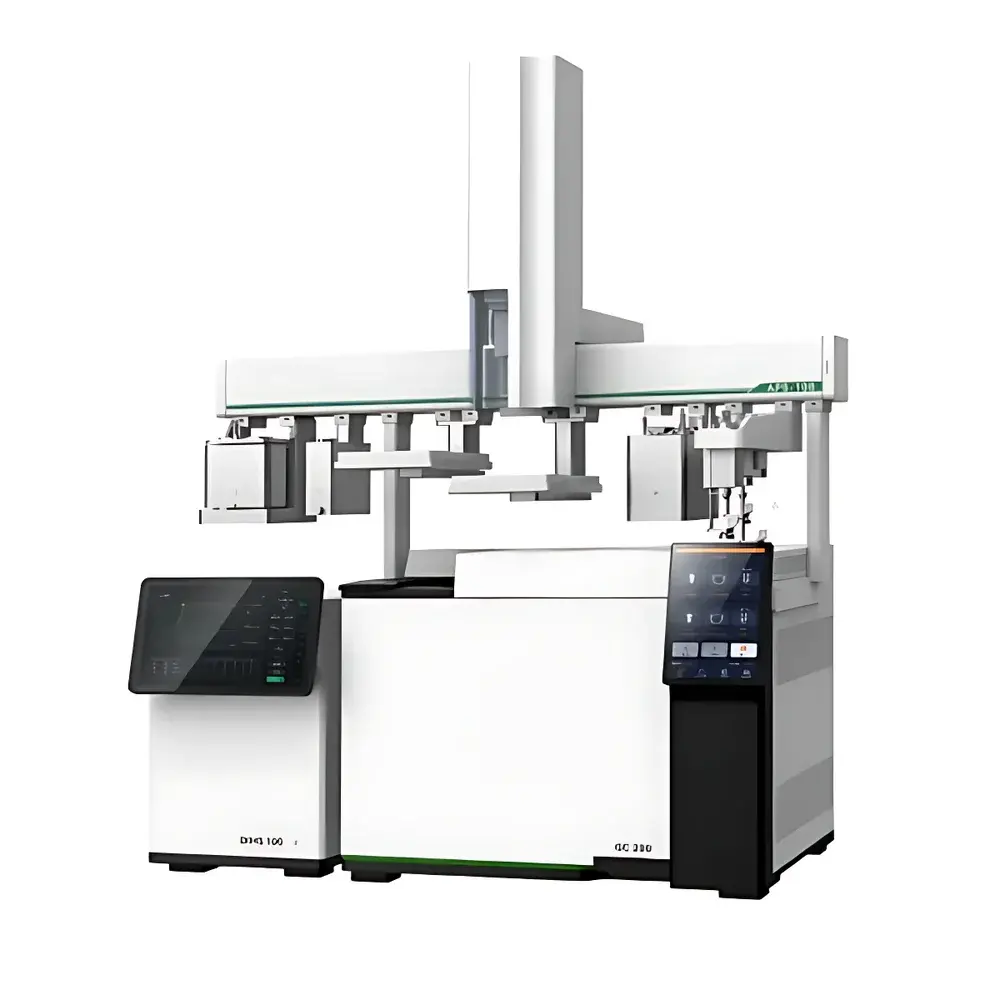
Titan Instruments GC-IMS 2000 Benchtop Gas Chromatography–Ion Mobility Spectrometry System
| Brand | Titan Instruments |
|---|---|
| Origin | Beijing, China |
| Model | GC-IMS 2000 |
| Configuration | Integrated GC (GC-200) + Dual-Polarity IMS (dIMS-200) + Automated Multi-Mode Sampling Platform |
| Ionization Source | Non-radioactive UV photoionization (10.6 eV) |
| Detection Polarity | Positive and negative ions simultaneously |
| Sensitivity | Sub-ppt (v/v) for volatile organic compounds |
| Software | Fully localized Chinese-language workstation with GLP-compliant audit trail, method/sequence automation, fingerprint spectral generation, and multivariate statistical analysis modules |
| Compliance | Designed to support ISO 17025 workflows, ASTM D7923 (VOCs in air), USP <1225> method validation principles, and FDA 21 CFR Part 11–ready data integrity architecture |
Overview
The Titan Instruments GC-IMS 2000 is a fully integrated benchtop analytical platform that couples gas chromatography (GC) with drift-tube ion mobility spectrometry (IMS) for high-resolution separation and rapid detection of volatile and semi-volatile organic compounds (VOCs and SVOCs). Unlike conventional mass spectrometry-based systems, GC-IMS operates on the principle of differential ion mobility—separating ions based on their collision cross-section (CCS) and charge state under controlled electric field and buffer gas conditions—enabling compound identification independent of mass-to-charge ratio. This orthogonal separation mechanism provides enhanced selectivity for structural isomers and low-molecular-weight analytes (e.g., aldehydes, ketones, sulfur compounds, amines) commonly encountered in environmental monitoring, food authenticity studies, clinical breath analysis, and industrial hygiene applications. The system features a self-contained GC-200 module with split/splitless injection capability, temperature-programmable oven (up to 250 °C), and capillary column compatibility; a dIMS-200 dual-polarity drift tube with sub-millisecond temporal resolution; and an automated multi-mode sampling interface supporting liquid syringe injection, headspace vial analysis, solid-phase microextraction (SPME), and thermal desorption—enabling direct analysis of complex matrices without derivatization or extensive sample preparation.
Key Features
- Non-radioactive 10.6 eV UV photoionization source: Eliminates regulatory licensing requirements, ensures operator safety, and delivers stable ion yield over extended operational periods without consumables or periodic replacement.
- Dual-polarity IMS detection: Simultaneous acquisition of positive- and negative-ion mobility spectra from a single injection—critical for comprehensive profiling of redox-active species (e.g., nitric oxide derivatives, carboxylates, protonated amines, deprotonated acids).
- Integrated automated sampling platform: Supports headspace, liquid, and solid-phase sampling modes with programmable incubation, equilibration, and injection timing—enabling unattended batch analysis of up to 120 samples per sequence.
- Benchtop form factor with modular architecture: All core components—including GC oven, IMS drift cell, vacuum manifold, and electronics—are housed within a single 60 cm × 50 cm footprint unit, minimizing laboratory space requirements while maintaining mechanical and thermal stability for reproducible retention time and drift time alignment.
- Embedded real-time signal processing: Onboard FPGA-accelerated data acquisition enables 50 Hz frame rate IMS spectra capture synchronized with GC elution profiles—preserving temporal fidelity for peak deconvolution and co-elution resolution.
Sample Compatibility & Compliance
The GC-IMS 2000 accommodates diverse sample types across regulated and research environments: ambient air, headspace vapors from soils/water/solids, exhaled breath condensate, polymer off-gassing extracts, and semiconductor process gases. It complies with foundational analytical quality frameworks including ISO/IEC 17025:2017 (general competence requirements for testing laboratories), ASTM D7923-21 (standard test method for VOCs in ambient air by GC-IMS), and supports documentation practices aligned with GLP (Good Laboratory Practice) and GMP (Good Manufacturing Practice) audits. Raw data files are stored in vendor-neutral HDF5 format with embedded metadata (instrument parameters, calibration timestamps, user annotations), satisfying traceability requirements under FDA 21 CFR Part 11 when deployed with appropriate access controls and electronic signature configuration.
Software & Data Management
The proprietary Titan IMS Workstation software is developed entirely in-house and delivered with full Chinese-language UI localization—without reliance on third-party translation layers. It provides unified control of GC temperature ramps, IMS voltage gradients, sampling sequences, and detector gain settings via drag-and-drop workflow builders. Analytical functions include baseline correction, mobility drift time alignment, peak integration using adaptive Gaussian modeling, and generation of 2D GC–IMS heatmaps (retention time vs. drift time). Advanced modules support principal component analysis (PCA), hierarchical clustering (HCA), partial least squares discriminant analysis (PLS-DA), and creation of compound-specific “fingerprint” libraries for rapid screening. All raw and processed data can be exported in CSV, TXT, or mzML-compatible formats for interoperability with open-source tools such as MZmine or commercial platforms like SIMCA.
Applications
- Environmental Monitoring: Real-time detection of odorants (e.g., skatole, indole, hydrogen sulfide), emergency response screening for chemical warfare agent simulants (e.g., DMMP), and soil/water VOC profiling following EPA Method TO-15 analog workflows.
- Food & Agriculture: Differentiation of geographical origin in tea, wine, and honey via volatile metabolite pattern recognition; quantification of spoilage markers (e.g., ethanol, acetaldehyde) in packaged foods; and BVOC emission profiling in plant stress physiology studies.
- Industrial Hygiene: Monitoring airborne molecular contaminants (AMCs) in cleanrooms per SEMI F21-0201; evaluating interior vehicle cabin air for aldehydes and plasticizers; and sulfur compound detection in natural gas streams at sub-ppb levels.
- Clinical & Translational Research: High-throughput breath VOC phenotyping for lung cancer, diabetes, and inflammatory bowel disease; pharmacokinetic tracking of volatile anesthetics (e.g., isoflurane); and metabolic pathway interrogation via exogenous probe compound metabolism.
- Security & Defense: Field-deployable detection of explosives (e.g., TNT, PETN), narcotics (e.g., methamphetamine, fentanyl analogs), and fumigants (e.g., methyl bromide) in cargo containers or postal parcels.
FAQ
Does the GC-IMS 2000 require radioactive sources for ionization?
No. It employs a sealed, solid-state 10.6 eV ultraviolet lamp with >10,000-hour lifetime and no regulatory permitting obligations.
Can the system quantify target analytes without external calibration standards?
Semi-quantitative analysis is supported via internal standard normalization and relative response factor libraries; absolute quantification requires matrix-matched calibration curves per ISO 80000-1 and EURACHEM guidelines.
Is the software compatible with LIMS integration?
Yes—via configurable RESTful API endpoints and scheduled database polling for result ingestion into laboratory information management systems compliant with ASTM E1482 or HL7 FHIR standards.
What maintenance intervals are recommended for routine operation?
IMS drift gas filters every 6 months; GC inlet liner and septum every 200 injections; and UV lamp output verification annually using certified reference standards.
Does the system support method transfer from other GC-MS platforms?
Retention indices and mobility drift times are instrument-specific; however, the software includes retention time prediction tools and CCS library matching algorithms to accelerate method adaptation from existing GC-MS workflows.





