
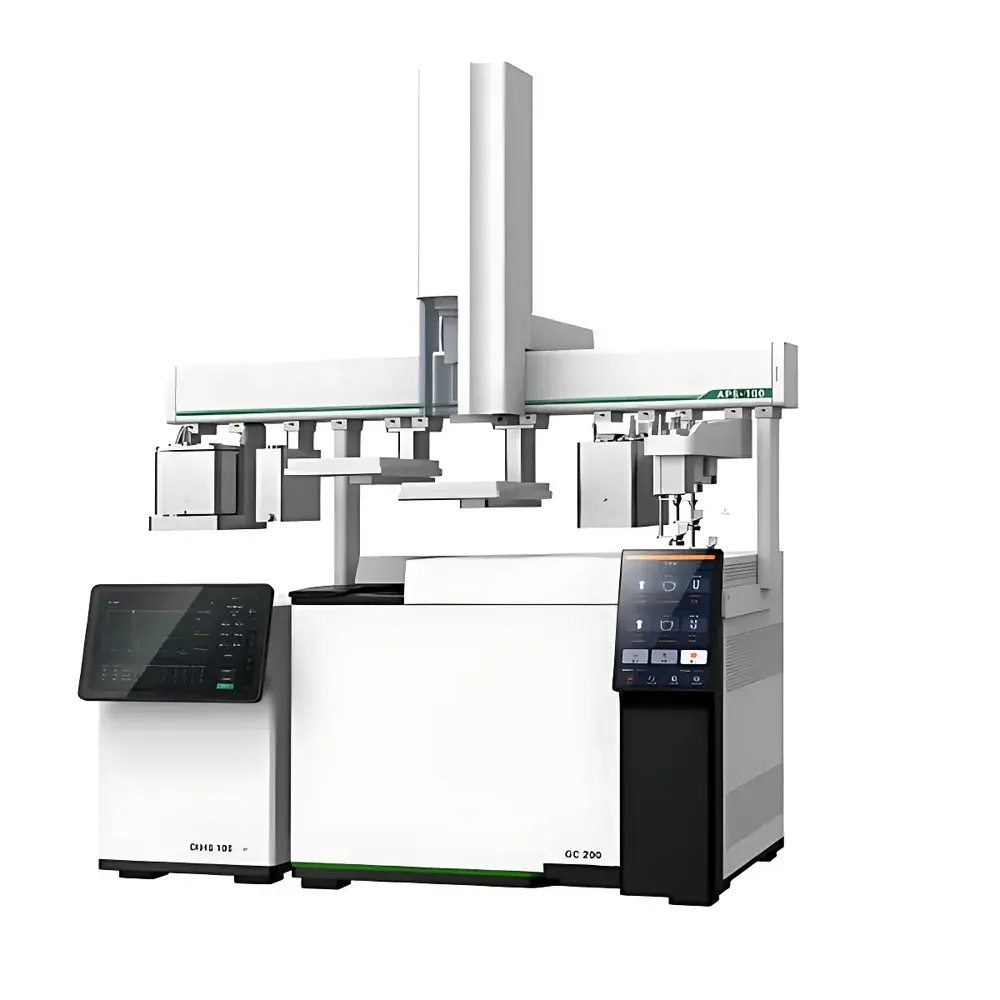
Titan Instruments GC-IMS 2000 Benchtop Gas Chromatography–Ion Mobility Spectrometry System
| Brand | Titan Instruments |
|---|---|
| Origin | Beijing, China |
| Manufacturer Type | Original Equipment Manufacturer (OEM) |
| Product Category | Domestic |
| Model | GC-IMS 2000 |
| Pricing | Available Upon Request |
Overview
The Titan Instruments GC-IMS 2000 is a benchtop hyphenated analytical platform integrating gas chromatography (GC) and drift-tube ion mobility spectrometry (IMS). It operates on the principle of sequential separation and ion mobility-based detection: volatile organic compounds (VOCs) are first resolved by GC based on volatility and polarity, then ionized via a non-radioactive, photoionization source (VUV lamp, 10.6 eV), and subsequently separated in the IMS drift region according to their collision cross-section (CCS), charge state, and mass-to-charge ratio. This orthogonal separation mechanism delivers enhanced peak capacity and compound specificity compared to standalone GC or IMS—particularly critical for complex, trace-level VOC matrices such as breath, headspace, or environmental air. Engineered for laboratory deployment, the system features compact footprint (< 0.8 m²), ambient-pressure operation, and real-time data acquisition at sub-second temporal resolution.
Key Features
- Integrated GC-IMS architecture with synchronized hardware triggering and time-aligned data fusion
- GC 200 module: split/splitless inlet compatible with liquid syringes, gas-tight valves, and automated headspace sampling via optional autosampler
- dIMS 200 dual-polarity drift tube: simultaneous positive- and negative-ion mode acquisition within a single injection—enabling comprehensive redox-sensitive profiling
- Non-radioactive vacuum ultraviolet (VUV) photoionization source (10.6 eV): stable output, zero regulatory burden, no periodic replacement or shielding requirements
- Sub-ppt (v/v) limit of detection for key sulfur- and nitrogen-containing VOCs (e.g., H₂S, dimethyl sulfide, trimethylamine) under optimized conditions
- Benchtop mechanical design with modular service access: column oven, IMS cell, and ion source are independently accessible for routine maintenance and calibration
Sample Compatibility & Compliance
The GC-IMS 2000 accepts gaseous, liquid, and solid samples via direct injection, thermal desorption, or headspace equilibrium. It supports EPA Method TO-17–compatible sampling for ambient air and indoor air VOCs, and aligns with ISO 16000-6 for indoor air quality monitoring. While not certified for clinical diagnostics per FDA 510(k) or CE-IVD, its data structure complies with ASTM E2933–22 (Standard Guide for Data Exchange in Chemical Analysis) and supports audit-ready metadata logging required under GLP environments. All software modules adhere to ALCOA+ principles (Attributable, Legible, Contemporaneous, Original, Accurate, Complete, Consistent, Enduring, Available) for raw data integrity.
Software & Data Management
The fully localized Titan GC-IMS Workstation provides method development, sequence scheduling, real-time spectral visualization, and post-run analysis in a unified GUI. Key capabilities include: retention time alignment across batches; mobility drift time calibration using internal standards (e.g., acetone, chloroform); 2D GC×IMS heatmap generation; unsupervised clustering (PCA, HCA); supervised classification (PLS-DA, SVM); and export of raw .tdf files compatible with open-source tools (e.g., DriftScope, IMS-Mining Toolkit). Audit trail functionality records all parameter modifications, user logins, and data processing steps—meeting baseline requirements for 21 CFR Part 11 compliance when deployed with electronic signature configuration.
Applications
- Environmental Monitoring: Real-time odorant profiling (e.g., skatole, indole, mercaptans) in wastewater treatment plants; emergency response screening for toxic industrial chemicals (TICs) and chemical warfare agent (CWA) simulants
- Food & Agriculture: Geographic origin authentication of olive oil, honey, and tea via volatile fingerprinting; process optimization in fermentation and roasting; biogenic volatile organic compound (BVOC) emission studies in controlled-environment plant phenotyping
- Industrial Hygiene: AMC (airborne molecular contamination) monitoring in semiconductor cleanrooms; off-gassing characterization of automotive interior materials per VDA 278
- Clinical Research: Non-invasive breath metabolomics for biomarker discovery in lung cancer, COPD, and metabolic disorders; intraoperative anesthetic vapor quantification
- Security & Defense: High-throughput screening of cargo containers for fumigants (e.g., methyl bromide, phosphine); detection of explosive precursors (e.g., nitroglycerin, PETN) in vapor phase
FAQ
What sample introduction methods are supported?
Liquid syringe injection, gas loop injection, thermal desorption tubes, and automated static/dynamic headspace sampling (with optional autosampler module).
Is the IMS detector radioactive?
No—the system employs a sealed VUV lamp (10.6 eV) for soft, non-radioactive ionization. No licensing, shielding, or disposal protocols are required.
Can the software export data for third-party statistical analysis?
Yes—raw mobility-resolved chromatograms (.tdf) and processed peak tables (.csv, .xlsx) are natively exportable; metadata follows mzML-compatible schema for interoperability.
Does the system support quantitative analysis?
Yes—external standard, internal standard, and standard addition calibration workflows are implemented; linear dynamic range spans 3–4 orders of magnitude for validated analytes.
What maintenance intervals are recommended?
Ion source cleaning every 200 runs; IMS drift tube conditioning every 500 runs; GC column trimming/replacement per manufacturer guidelines (typically 3–6 months under continuous use).





