
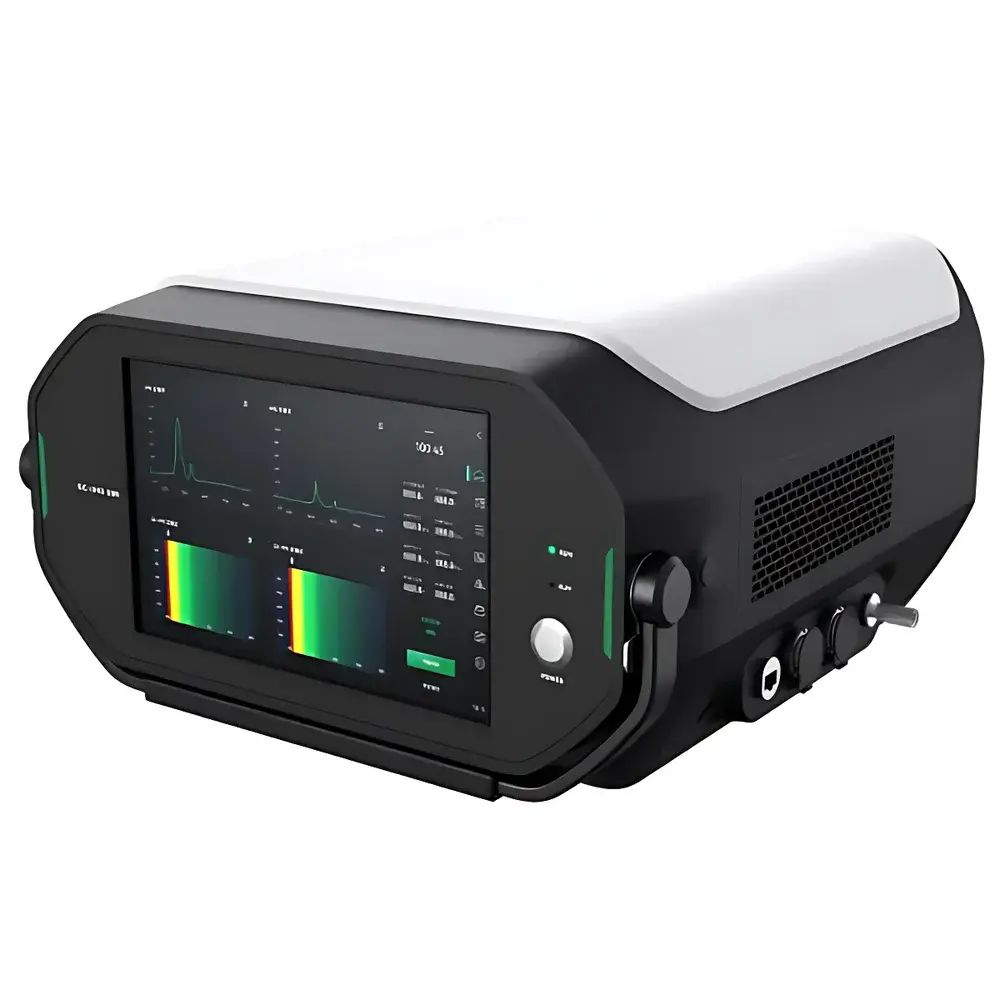
Titan Instruments GC-IMS 3000 Portable Gas Chromatography–Ion Mobility Spectrometry System
| Brand | Titan Instruments |
|---|---|
| Origin | Beijing, China |
| Model | GC-IMS 3000 |
| Configuration | GC-IMS300 Main Unit + BP30 Rechargeable Battery Pack + HS30 Handheld Sampling Probe |
| Power Supply | Dual-mode (AC adapter & internal Li-ion battery) |
| Operating Environment | 5–40 °C, <85% RH (non-condensing) |
| Dimensions (Main Unit) | 320 × 240 × 180 mm |
| Weight | ≤8.5 kg (fully configured) |
| Sample Introduction | Negative-pressure direct draw via inertized capillary path |
| Ionization Source | Non-radioactive UV photoionization lamp (10.6 eV) |
| Polarity Mode | Bipolar (simultaneous positive/negative ion detection) |
| Detection Limit | Sub-ppt (v/v) for selected VOCs and S-compounds |
| Data Acquisition Rate | Up to 50 spectra/sec |
| Software Interface | Standalone Windows-based GUI with embedded chemometric tools |
Overview
The Titan Instruments GC-IMS 3000 is a field-deployable, integrated analytical platform combining gas chromatography (GC) and differential mobility spectrometry (DMS), optimized for real-time, trace-level volatile organic compound (VOC) and semi-volatile compound profiling in complex gaseous matrices. Unlike conventional mass spectrometry systems, the GC-IMS 3000 leverages ion mobility separation—based on the differential drift velocity of ions under alternating high/low electric fields—to resolve structurally similar isomers and low-mass compounds that co-elute in GC alone. Coupled with a fast, low-thermal-mass GC column (programmable up to 120 °C), the system achieves separation times under 90 seconds for typical environmental and industrial VOC panels. Its core architecture includes a fully inertized sampling pathway, a valve-driven multi-segment flow control module, a dual-polarity DMS cell with symmetric waveform generation, and an embedded industrial-grade PC running deterministic real-time acquisition firmware. Designed for operational autonomy, it requires no external gas supplies, vacuum pumps, or cryogenic cooling—making it uniquely suited for unattended outdoor deployment, mobile laboratory integration, and rapid-response emergency scenarios.
Key Features
- True portable form factor: Compact footprint (≤32 cm wide), weight-optimized chassis, and modular battery-powered operation (BP30 pack supports ≥4.5 h continuous analysis at 25 °C)
- Direct ambient sampling capability: Negative-pressure inlet eliminates need for pre-concentration traps or carrier gas cylinders; compatible with Tedlar® bags, canisters, headspace vials, and open-air sniffing via HS30 probe
- Non-radioactive, maintenance-free ionization: 10.6 eV UV lamp ensures regulatory compliance (no NRC licensing required) and stable ion yield over >10,000 operating hours
- Bipolar DMS detection: Simultaneous acquisition of both positive- and negative-ion mobility spectra from a single injection—critical for redox-active species (e.g., H₂S, NH₃, NO₂, carbonyls, organic acids)
- Hardware-accelerated data processing: On-board FPGA handles real-time peak deconvolution, drift time calibration, and baseline correction prior to storage
- Multi-angle adjustable stand: Precision-machined aluminum mount enables stable positioning on uneven terrain, vehicle dashboards, or laboratory benches without additional fixtures
Sample Compatibility & Compliance
The GC-IMS 3000 accepts gaseous samples directly from ambient air, evacuated canisters (Summa-type), polymer sampling bags, and dynamic headspace extracts. All wetted surfaces—including transfer lines, microvalves, and the DMS gate electrode assembly—are passivated with SilcoNert® or Sulfinert® coatings to prevent adsorption, catalytic decomposition, or memory effects for reactive sulfur, nitrogen, and halogenated compounds. The system meets ISO 16000-6:2011 requirements for VOC measurement in indoor air and aligns with EPA Method TO-15B principles for field-portable screening. While not a GLP-certified instrument per se, its firmware enforces audit-trail logging (user actions, method parameters, calibration timestamps) compliant with FDA 21 CFR Part 11 Annex 11 expectations for regulated field use. Data export formats include .ims (native binary), .csv (drift time–retention time heatmaps), and .cdf (netCDF-compliant spectral metadata).
Software & Data Management
The embedded Titan IMS Suite v4.x provides a full-featured, Chinese-language GUI—localized for technical operators without English fluency—while maintaining underlying ISO/IEC 17025-aligned metadata structures. Key modules include: (1) Method Builder for GC temperature ramping, DMS compensation voltage sweeps, and valve sequencing logic; (2) Real-Time View with synchronized 2D chromatogram–mobility plot rendering; (3) Library Search Engine supporting custom-built spectral libraries (with retention index and reduced mobility K₀ annotation); (4) Quantitative Module applying internal standard normalization and matrix-matched calibration curves. All processed data are stored in encrypted SQLite databases with SHA-256 integrity hashing. Raw acquisition files support post-hoc reprocessing using open-source Python toolkits (e.g., imsis, PyIMSBin) via documented HDF5 export.
Applications
- Environmental Monitoring: Odor source identification (e.g., skatole, indole, dimethyl sulfide), fugitive emission mapping (landfill CH₄/S-compounds), and real-time VOC speciation during wildfire plume characterization
- Industrial Hygiene: Semiconductor fab airborne molecular contamination (AMC) tracking (amines, aldehydes, siloxanes), automotive cabin air quality assessment (aldehydes, plasticizers, residual solvents)
- Food & Agriculture: Rapid varietal authentication of olive oil, coffee, or honey via volatile fingerprinting; in-field monitoring of biogenic VOC emissions (BVOCs) from stressed crops
- Clinical Research: Exhaled breath condensate (EBC) analysis for asthma biomarkers (isoprene, acetone, pentanal); longitudinal VOC profiling in ICU patients under mechanical ventilation
- Security & Defense: High-throughput screening of cargo containers for fumigants (methyl bromide, phosphine), explosives precursors (nitroesters, peroxides), and chemical warfare agent simulants (DMMP, simulant G-series analogs)
FAQ
Does the GC-IMS 3000 require carrier gas or compressed air?
No. It operates exclusively on ambient air drawn via built-in diaphragm pump; no external gas cylinders or regulators are needed.
Can the system quantify target analytes without external calibration standards?
Yes—semi-quantitative results are generated using response factors derived from factory-installed reference spectra; however, regulatory-grade quantification requires matrix-matched calibration with certified standards.
Is the DMS cell susceptible to humidity-induced signal drift?
The system incorporates active humidity compensation via integrated capacitive RH sensor feedback to the DMS waveform generator, maintaining K₀ stability across 20–80% RH.
What is the recommended maintenance interval for the UV lamp and DMS electrodes?
The UV lamp is rated for >10,000 hours; DMS electrodes require cleaning only after 500+ sample injections in high-particulate environments—procedure detailed in the Field Service Manual.
Can raw data be exported for third-party multivariate analysis (e.g., PCA, PLS-DA)?
Yes—full-resolution .ims files contain calibrated drift time, compensation voltage, and intensity arrays; Python and MATLAB readers are publicly available under MIT license.




