
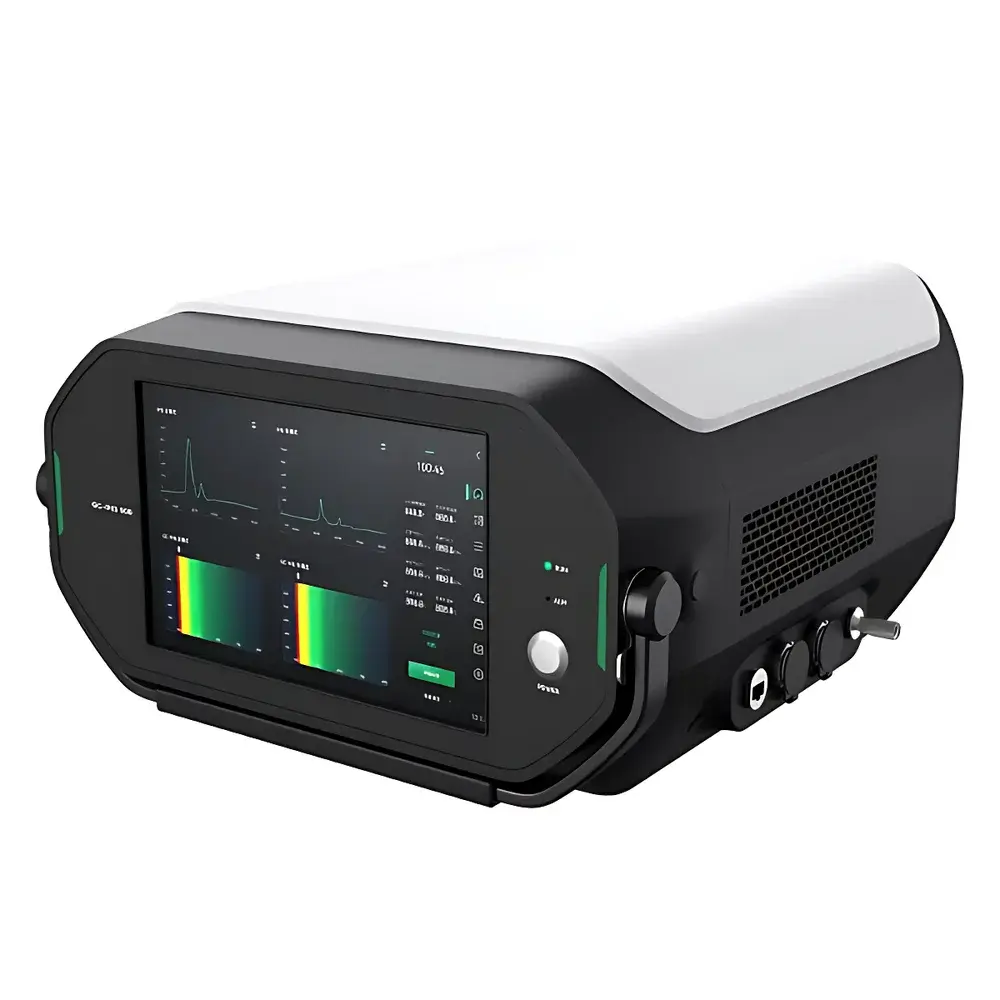
Titan Instruments GC-IMS 3000 Portable Gas Chromatography–Ion Mobility Spectrometry System
| Brand | Titan Instruments |
|---|---|
| Origin | Beijing, China |
| Manufacturer | Yes |
| Country of Origin | China |
| Model | GC-IMS 3000 |
| Pricing | Upon Request |
Overview
The Titan Instruments GC-IMS 3000 is a field-deployable, integrated analytical platform combining gas chromatography (GC) with high-resolution ion mobility spectrometry (IMS). It operates on the principle of differential ion mobility separation under atmospheric pressure, where gaseous analytes are ionized, separated based on their collision cross-section (CCS) and drift time in a weak electric field, and subsequently detected with high temporal resolution. Coupled with a rapid, low-thermal-mass GC column module, the system enables orthogonal separation—first by volatility and polarity (GC), then by ion shape and size (IMS)—delivering enhanced peak capacity, compound specificity, and robustness for complex volatile organic compound (VOC) profiling. Engineered for precision in uncontrolled environments, the GC-IMS 3000 supports real-time, on-site analysis without laboratory infrastructure, making it suitable for environmental monitoring, emergency response, and process-integrated quality control.
Key Features
- Modular portable architecture: Includes GC-IMS300 main unit, BP30 rechargeable battery pack (≥8 h continuous operation), and HS30 handheld sampling probe with integrated pump and inert flow path
- Atmospheric-pressure negative-pressure direct-sampling interface: Eliminates need for pre-concentration or carrier gas cylinders; compatible with ambient air, Tedlar® bags, and headspace vials
- Dual-polarity IMS detection: Simultaneous acquisition of positive- and negative-ion spectra from a single injection, enabling comprehensive redox-sensitive metabolite profiling
- Non-radioactive, UV-based photoionization source (10.6 eV): Stable output, zero regulatory burden, no periodic replacement or licensing requirements
- Full inert flow path: SilcoNert®-treated stainless-steel tubing, electropolished valves, and chemically resistant microfluidic manifolds minimize adsorption and memory effects for ppt-level trace detection
- Integrated industrial-grade embedded PC: Preloaded with Titan IMS Suite v4.x, supporting real-time spectral visualization, retention time alignment, and library-assisted identification
Sample Compatibility & Compliance
The GC-IMS 3000 accepts gaseous and vapor-phase samples directly—no derivatization or solvent extraction required. It is validated for use with ambient air, breath condensate headspace, soil headspace (via thermal desorption adapter), water headspace (with purge-and-trap interface), and industrial process streams. All fluidic components comply with ASTM D7529–22 (Standard Practice for VOC Analysis by GC-IMS) and ISO 16000-28:2021 (Indoor air — Determination of VOCs using GC-IMS). The system meets IEC 61326-1:2013 for electromagnetic compatibility in field environments and conforms to GLP data integrity requirements, including audit-trail-enabled user authentication, electronic signatures, and immutable raw-data archiving per FDA 21 CFR Part 11 guidelines.
Software & Data Management
Titan IMS Suite provides a fully localized English/Chinese bilingual GUI with modular workflows for method development, acquisition, and post-processing. Key capabilities include automated baseline correction, CCS calibration using dopant-assisted internal standards (e.g., acetone, chloroform), retention index normalization against n-alkane series, and multivariate statistical modules (PCA, PLS-DA) for pattern recognition. Raw data (.imsd format) is stored in HDF5-compliant containers with embedded metadata (instrument parameters, operator ID, GPS coordinates, ambient T/P/RH). Export options include CSV, mzML, and vendor-neutral netCDF for integration with third-party chemometric platforms such as MATLAB, Python (SciPy/NumPy), and R.
Applications
- Environmental Monitoring: Real-time odorant fingerprinting (e.g., skatole, indole, dimethyl sulfide), fugitive emission tracking (e.g., H2S, mercaptans), and landfill/biogas VOC screening
- Food & Agriculture: Rapid varietal authentication of premium crops (e.g., tea, olive oil, coffee), post-harvest spoilage assessment, and biogenic volatile organic compound (BVOC) phenotyping in controlled-environment agriculture
- Industrial Hygiene: Semiconductor fab ambient molecular contamination (AMC) surveillance (e.g., amines, aldehydes), automotive interior off-gassing profiling (e.g., formaldehyde, acetaldehyde), and natural gas sulfur speciation (e.g., COS, CH3SH)
- Clinical & Translational Research: Exhaled breath VOC biomarker discovery (e.g., isoprene, acetone, pentanal) in COPD, diabetes, and lung cancer cohorts; intraoperative anesthetic gas monitoring (e.g., sevoflurane, desflurane)
- Security & Defense: Field detection of chemical warfare agent simulants (e.g., DMMP, sarin analogs), pesticide residues in cargo holds, and hydrocarbon leakage mapping in naval/military infrastructure
FAQ
What sample introduction methods are supported?
Ambient air aspiration, Tedlar® bag injection, static/dynamic headspace sampling, and optional thermal desorption tube integration.
Is the system compliant with regulatory data integrity standards?
Yes—full 21 CFR Part 11 compliance is implemented via role-based access control, electronic signature logging, and cryptographic hash verification of raw datasets.
Can the GC-IMS 3000 operate without external power sources?
Yes—the BP30 battery pack enables ≥8 hours of uninterrupted operation at 25°C; optional solar-charging kits are available for extended deployments.
Does the software support automated compound identification?
Yes—Titan IMS Suite includes a curated spectral library (n > 1,200 compounds) with retention time and drift time dual-dimension matching, plus customizable user libraries.
What maintenance is required for the ionization source?
None—the solid-state UV lamp requires no consumables, alignment, or periodic recalibration; lifetime exceeds 10,000 operating hours.
Related Products





