
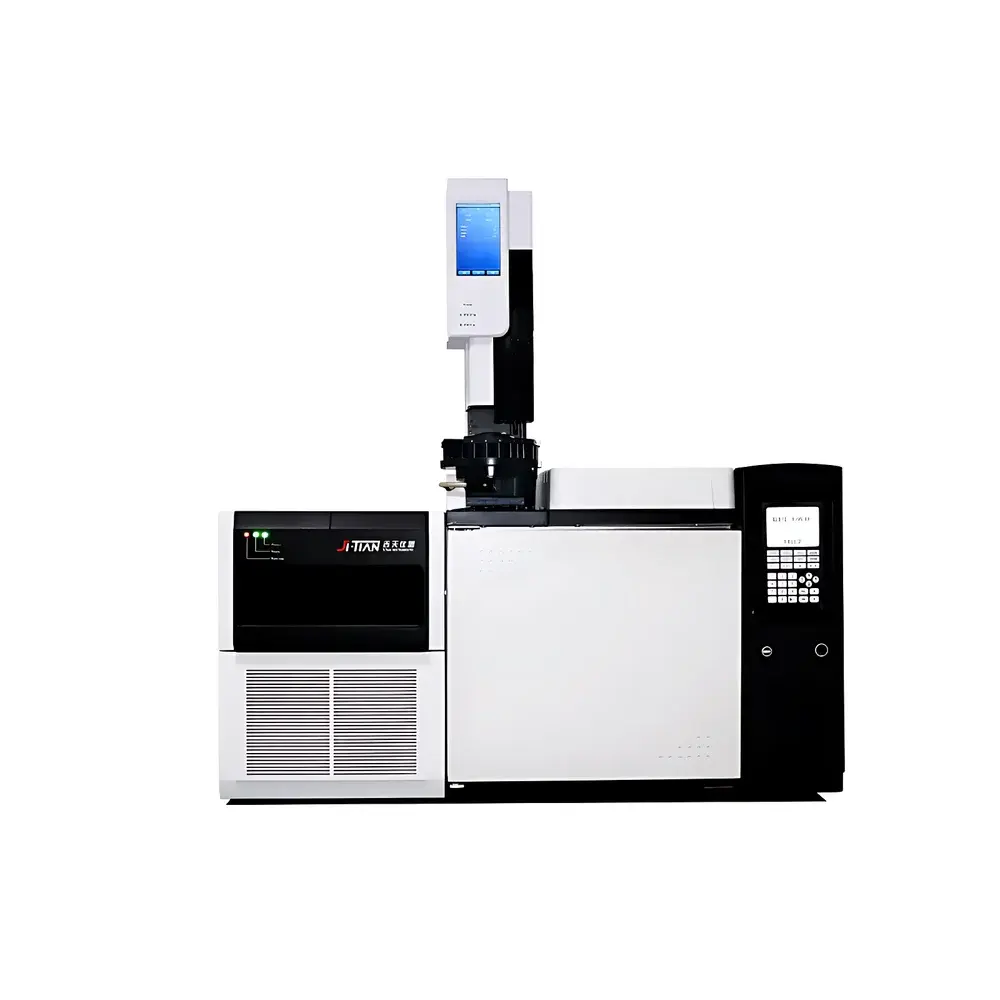
Titan Instruments GC-MS 8700 Gas Chromatography-Mass Spectrometry System
| Brand | Titan Instruments |
|---|---|
| Origin | Beijing, China |
| Manufacturer Type | Original Equipment Manufacturer (OEM) |
| Product Origin | Domestic (China) |
| Model | GC-MS 8700 |
| Pricing | Available Upon Request |
Overview
The Titan Instruments GC-MS 8700 is a high-performance gas chromatography-mass spectrometry (GC-MS) system engineered for robust, reproducible organic compound analysis in routine and research laboratories. It integrates a capillary gas chromatograph with a quadrupole mass spectrometer operating on electron ionization (EI) principles, enabling separation, identification, and quantification of volatile and semi-volatile organic compounds across complex matrices. The system is designed for compatibility with common sample introduction techniques—including purge-and-trap, thermal desorption, and accelerated solvent extraction—supporting solid, liquid, and gaseous samples without hardware modification. Its architecture adheres to fundamental GC-MS operational requirements: precise temperature-controlled oven programming, stable carrier gas flow regulation (helium or hydrogen), and mass-resolved detection with unit mass resolution across the full mass range.
Key Features
- Independent dual-chamber design isolates the ion source from the quadrupole mass analyzer, minimizing cross-contamination and ensuring long-term vacuum integrity.
- 250 L/s high-capacity turbomolecular pump maintains ultra-high vacuum (<1×10⁻⁶ Torr) in the mass analyzer region, critical for signal stability and low chemical noise.
- Ceramic-based, high-temperature ion source enhances ionization efficiency while resisting carbon deposition and acid-induced degradation—particularly beneficial for chlorinated and sulfur-containing analytes.
- Dual filament configuration with inert-material filaments extends operational lifetime by up to 2× compared to conventional tungsten-rhenium designs; automatic filament switching ensures uninterrupted analysis during maintenance cycles.
- Removable pre-quadrupole assembly acts as an ion filter and sacrificial surface, reducing contaminant accumulation on the main quadrupole rods and extending calibration interval duration.
- Simultaneous SCAN and Selected Ion Monitoring (SIM) acquisition mode allows full-spectrum data capture for qualitative confirmation while concurrently integrating target ions for quantitative accuracy—all within a single chromatographic run.
- Mass range extends to 1250 amu, supporting analysis of high-molecular-weight pesticides, brominated flame retardants (e.g., PBDEs), and pharmaceutical metabolites without fragmentation limitations.
- Real-time filament and electron multiplier (EM) gating enables dynamic deactivation during solvent front elution or high-abundance peaks, preventing detector saturation and preserving EM gain linearity over extended use.
Sample Compatibility & Compliance
The GC-MS 8700 supports standard 0.25–0.53 mm ID fused-silica capillary columns (e.g., DB-5ms, HP-5MS, Rxi-5Sil MS) and accommodates split/splitless, PTV, and direct inlet configurations. It meets essential regulatory prerequisites for environmental and food testing workflows, including alignment with EPA Methods 8260D, 8270E, and 1613B for VOCs and SVOCs; ISO 17025-compliant operation when paired with validated SOPs; and structural readiness for GLP/GMP environments through audit-ready log generation and user-access control protocols. While not pre-certified to FDA 21 CFR Part 11, its software architecture supports electronic signature implementation and audit trail configuration per laboratory-defined validation scope.
Software & Data Management
Controlled via Titan’s proprietary MassLab™ 3.0 platform, the system delivers intuitive method setup, real-time spectral viewing, automated library search (NIST MS Search 2.4 compatible), and customizable report templates. Raw data files (.TDF) are stored in open-format binary structure, enabling third-party processing in MassHunter, Xcalibur, or OpenChrom. All acquisition parameters, instrument status logs, and user actions are timestamped and archived with SHA-256 checksum verification. Data export supports CSV, PDF, and XML formats compliant with LIMS integration standards (ASTM E1467, ANSI/ISO/IEC 17025:2017 Annex A.3).
Applications
- Environmental Monitoring: Quantitative analysis of polycyclic aromatic hydrocarbons (PAHs), organochlorine pesticides (OCPs), phthalates, and emerging contaminants (e.g., PFAS precursors) in soil, sediment, drinking water, and ambient air extracts.
- Public Health & Drinking Water: Multi-residue screening of trihalomethanes (THMs), haloacetic acids (HAAs), and endocrine-disrupting compounds per WHO and GB/T 5750.8–2023 guidelines.
- Food Safety: Residue testing for organophosphorus and pyrethroid pesticides in fruits/vegetables; veterinary drug residues (e.g., sulfonamides, tetracyclines) in meat and dairy; and migrant substances (e.g., BADGE, NOGE) from food contact materials.
- Industrial Quality Control: Profiling of fragrance volatiles in cosmetics; identification of residual solvents in polymer coatings; and impurity profiling in fine chemical synthesis intermediates.
- Academic Research: Method development for non-targeted screening, isotopic ratio monitoring (¹³C/¹²C), and coupling with comprehensive two-dimensional GC (GC×GC) for enhanced peak capacity.
FAQ
Is the GC-MS 8700 compatible with hydrogen carrier gas?
Yes—the system supports helium, hydrogen, and nitrogen carrier gases, with optimized flow control algorithms and leak-tolerant vacuum management for H₂ operation.
What is the typical maintenance interval for the ion source?
Under standard environmental testing conditions (50–100 injections/week), ceramic ion source cleaning is recommended every 3–6 months; frequency increases with high-lipid or high-salt matrix exposure.
Does the system support method transfer from other GC-MS platforms?
Method parameters (oven ramp, injection volume, SIM lists) can be imported via CSV; retention time alignment requires column-specific retention index calibration using n-alkane standards.
Can MassLab™ 3.0 generate 21 CFR Part 11-compliant audit trails?
Yes—when deployed on a validated Windows Server environment with domain-level authentication, MassLab™ 3.0 supports configurable audit trail logging, electronic signatures, and role-based access control per laboratory SOPs.
What consumables require regular replacement?
Standard replacements include EI filaments (dual-pack), electron multiplier (EM), inlet septa, gold-plated liner O-rings, and turbomolecular pump oil (if applicable); all part numbers are cataloged in the Titan Instruments Consumables Reference Guide v4.2.





