
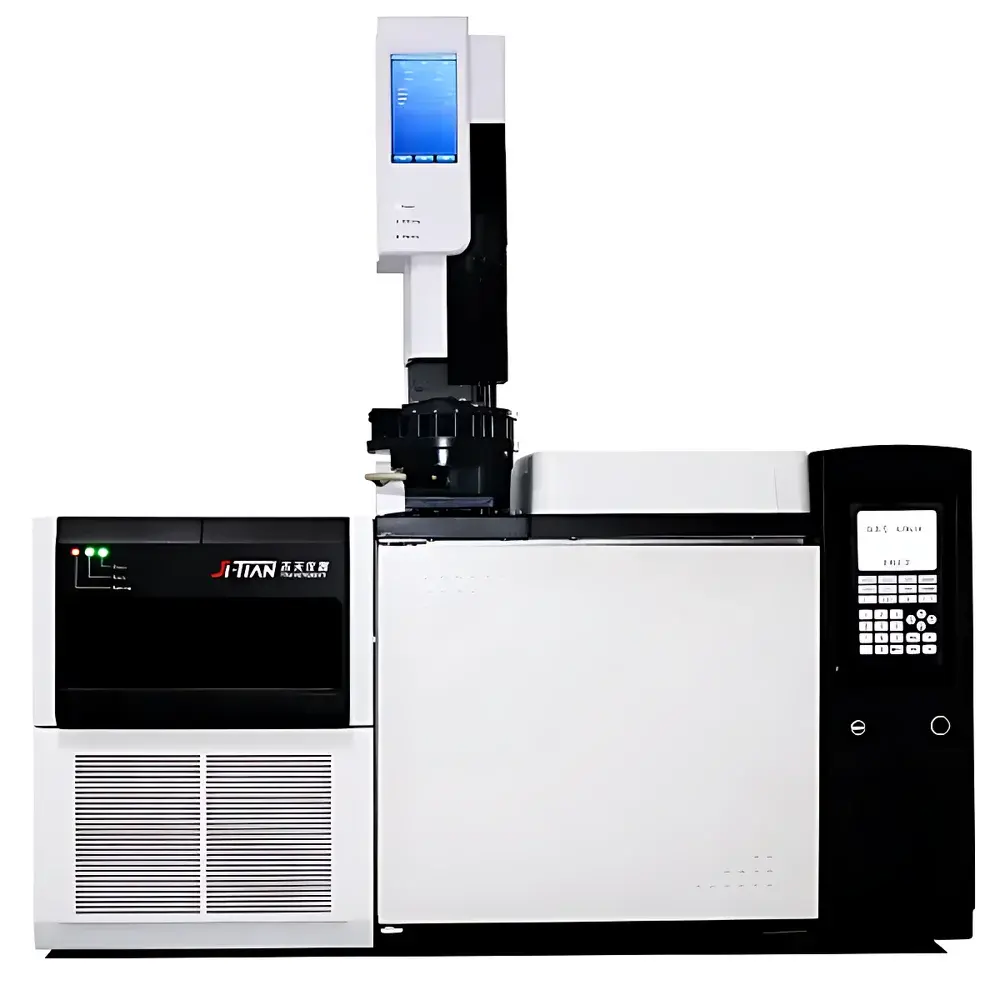
Titan Instruments GC-MS 8700 Single Quadrupole Gas Chromatography-Mass Spectrometer
| Brand | Titan Instruments |
|---|---|
| Origin | Beijing, China |
| Model | GC-MS 8700 |
| Mass Analyzer Type | Single Quadrupole |
| Mass Range | Up to 1250 amu |
| Ion Source | High-Temperature Inert Ceramic |
| Vacuum System | Dual-Chamber Design with 250 L/s Turbo Molecular Pump |
| Ionization Modes | Electron Ionization (EI) |
| Scan Modes | Full Scan (SCAN) and Selected Ion Monitoring (SIM) Simultaneously |
| Filament | Dual Long-Life Inert Filament |
| Pre-Quadrupole | Removable |
| Detector | Electron Multiplier with Active Protection Logic |
| Compliance | Designed for GLP/GMP-aligned workflows, compatible with ASTM D5847, ISO 17025–compliant data handling, and supports 21 CFR Part 11–ready audit trail configuration (via optional software module) |
Overview
The Titan Instruments GC-MS 8700 is a single quadrupole gas chromatography-mass spectrometry (GC-MS) system engineered for high-fidelity separation, identification, and quantification of volatile and semi-volatile organic compounds. It integrates a robust capillary gas chromatograph with a thermally stable, high-transmission mass spectrometer based on quadrupole mass filtering technology. The system operates on electron ionization (EI) principles, generating reproducible fragment ion spectra suitable for library-based compound identification (e.g., NIST MS Search) and precise quantitative analysis via internal or external standard calibration. Its dual-chamber vacuum architecture—featuring independent ion source and mass analyzer chambers evacuated by a 250 L/s turbo molecular pump—ensures rapid pump-down, ultra-low base pressure (<5 × 10⁻⁷ Torr), and minimal cross-contamination between analyses. This design directly enhances signal-to-noise ratio, detection sensitivity (sub-pg on-column for target analytes such as chlorinated benzenes or PAHs), and long-term operational stability across multi-day batch runs.
Key Features
- Dual-chamber vacuum architecture isolates the ion source from the quadrupole mass filter, significantly reducing carbon deposition and background hydrocarbon interference.
- High-temperature inert ceramic ion source enables efficient desolvation and ionization of thermally labile compounds while resisting corrosion from acidic or halogenated matrices.
- Dual long-life inert filaments extend operational uptime; automatic filament switching occurs during method-defined retention time windows to avoid saturation by high-abundance analytes.
- Removable pre-quadrupole acts as an ion optical filter, trapping neutral species and low-energy ions before they reach the main quadrupole—reducing contamination accumulation and extending quadrupole service intervals.
- Simultaneous SCAN/SIM acquisition allows full-spectrum qualitative screening and targeted quantitation in a single injection, eliminating need for re-injection or method duplication.
- Electron multiplier protection logic dynamically disables detector gain and filament emission during solvent front elution or known high-concentration zones, preserving detector linearity and longevity.
- Mass range extends to 1250 amu, supporting analysis of larger molecules including certain pharmaceutical metabolites, pesticide transformation products, and brominated flame retardants.
Sample Compatibility & Compliance
The GC-MS 8700 interfaces seamlessly with industry-standard sample introduction systems—including purge-and-trap concentrators, thermal desorption units, and accelerated solvent extractors—enabling trace-level analysis of solids (soil, sediment, polymer packaging), liquids (drinking water, beverages, extracts), and gases (ambient air, headspace vials). It meets foundational requirements for environmental and food safety testing under EPA Methods 502.2, 524.4, 8270, and 8321B; supports ISO 17025 documentation workflows; and provides configurable audit trail, electronic signature, and user access control features required for GLP and GMP environments when paired with validated data system software. Instrument qualification protocols (IQ/OQ/PQ) are supported through vendor-provided templates aligned with ASTM E2656 and USP .
Software & Data Management
Controlled via Titan GC-MS Navigator™ software (Windows 10/11 64-bit), the system delivers intuitive method building, real-time spectral monitoring, automated peak integration, and customizable reporting. Raw data files adhere to ANDI/NetCDF format for third-party compatibility (e.g., OpenChrom, Chromeleon). The software includes built-in NIST MS Search 2.4 library with over 300,000 reference spectra, deconvolution algorithms for co-eluting peaks, and SIM optimization tools for method development. For regulated laboratories, optional 21 CFR Part 11 compliance modules provide role-based permissions, electronic signatures, immutable audit trails, and secure data archiving—fully traceable to instrument events, user actions, and parameter changes.
Applications
- Environmental Monitoring: Quantification of VOCs (e.g., benzene, toluene), SVOCs (e.g., PCBs, phthalates), and emerging contaminants (e.g., PFAS precursors) in water, soil, sediment, and ambient air samples.
- Drinking Water & Public Health: Compliance testing per WHO and national standards for disinfection by-products (e.g., trihalomethanes), pesticides (e.g., atrazine, simazine), and endocrine disruptors.
- Food Safety: Residue analysis of organophosphorus and organochlorine pesticides, veterinary drug residues (e.g., chloramphenicol), mycotoxin metabolites, and migrant substances from food contact materials.
- Industrial Quality Control: Fingerprinting of essential oils, quantification of flavor/aroma compounds in beverages, and purity assessment of synthetic intermediates in fine chemical manufacturing.
- Academic & Government Research: Method validation studies, metabolomic profiling of biological fluids, and forensic toxicology screening where compound class coverage and spectral reliability are critical.
FAQ
What is the maximum operating temperature of the ion source?
The inert ceramic ion source is rated for continuous operation up to 350 °C, enabling efficient ionization of high-boiling-point analytes without thermal degradation.
Can the GC-MS 8700 be upgraded to support chemical ionization (CI)?
No—the current configuration supports only electron ionization (EI); CI capability requires hardware redesign and is not field-upgradable.
Is the system compatible with third-party GC ovens or autosamplers?
Yes, it accepts standard analog and digital signals (e.g., RS-232, Ethernet) for synchronization with major OEM GC platforms and liquid handlers meeting ASTM E1947 timing specifications.
How often does the electron multiplier require replacement under typical usage?
With active protection logic engaged and routine maintenance (e.g., source cleaning every 100–200 injections), typical service life exceeds 18 months at sub-ng/mL detection levels.
Does the software support automated calibration verification per regulatory guidelines?
Yes—Navigator™ includes scheduled calibration check routines using tune compounds (e.g., PFTBA), with pass/fail criteria configurable per ISO/IEC 17025 or laboratory SOP requirements.






