
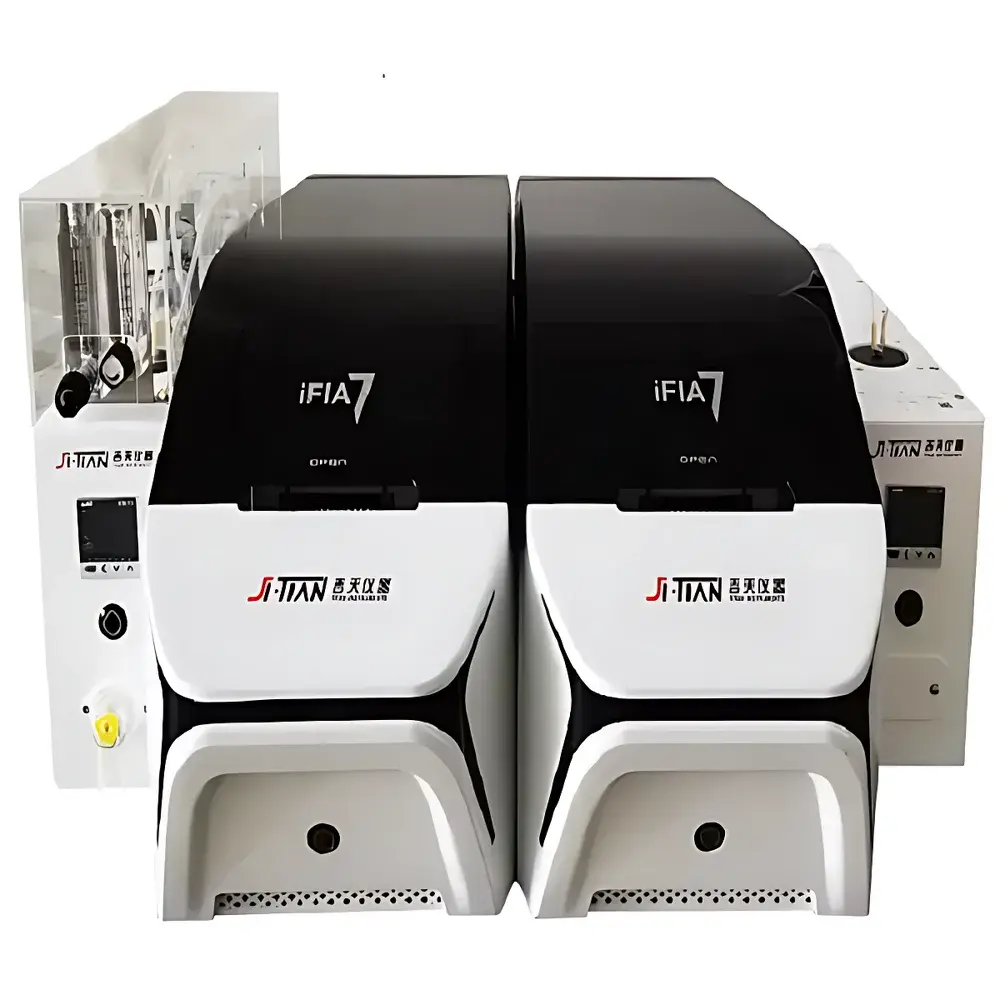
Titan Instruments iFIA 7Plus Advanced Flow Injection Analyzer
| Brand | Titan Instruments |
|---|---|
| Origin | Beijing, China |
| Model | iFIA 7Plus |
| Product Type | Flow Injection Analyzer |
| Category | Chemical Analysis Instrumentation — General Analytical Instruments — Flow Injection Analyzer |
| Manufacturer Status | Authorized Distributor |
| Regional Classification | Domestic (PRC) |
| Pricing | Upon Request |
Overview
The Titan Instruments iFIA 7Plus Advanced Flow Injection Analyzer is a fully automated, modular flow-based analytical platform engineered for high-precision, multi-parameter determination in complex aqueous and semi-solid matrices. It operates on the fundamental principles of controlled non-steady-state reaction kinetics coupled with analog steady-state pre-treatment—enabling reproducible zone formation, precise reagent-sample mixing, and optimized reaction timing within narrow-bore PTFE or fluoropolymer tubing. Unlike conventional segmented-flow systems, the iFIA 7Plus employs programmable peristaltic pumping, real-time flow-rate modulation, and integrated microfluidic control to achieve robust chemical derivatization under precisely defined residence time windows. This architecture delivers exceptional resilience against matrix-induced signal suppression or enhancement—particularly critical when analyzing environmental, food, and agricultural samples with high ionic strength, alkalinity, suspended solids, or hardness. The system is designed for compliance-driven laboratories requiring trace-level detection (e.g., µg/L–mg/L range) across regulated methods including ISO 6439 (cyanide), ISO 11905-1 (phenols), EPA Method 353.2 (nitrate/nitrite), and APHA Standard Methods 4500-P E (total phosphorus).
Key Features
- Integrated “pre-distillation” and “pre-digestion” modules—chemically selective, thermally stabilized units that remove volatile interferences (e.g., sulfides, organic acids) and hydrolyze refractory nitrogen/phosphorus species prior to detection.
- Full online sample pretreatment: automatic dilution (1:2 to 1:1000), reagent replenishment, carrier stream conditioning, and air-segmented aspiration—all without manual intervention or offline preparation time.
- Hardness-resistant fluidic architecture: corrosion-inert PFA/PTFE manifolds, ceramic-sapphire pump rollers, and adaptive backpressure regulation to prevent clogging in high-Ca²⁺/Mg²⁺ groundwater or seawater matrices.
- Multi-channel simultaneous analysis: up to 8 independent analytical streams operated in parallel, each configurable with dedicated wavelength selection (LED or photodiode array), flow-cell pathlength (10–50 mm), and reaction coil geometry.
- Modular detector compatibility: supports spectrophotometric (340–900 nm), fluorometric (excitation/emission filters), and electrochemical (amperometric, conductometric) detection modes via standardized interface protocols.
Sample Compatibility & Compliance
The iFIA 7Plus accommodates liquid samples ranging from clarified surface water and wastewater effluents to acid-digested soil extracts, homogenized plant tissues, and filtered food digests. Its tolerance for total dissolved solids (TDS) up to 35 g/L and alkalinity >500 mg CaCO₃/L enables direct analysis of seawater, brackish groundwater, and industrial process streams. All wetted components comply with USP Class VI and FDA 21 CFR 177.1550 standards for food-contact materials. System validation adheres to ICH Q2(R2) guidelines; method verification supports GLP and ISO/IEC 17025 accreditation requirements. Data integrity conforms to FDA 21 CFR Part 11 through electronic audit trails, user role-based access control, and immutable raw-data archiving.
Software & Data Management
Controlled by TitanFlow™ v4.2 software, the iFIA 7Plus provides method-driven workflow automation—including sequence scheduling, dynamic calibration curve generation (linear, quadratic, or cubic), real-time drift correction, and QC flagging per ASTM D5847. Raw absorbance/fluorescence signals are stored in vendor-neutral .csv and .netCDF formats. Integrated LIMS connectivity (via HL7 and ASTM E1384) enables bidirectional sample tracking and result reporting. Software modules support full audit trail review, electronic signature capture, and automated report generation compliant with ISO 17025 clause 7.8.2.
Applications
- Water & Wastewater: Phenols (volatile & total), cyanide (free & total), sulfide, nitrate/nitrite, ammonium, phosphate, total phosphorus, total nitrogen (TN), hardness, chromium(VI), boron, formaldehyde, anionic surfactants.
- Environmental Solid Matrices: TN, NH₄⁺-N, NO₃⁻-N, Kjeldahl N/P, sulfate, orthophosphate, aluminum, boron in soil, sediment, and plant digests.
- Food & Agriculture: Cyanide in cassava/flaxseed, sulfide in canned vegetables, nitrate/nitrite in cured meats, reducing sugars in fruit juices, urea in dairy products.
- Agrochemical & Veterinary: Kjeldahl nitrogen in feedstuffs, available phosphorus in fertilizers, boron in irrigation water, nitrate in livestock drinking water.
FAQ
What regulatory methods does the iFIA 7Plus support out-of-the-box?
Pre-configured methods include ISO 6439 (cyanide), ISO 11905-1 (phenols), EPA 353.2 (nitrate/nitrite), APHA 4500-P E (phosphorus), and DIN 38405-27 (ammonia). Custom method development is supported via open scripting in TitanFlow™.
Can the system handle viscous or particulate-laden samples?
Yes—optional inline filtration (0.45 µm PES membrane) and ultrasonic-assisted sample introduction enable analysis of homogenized sludge, algal suspensions, and fruit pulp extracts without clogging.
Is remote monitoring and troubleshooting possible?
The system supports secure TLS 1.2–enabled remote desktop access, real-time diagnostic dashboards, and predictive maintenance alerts via TitanCloud™ telemetry infrastructure.
How is calibration stability maintained over extended runs?
Automatic zero-point correction using dual-reference baselines and periodic standard bracketing (every 10–20 samples) ensure ≤2% RSD over 8-hour continuous operation.
Does the iFIA 7Plus meet data integrity requirements for regulated environments?
Yes—full 21 CFR Part 11 compliance includes electronic signatures, audit trail export, password-protected method locking, and tamper-evident raw data storage with SHA-256 hashing.
Related Products





