
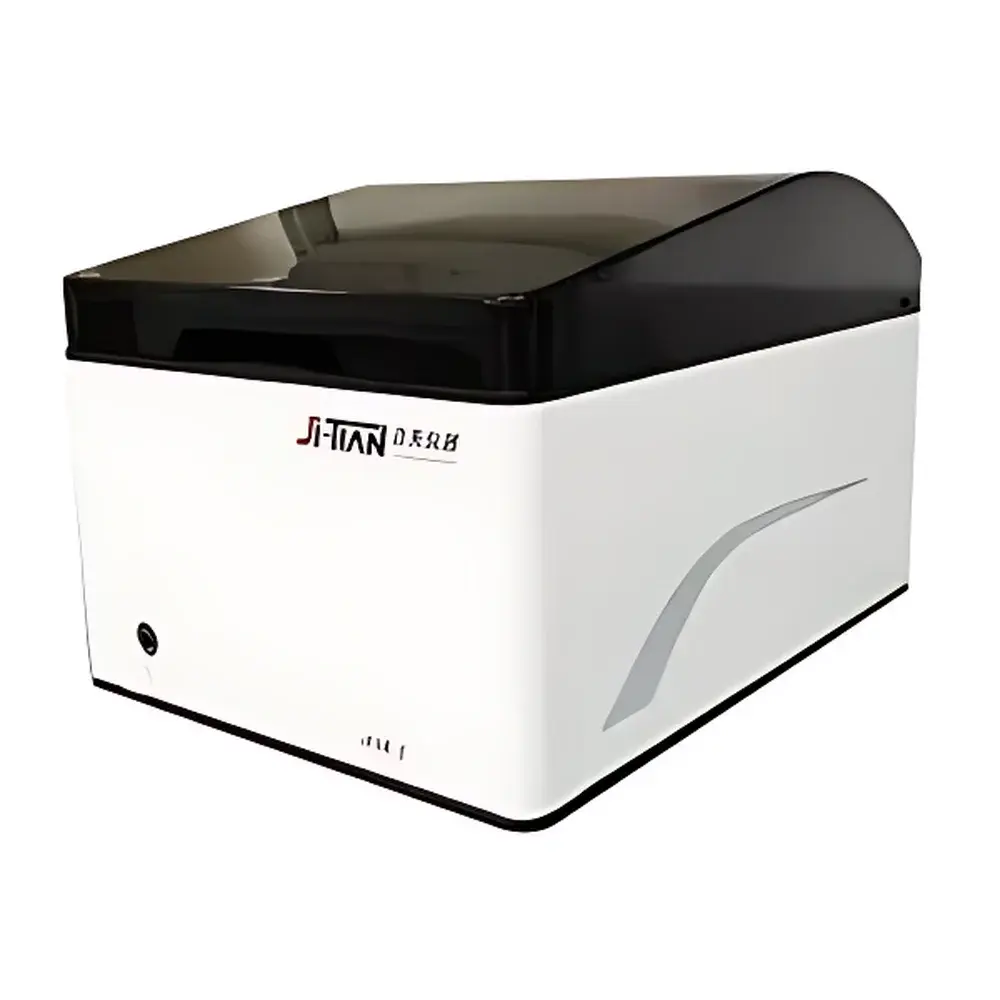
Titan Instruments iFIA E Fully Automated Multi-Parameter Flow Injection Analyzer
| Brand | Titan Instruments |
|---|---|
| Origin | Beijing, China |
| Model | iFIA E |
| Product Type | Flow Injection Analyzer |
| Wavelength Range | 340–1100 nm |
| Sample Capacity | 10–50 mL per vial / 50–300 positions |
| Reagent Positions | 12 |
| Flow Cell Path Length | 10 mm |
| Light Source | Tungsten Lamp |
Overview
The Titan Instruments iFIA E is a fully automated, multi-parameter flow injection analyzer engineered for high-throughput, trace-level quantification of inorganic and organic analytes in liquid matrices—primarily water, soil extracts, and biological digests. Built upon the well-established principles of flow injection analysis (FIA), the system employs precise, computer-controlled fluidic segmentation, reproducible dispersion, and on-line reaction kinetics to deliver robust analytical performance without manual sample pretreatment. Unlike segmented-flow or continuous-flow systems, the iFIA E utilizes a micro-bore tubular architecture with programmable timing, enabling strict control over reagent mixing ratios, reaction residence time, and detection window synchronization. This architecture ensures high repeatability (RSD < 2% for routine calibration standards) and minimizes carryover between samples—critical for regulatory compliance in environmental and drinking water testing laboratories.
Key Features
- Pressure-adjustable integrated peristaltic pump manifold with dual-channel precision rollers, delivering stable flow rates (0.5–5.0 mL/min) across extended operational cycles (>8 hours uninterrupted).
- On-board temperature control module with digital LCD interface and real-time feedback; setpoint range: 25–100 °C ±0.3 °C, supporting digestion, distillation, and enzymatic reactions.
- Integrated pre-treatment unit featuring simultaneous UV photolysis (254 nm), PTFE membrane-based phase separation, thermally regulated distillation, and semiconductor-cooled condensation—eliminating external benchtop modules and reducing interferences from ambient thermal drift.
- Optimized optical detection system with tungsten-halogen broadband source and fixed 10-mm pathlength flow cell, calibrated across 340–1100 nm for absorbance, colorimetric, and catalytic endpoint assays.
- Modular reagent management with 12 independently addressable reagent ports, each equipped with level sensing and air-gap detection to prevent aspiration errors.
- Self-diagnostic firmware with automatic priming, bubble detection, pressure monitoring, and fault logging compliant with ISO/IEC 17025 internal quality assurance protocols.
Sample Compatibility & Compliance
The iFIA E accommodates aqueous samples ranging from raw surface water and wastewater effluents to acid-digested soil leachates and enzymatically hydrolyzed plant tissues. It supports standardized methods including EPA Method 353.2 (nitrate/nitrite), EPA Method 4500-NH₃ F (ammonia), ISO 6779:2021 (cyanide), ISO 11908:2015 (phenols), and ASTM D5176-22 (anionic surfactants). All hardware and software components are designed to meet GLP and GMP documentation requirements, with full audit trail capability for method parameters, calibration history, and raw signal data. The system complies with FDA 21 CFR Part 11 for electronic records and signatures when deployed with Titan’s validated LIMS integration package.
Software & Data Management
Control and data acquisition are managed via Titan’s proprietary FIA-Control Suite v4.2—a Windows-based application supporting method development, sequence scheduling, real-time chromatogram visualization, peak integration using tangent skim and second-derivative algorithms, and automated QC flagging (e.g., drift >5% baseline, calibration R² < 0.999). Raw absorbance/time datasets are stored in vendor-neutral CSV and HDF5 formats. Optional integration with third-party LIMS platforms (e.g., LabWare, Thermo Fisher SampleManager) is supported through ASTM E1384-compliant API interfaces. All method files include embedded metadata (operator ID, instrument serial, environmental conditions) to satisfy ISO/IEC 17025 clause 7.7 traceability requirements.
Applications
The iFIA E delivers validated performance across regulated environmental monitoring programs: determination of volatile phenols (as 4-aminoantipyrine derivatives), total cyanide (pyridine-barbituric acid), anionic surfactants (MBAS), ammonia nitrogen (indophenol blue), sulfide (methylene blue), permanganate index (CODMn), total phosphorus (ascorbic acid–molybdate), and total nitrogen (alkaline persulfate oxidation + nitrate reduction). In agronomic labs, it quantifies ammonium, nitrate, phosphate, and boron in Mehlich-3 and Olsen extracts. Food safety applications include formaldehyde in fish products (AOAC 2015.02) and urea in milk (IDF Standard 172:2019). All methods adhere to matrix-matched calibration and spike recovery validation per ISO 8466-1.
FAQ
What regulatory standards does the iFIA E support for drinking water analysis?
The system implements EPA-approved chemistries and meets the instrumental requirements of US EPA Methods 300.0, 353.2, and 4500 series for inorganic nutrients and contaminants.
Can the iFIA E perform simultaneous multi-analyte determinations in a single run?
Yes—through sequential zone injection and wavelength-switched detection, up to four analytes (e.g., NO₂⁻, NO₃⁻, NH₄⁺, PO₄³⁻) can be quantified per sample without physical reconfiguration.
Is method validation data available for ISO/IEC 17025 accreditation?
Titan provides comprehensive validation reports—including LOD/LOQ, linearity (5–7 point), precision (within-day and between-day RSD), and recovery studies—for all core water quality methods.
How is carryover minimized during high-concentration sample analysis?
The system employs dual-stage rinsing (deionized water + 10% HNO₃) with programmable dwell times, validated to achieve <0.05% carryover for Cr(VI) at 100 µg/L.
Does the software support remote monitoring and alarm notifications?
FIA-Control Suite includes SMTP-based alerting for critical events (e.g., low reagent, pressure anomaly, calibration failure) and optional cloud-sync for supervisory review via secure TLS-encrypted channel.
Related Products




