
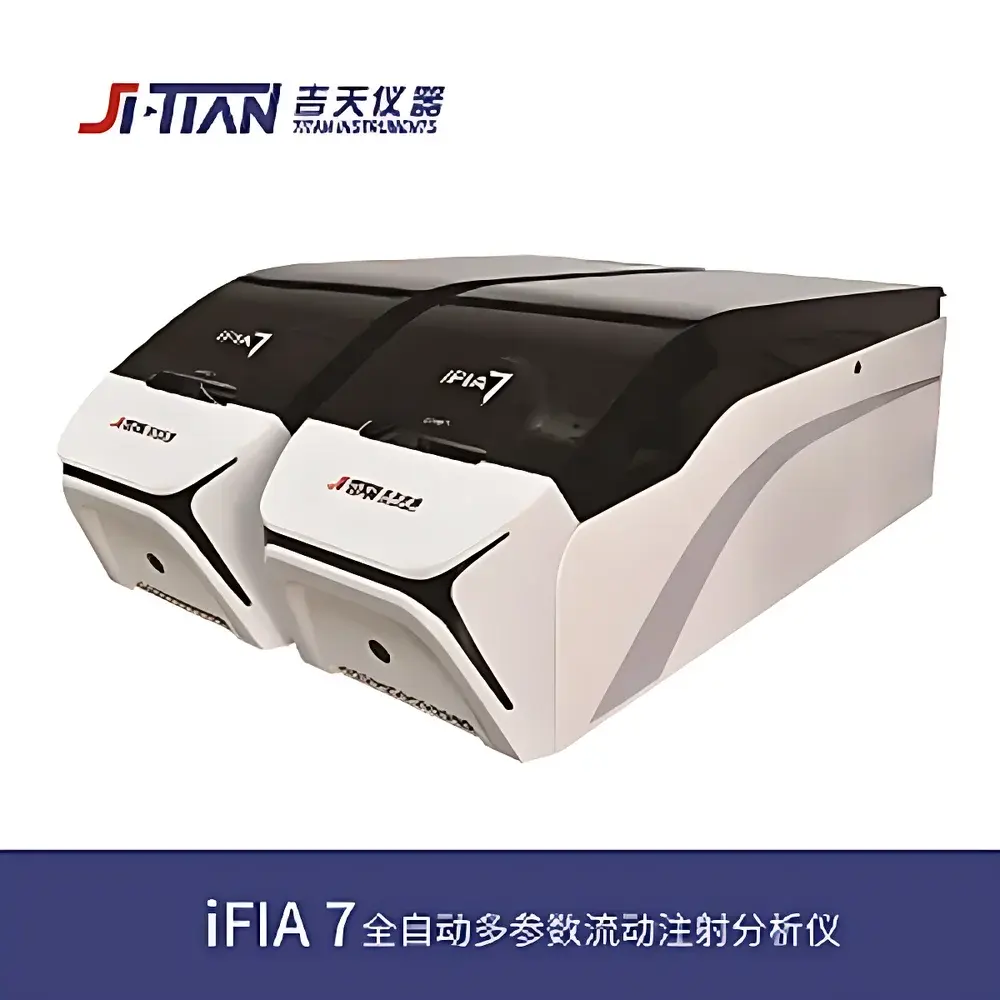
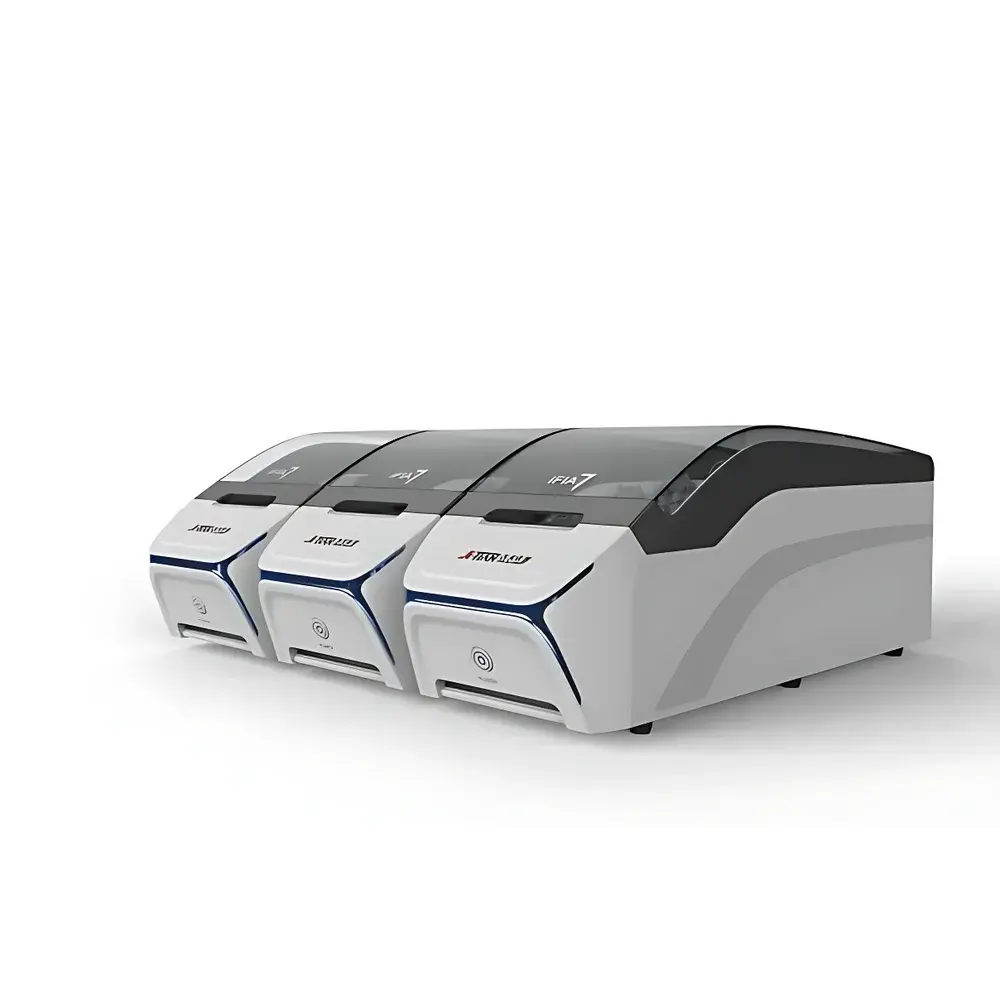
Titan Instruments iFIA7 Fully Automated Multi-Parameter Flow Injection Analyzer
| Brand | Titan Instruments |
|---|---|
| Origin | Beijing, China |
| Manufacturer Type | Manufacturer |
| Product Category | Flow Injection Analyzer |
| Model | iFIA7 |
| Wavelength Range | 340–1100 nm |
| Sample Capacity | 85–301 positions |
| Reagent Positions | 12 |
| Flow Cell Path Length | 10–30 mm |
| Light Source | Tungsten-Halogen Lamp |
Overview
The Titan Instruments iFIA7 Fully Automated Multi-Parameter Flow Injection Analyzer is an engineered platform for high-throughput, standardized spectrophotometric analysis of inorganic and organic analytes in environmental, food, agricultural, and industrial matrices. Based on the well-established flow injection analysis (FIA) principle—where discrete sample zones are introduced into a continuously flowing carrier stream and subjected to controlled mixing, reaction, and detection—the iFIA7 implements segmented, programmable fluidic pathways with precise timing, thermal management, and optical optimization. Unlike conventional batch or manual FIA systems, the iFIA7 integrates modular chemistry units, independent channel architecture, and adaptive photometric detection to support concurrent multi-analyte determination without cross-channel interference. Its design complies with fundamental FIA theory as defined in ISO 15682 and ASTM D5179, emphasizing reproducibility through strict control of dispersion, reaction kinetics, and residence time.
Key Features
- Fully integrated hardware architecture: Each analytical channel operates independently—featuring its own peristaltic pump, dedicated dual-beam photometer, method-specific chemical manifold, pre-treatment module, and isolated power/control circuitry—eliminating shared components that could introduce inter-channel variability.
- Automated fluidic reconfiguration: The system dynamically configures sample pretreatment modules (e.g., distillation, digestion, gas-diffusion, UV digestion) and reaction tubing paths based on selected method files; all modules automatically heat to specified temperatures prior to analysis initiation.
- Adaptive optical detection: A tungsten-halogen light source coupled with a programmable monochromator enables automatic wavelength selection across 340–1100 nm and real-time intensity optimization for each assay, ensuring optimal signal-to-noise ratio across diverse colorimetric chemistries.
- Real-time process monitoring: All critical operational states—including pump rotation, valve actuation, temperature stabilization, and detector baseline—are continuously logged and synchronized with method-defined timing windows to minimize overshoot and lag effects during transient reaction phases.
- Modular autosampler compatibility: Supports interchangeable sample carousels accommodating 85 to 301 vials, enabling flexible throughput scaling from routine QC to large-scale environmental monitoring campaigns.
Sample Compatibility & Compliance
The iFIA7 is validated for liquid-phase analysis of aqueous extracts, digests, filtrates, and clarified homogenates derived from water, wastewater, seawater, soil leachates, plant tissues, food homogenates, and tobacco samples. It supports EPA-compliant methodologies including EPA Method 353.2 (nitrate/nitrite), EPA Method 375.4 (cyanide), and EPA Method 365.3 (phosphate), as well as ISO standards such as ISO 11905-1 (ammonia), ISO 11905-2 (nitrate), and ISO 15682 (general FIA performance criteria). In China, it fully implements national standard methods GB 8538–2016 (cyanide), HJ 666–2013 (ammonia nitrogen), HJ 668–2013 (total nitrogen), HJ 671–2013 (total phosphorus), HJ 823–2017 (cyanide), HJ 824–2017 (sulfide), HJ 825–2017 (phenols), HJ 826–2017 (anionic surfactants), and HJ 908–2017 (hexavalent chromium). Instrument operation adheres to GLP principles, with full audit trail capability for method execution, parameter changes, and data export events.
Software & Data Management
The iFIA7 is operated via Titan’s proprietary FIA Workstation software—a Windows-based application supporting method library management, multi-channel synchronization, real-time chromatogram visualization, peak integration, calibration curve generation (linear, quadratic, or weighted), and automated QC flagging. Preloaded method templates cover over 20 analytes referenced in regulatory protocols, including ammonia, nitrate, nitrite, phosphate, silicate, cyanide, phenol, sulfide, Cr(VI), formaldehyde, borate, and anionic surfactants. Data files comply with ASTM E1382 metadata conventions and can be exported in CSV, TXT, or XML formats compatible with LIMS integration. Software enforces role-based access control (administrator, analyst, reviewer), electronic signatures, and 21 CFR Part 11–compliant audit trails for all instrument actions and result modifications.
Applications
The iFIA7 delivers robust performance across multiple sectors requiring trace-level quantification of nutrients, contaminants, and functional compounds. In environmental laboratories, it performs simultaneous determination of five marine nutrients (NH₄⁺-N, NO₃⁻-N, NO₂⁻-N, SiO₃²⁻, PO₄³⁻) in seawater and quantifies priority pollutants—including cyanide, phenol, sulfide, and Cr(VI)—in wastewater per HJ-series standards. For drinking water compliance, it executes parallel assays for ammonia, total cyanide, anionic surfactants, permanganate index, and volatile phenols under GB 8538–2016. In food and agriculture, it supports AOAC-endorsed determinations of sulfite, reducing sugars, nitrate, urea, and volatile acidity in beverages, dairy, and tobacco products. In agronomic testing, it enables rapid analysis of Kjeldahl nitrogen, Olsen phosphorus, available boron, and nitrate-nitrogen in soil and plant tissue extracts.
FAQ
Does the iFIA7 support EPA and ISO-certified methods?
Yes—the instrument is configured to execute multiple EPA-approved and ISO-standardized FIA procedures, with built-in method templates and validation-ready documentation.
Can multiple analytes be measured simultaneously on a single channel?
No—each channel is optimized for one chemistry at a time; however, up to eight independent channels can operate in parallel, enabling true multi-analyte throughput.
Is the system compliant with 21 CFR Part 11 requirements?
Yes—the software includes electronic signature capability, user authentication, and immutable audit trails for all analytical and administrative actions.
What maintenance intervals are recommended for the peristaltic pump tubing?
Tubing replacement is advised every 500–1,000 hours of cumulative operation, depending on reagent aggressiveness and flow rate; the system logs pump runtime and alerts users at configurable thresholds.
Can custom reaction manifolds be integrated?
Yes—hardware modularity allows physical integration of user-designed digestion, distillation, or gas-diffusion modules, provided they conform to the system’s pressure, volume, and thermal interface specifications.



