
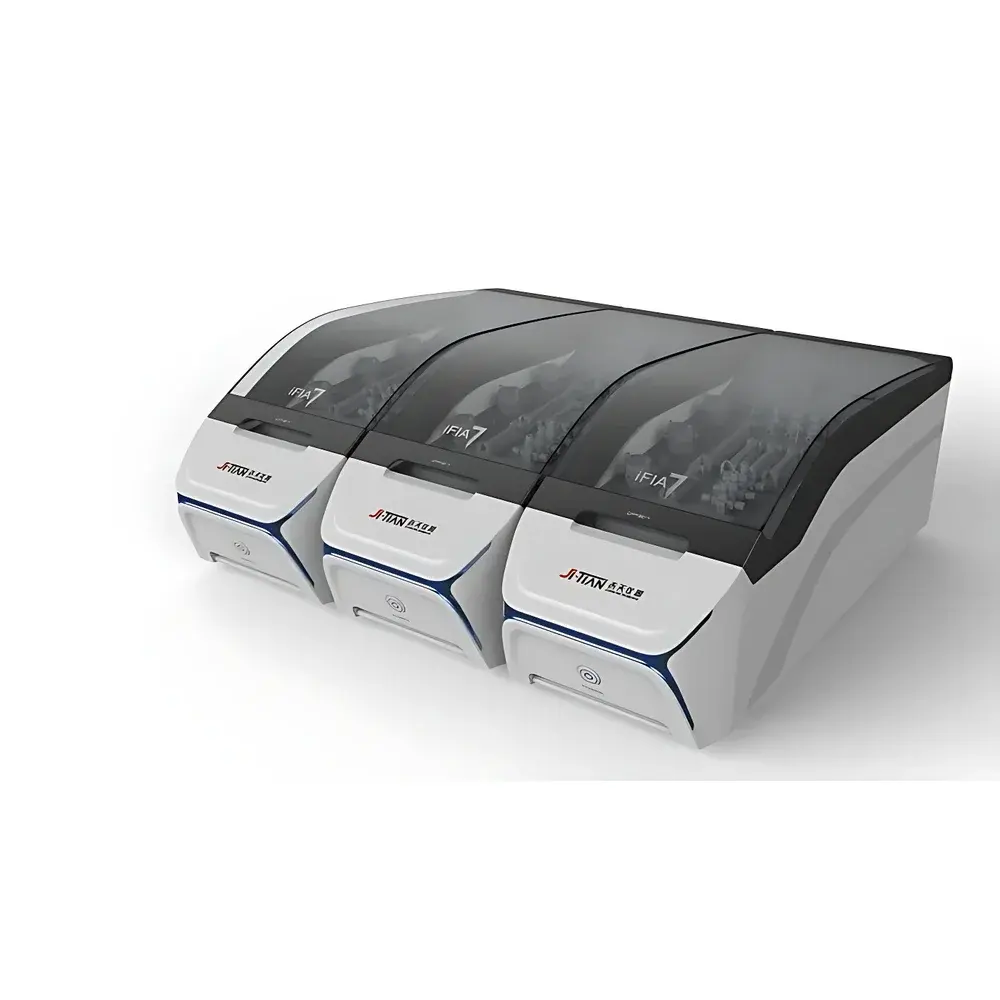
Titan Instruments iFIA7 Fully Automated Multi-Parameter Flow Injection Analyzer
| Brand | Titan Instruments |
|---|---|
| Origin | Beijing, China |
| Model | iFIA7 |
| Product Type | Flow Injection Analyzer |
| Wavelength Range | 340–1100 nm |
| Sample Capacity | 85–301 positions |
| Reagent Positions | 12 |
| Flow Cell Path Length | 10–30 mm |
| Light Source | Tungsten-Halogen Lamp |
Overview
The Titan Instruments iFIA7 Fully Automated Multi-Parameter Flow Injection Analyzer is an engineered solution for high-throughput, standardized chemical analysis in environmental, agricultural, food, and industrial laboratories. Based on the well-established flow injection analysis (FIA) principle—characterized by precise zone segmentation, controlled dispersion, and reproducible reaction kinetics—the iFIA7 delivers robust, trace-level quantification of key analytes without manual intervention. Its core architecture integrates segmented flow generation, programmable reagent delivery, thermally stabilized reaction coils, and dual-beam photometric detection across the visible-to-near-IR spectrum (340–1100 nm). Designed to meet the operational rigor of routine QC/QA labs and regulatory testing facilities, the system supports method-compliant determinations per ISO, ASTM, and Chinese national standards—including GB 8538-2016, HJ 666–671, HJ 823–827—and is validated for use in drinking water, wastewater, seawater, soil extracts, plant tissues, food matrices, and fertilizers.
Key Features
- Adjustable-pressure peristaltic pumping system with continuous speed control (0–100 rpm), utilizing advanced elastomeric tubing compatible with variable wall thicknesses—eliminating differential fatigue issues common in fixed-compression pump heads.
- Adaptive optical module featuring automated wavelength selection, real-time gain compensation, and dynamic path-length optimization (10–30 mm flow cells), ensuring consistent photometric sensitivity across multi-analyte methods.
- Modular detector interface supporting UV-Vis spectrophotometry, electrochemical detection, and future expansion to fluorescence or conductivity modules—enabling method flexibility without hardware replacement.
- Intelligent fluidic routing with auto-switching between up to 17 pre-configured analytical protocols (e.g., NH₃-N, NO₃⁻, NO₂⁻, PO₄³⁻, SiO₃²⁻, B, Cr(VI), total hardness, alkalinity, Fe²⁺/Fe³⁺, Ca²⁺, Al³⁺, offline sulfide, offline Kjeldahl N/P), including integrated post-method cleaning cycles to prevent cross-contamination.
- MAC (Multi-Application Control) software architecture enabling simultaneous execution of 3–17 independent assays within a single run sequence—optimized for batched sample processing and resource-efficient reagent utilization.
- Thermally stabilized reaction manifold with precision temperature control (±0.2 °C), critical for kinetic-based colorimetric reactions such as salicylate, diazotization, and molybdate blue methodologies.
Sample Compatibility & Compliance
The iFIA7 accommodates liquid samples across diverse matrices: aqueous environmental samples (freshwater, seawater, leachates), acid-digested soil extracts, enzymatic or microwave-assisted plant digests, food homogenates, and fertilizer solutions. It complies with method requirements specified in HJ 666–671, HJ 823–827, and GB 8538-2016 for cyanide, phenols, anionic surfactants, sulfide, total phosphorus, total nitrogen, hexavalent chromium, and boron. Instrument design adheres to GLP-aligned operational principles, including audit-trail-enabled method versioning, user-access controls, and electronic signature support compatible with FDA 21 CFR Part 11 readiness when deployed with compliant LIMS integration. All optical and fluidic components are constructed from chemically inert, low-adsorption materials (e.g., PTFE, quartz, borosilicate glass) to ensure long-term calibration stability and minimal carryover (<0.05%).
Software & Data Management
The iFIA7 operates under Titan’s proprietary MAC v4.x software platform—a Windows-based application built for analytical traceability and workflow transparency. The interface provides real-time visualization of pump status, valve positions, detector output, temperature profiles, and fluidic pressure metrics. Method files embed full procedural metadata: reaction time, mixing coil length, heating duration, wavelength, gain setting, and calibration curve parameters. Software includes built-in compliance templates aligned with Chinese EPA and MEE standard methods, plus customizable report generation (PDF/CSV/XLSX) with embedded chromatogram-like FIA peak plots, integration windows, and statistical summaries (mean, SD, RSD, LOD/LOQ). Data storage follows hierarchical folder structures with automatic timestamping and user-labeled batch IDs; raw signal files (.dat) and processed results (.res) are separately archived for retrospective reprocessing.
Applications
- Water & Wastewater Analysis: Routine monitoring of NH₃-N, NO₃⁻, NO₂⁻, PO₄³⁻, Cr(VI), CN⁻, phenols, anionic surfactants, and sulfide in municipal, industrial, and marine environments per HJ-series and ISO 15681 standards.
- Soil & Plant Nutrition: Quantification of nitrate, phosphate, silicate, sulfate, and boron in Mehlich-3, Olsen, or ammonium acetate extracts—supporting agronomic decision-making and nutrient balance modeling.
- Food & Feed Safety: Determination of formaldehyde, free cyanide, reducing sugars, calcium, and urea in cereals, dairy products, and animal feed—aligned with GB 5009 series and AOAC guidelines.
- Fertilizer Quality Control: Simultaneous measurement of total N (Kjeldahl), nitrate-N, ammoniacal-N, phosphate, and potassium in complex blended formulations—ensuring label claim accuracy and regulatory conformity.
FAQ
What regulatory standards does the iFIA7 support out-of-the-box?
The system ships with validated method configurations for 12+ Chinese national standards (HJ and GB series), including HJ 666–671 and HJ 823–827, and can be adapted to ISO 15681-1/2 and ASTM D5176 for international compliance.
Can the iFIA7 perform offline analyses such as Kjeldahl nitrogen or sulfide?
Yes—integrated offline modules enable automated distillation, digestion, and post-reaction derivatization workflows with synchronized autosampler coordination and timed reagent addition.
Is remote monitoring or multi-instrument network operation supported?
The MAC software supports centralized control of up to 254 iFIA7 units via TCP/IP; individual instruments report status, alarms, and diagnostic logs to a central server for enterprise-scale deployment.
What maintenance intervals are recommended for optical and fluidic components?
Lamp lifetime is rated at ≥2,000 hours; flow cells require quarterly cleaning with 10% nitric acid; peristaltic pump tubing should be replaced every 3–6 months depending on usage intensity and reagent corrosivity.
Does the system provide audit trail functionality for GLP/GMP environments?
Yes—software logs all user actions, method edits, calibration events, and result exports with timestamps and operator IDs; optional LIMS integration enables full 21 CFR Part 11 compliance with digital signatures and secure archive retention.
Related Products





