
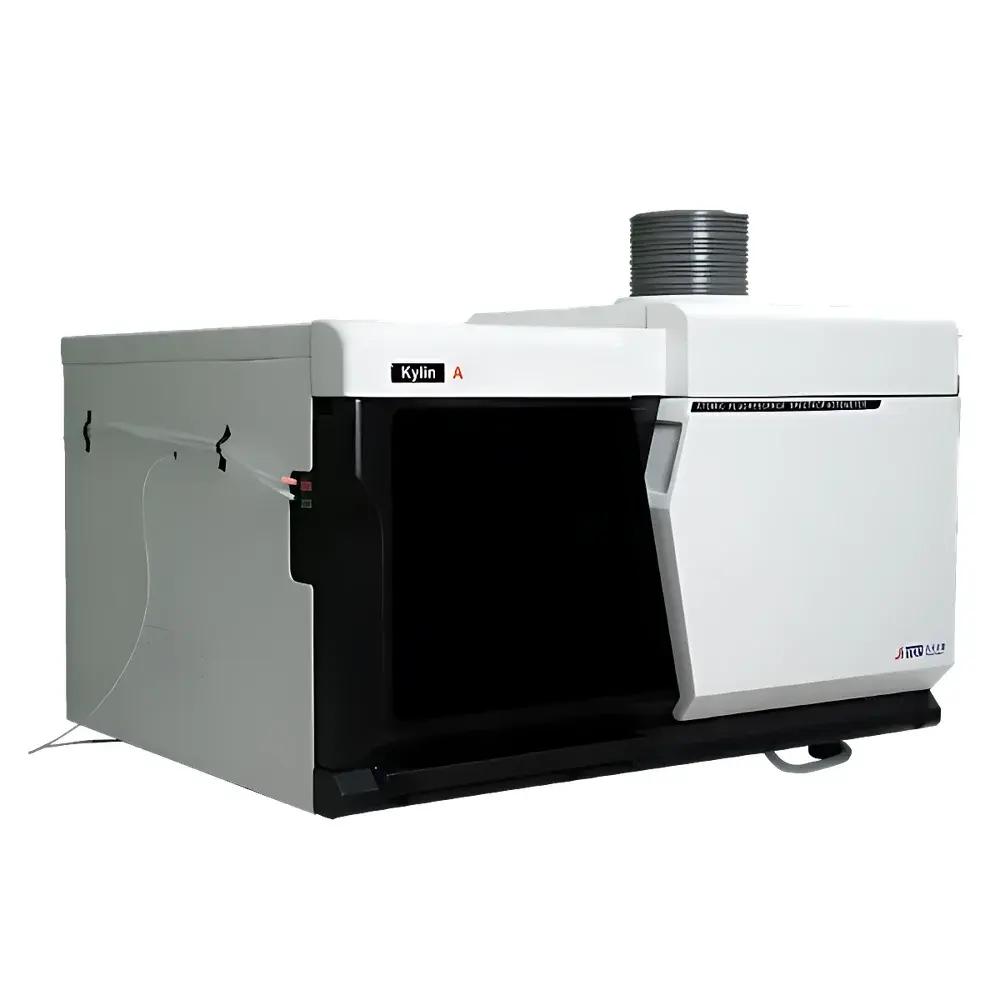
Titan Instruments Kylin A12 Dual-Channel Atomic Fluorescence Spectrometer
| Brand | Titan Instruments |
|---|---|
| Origin | Beijing, China |
| Manufacturer Type | OEM Manufacturer |
| Instrument Type | Multi-channel Atomic Fluorescence Spectrometer |
| Sample Introduction | Dual Sequential Injection Pumps |
| Waste Disposal | Rear Exhaust Design |
| Hydride Generation Mode | Vapor Generation / Hydride Generation |
| Gas Flow Control | Mass Flow Controller (MFC) |
| Detectable Elements | As, Sb, Bi, Sn, Se, Te, Pb, Ge, Hg, Cd, Zn |
| RSD | <0.6% |
| Linear Dynamic Range | >3 orders of magnitude |
| Detection Limits (As, Sb, Se, Bi, Te, Hg, Sn, Pb) | <0.01 µg/L |
| PMT Wavelength Range | 160–320 nm |
| Atomizer Temperature Control Range | 100–350 °C |
Overview
The Titan Instruments Kylin A12 Dual-Channel Atomic Fluorescence Spectrometer is a high-performance, hydride-generation-based analytical instrument engineered for trace-level quantification of hydride-forming and cold-vapor elements in complex environmental, food, clinical, and industrial matrices. It operates on the principle of atomic fluorescence spectroscopy (AFS), where analyte atoms—generated in situ via chemical reduction (e.g., NaBH4 in acidic medium)—are excited by a high-intensity, element-specific hollow cathode lamp (HCL) or electrodeless discharge lamp (EDL). The resulting fluorescence emission at characteristic wavelengths is collected orthogonally to minimize background scatter and detected with a low-noise photomultiplier tube (PMT) operating across 160–320 nm. The dual-channel architecture enables simultaneous, independent measurement of two elements—such as As and Se or Hg and Sb—without spectral interference or cross-talk, significantly improving throughput in regulated multi-element workflows.
Key Features
- Dual-channel, fully independent optical paths with orthogonal double-beam geometry—reducing stray light and enhancing signal-to-noise ratio.
- Automated dual sequential injection system with precise volumetric delivery, supporting reproducible hydride generation kinetics and minimizing reagent carryover.
- Integrated mass flow controller (MFC)-based gas regulation with real-time pressure and flow monitoring, ensuring stable carrier gas (Ar) delivery critical for atomization efficiency and baseline stability.
- Intelligent temperature-controlled quartz-trap atomizer (100–350 °C), dynamically optimized per element to maximize atomization yield while suppressing interferences from matrix volatiles.
- Direct-insertion, auto-aligned hollow cathode lamps with built-in current regulation and operational hour logging—eliminating manual alignment and enabling traceable lamp lifetime management.
- Carbon-fiber-reinforced PTFE sampling probes—resistant to mechanical fracture and chemical corrosion compared to conventional fused-silica capillaries.
- Comprehensive self-diagnostic suite covering optical alignment, vapor generation efficiency, atomizer integrity, gas flow consistency, liquid level status, and lamp performance—reporting fault codes with actionable resolution guidance.
- Graphical, real-time instrument status dashboard with color-coded subsystem indicators and parameter trend visualization for rapid operational assessment.
Sample Compatibility & Compliance
The Kylin A12 is validated for use with acid-digested, microwave-assisted, or leached samples across solid, liquid, and semi-solid matrices—including soils, sediments, biological tissues, foodstuffs, pharmaceutical excipients, petrochemicals, and clinical specimens (whole blood, urine, hair, nails). Its detection performance meets or exceeds requirements specified in major international and national standards, including ASTM D6729 (petroleum mercury), ISO 17294-2 (water metals), and US EPA Method 1631E (mercury in water). In regulated environments, the system supports full audit trail compliance per FDA 21 CFR Part 11 when deployed with Titan’s certified software package—enabling electronic signatures, role-based access control, method versioning, and immutable raw data archiving aligned with GLP/GMP practices.
Software & Data Management
Titan’s proprietary AFS Control Suite provides a bilingual (English/Chinese), Windows-based interface with integrated method development, sequence scheduling, calibration curve fitting (linear, quadratic, weighted), QC flagging (e.g., bracketing standard deviation, recovery thresholds), and customizable reporting templates compliant with ISO/IEC 17025 documentation requirements. All user actions—including method edits, calibration events, and result approvals—are time-stamped and logged with operator ID. Data files are stored in encrypted binary format with SHA-256 checksum validation; export options include CSV, PDF, and XML for LIMS integration. Remote diagnostics and firmware updates are supported via secure TLS-encrypted connection without compromising local network integrity.
Applications
- Environmental Monitoring: Quantification of As, Hg, Sb, Se, and Pb in drinking water (EPA 1631, HJ 694), airborne particulates (HJ 1133), soils and sediments (HJ 680, GB/T 22105).
- Food & Agriculture Safety: Screening of inorganic arsenic in rice (GB 5009.11), total mercury in seafood and dairy (GB 5009.17), and antimony migration from packaging materials.
- Clinical Toxicology: Measurement of selenium status in serum, mercury burden in urine, and arsenic exposure biomarkers in hair and nails per CLIA-recognized protocols.
- Pharmaceutical Quality Control: Residual catalyst analysis (Pd, Pt) and elemental impurity testing (ICH Q3D Class 1 & 2 elements) in APIs and excipients.
- Geochemical & Metallurgical Analysis: Determination of trace Ge, Te, and Au in ores and alloys following ISO 11047 and ASTM E1019 workflows.
FAQ
Does the Kylin A12 support automated method switching between hydride-forming and cold-vapor elements?
Yes—predefined methods for As/Sb/Bi/Se/Te/Sn/Pb and Hg/Cd/Zn are stored in the instrument library and can be invoked with one-click selection; no hardware reconfiguration is required.
Is the system compatible with third-party autosamplers?
The Kylin A12 communicates via RS-232 and Ethernet protocols and supports OEM integration with standard 160- or 212-position polar-coordinate autosamplers using Titan’s open command set.
How is drift correction handled during long-duration analyses?
All channels implement real-time reference-beam drift compensation using a dedicated internal monitor signal, independent of sample introduction—ensuring sub-0.3% baseline stability over 8-hour runs.
What maintenance intervals are recommended for routine operation?
Daily: rinse cycle verification and waste level check. Weekly: pump tubing inspection and gas line leak test. Quarterly: PMT gain calibration and atomizer quartz tube visual inspection. Annual: full optical alignment validation and MFC recalibration traceable to NIST standards.



