
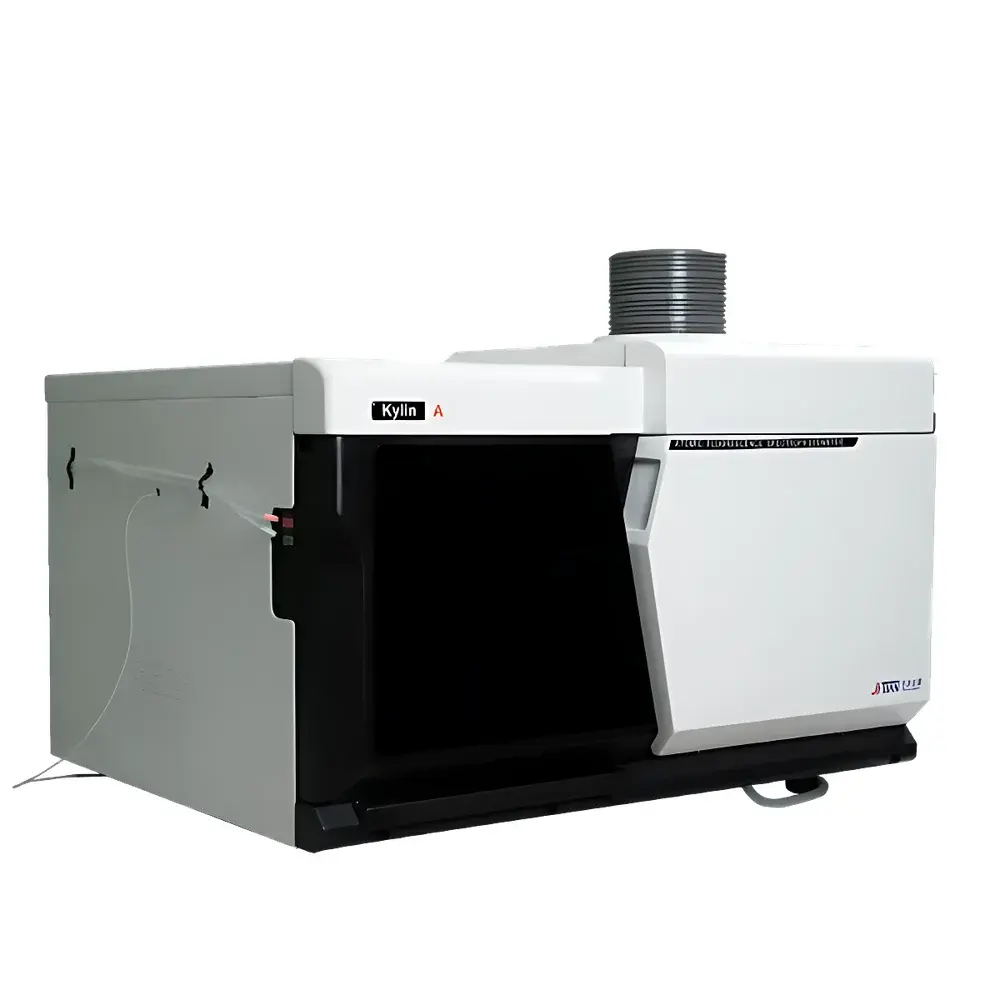
Titan Instruments Kylin A13 Triple-Channel Atomic Fluorescence Spectrometer
| Brand | Titan Instruments |
|---|---|
| Origin | Beijing, China |
| Manufacturer | Yes |
| Instrument Type | Multi-channel Atomic Fluorescence Spectrometer |
| Sample Introduction | Dual Sequential Injection Pumps |
| Waste Disposal | Rear Exhaust Design |
| Hydride Generation Mode | Vapor Generation / Hydride Generation |
| Gas Flow Control | Mass Flow Controller (MFC) |
| Detectable Elements | As, Sb, Bi, Sn, Se, Te, Pb, Ge, Hg, Cd, Zn |
| RSD | <0.6% |
| Linear Dynamic Range | >3 orders of magnitude |
| Detection Limits | As, Sb, Se, Bi, Te, Hg, Sn, Pb < 0.01 µg/L |
| PMT Wavelength Range | 160–320 nm |
| Atomizer Temperature Control Range | 100–350 °C |
Overview
The Titan Instruments Kylin A13 Triple-Channel Atomic Fluorescence Spectrometer is an engineered solution for trace-level quantification of hydride-forming and cold-vapor elements in environmental, food, clinical, pharmaceutical, geological, and industrial matrices. It operates on the principle of atomic fluorescence spectroscopy (AFS), where analyte atoms—generated in situ via chemical vapor generation (CVG) or hydride generation (HG)—are excited by a high-intensity, element-specific hollow cathode lamp (HCL). The resulting fluorescence emission at characteristic wavelengths is detected by a low-noise photomultiplier tube (PMT) operating in the vacuum ultraviolet to near-UV range (160–320 nm). Unlike single-channel systems, the Kylin A13 integrates three fully independent optical detection channels with synchronized timing control, enabling simultaneous, real-time measurement of up to three elements without spectral interference or sequential dwell-time penalties. This architecture significantly improves throughput while maintaining analytical integrity across complex multi-element workflows.
Key Features
- Triple-channel parallel detection system with full optical isolation, ensuring channel-to-channel consistency and eliminating cross-talk during simultaneous As–Se–Hg or Sb–Bi–Pb analysis.
- Orthogonal dual-beam optical design with precisely aligned excitation and detection axes, minimizing stray light and enhancing signal-to-noise ratio (SNR) for sub-ppt detection capability.
- Intelligent plug-and-play hollow cathode lamps with auto-identification and real-time current monitoring; mercury lamps feature automatic pre-ignition activation for stable cold-vapor generation.
- Temperature-controlled quartz-trap atomizer with programmable ramping (100–350 °C), optimized per element to maximize atomization efficiency and minimize interferences from matrix volatilization.
- Dual sequential injection pumps with pressure-stabilized pneumatic actuation, enabling precise, reproducible reagent delivery and rapid (<8 s) cycle times for both sample and blank.
- EFC-based gas flow regulation with continuous pressure and mass flow monitoring, integrated alarm logic for under/over-pressure events, and fail-safe shut-off protocols.
- Carbon-fiber-reinforced PTFE sampling probes replacing fragile quartz needles—improving mechanical durability and reducing carryover in high-salinity or particulate-laden samples.
- Comprehensive self-diagnostic suite covering optical alignment, HG reaction kinetics, atomizer thermal stability, gas integrity, liquid level status, and lamp operational health—reporting faults with actionable remediation guidance.
Sample Compatibility & Compliance
The Kylin A13 is validated for use with acid-digested aqueous extracts, microwave-assisted digests (per HJ 680-2013, HJ 702-2014), and direct hydride-generating solutions across regulatory matrices. It meets performance criteria outlined in multiple international and national standards, including ISO 17025–accredited laboratories’ requirements for method validation. Its analytical output supports compliance with U.S. EPA Method 1631E (mercury), ASTM D6720–22 (trace metals in fuels), and EU Commission Regulation (EU) No 2023/2006 for heavy metals in food contact materials. For GLP/GMP environments, the instrument’s software architecture conforms to FDA 21 CFR Part 11 requirements—including electronic signatures, audit trail retention (>18 months), role-based access control, and immutable method versioning.
Software & Data Management
The Kylin A13 is operated via Titan’s proprietary AFSControl Suite—a dual-language (English/Chinese), 64-bit Windows application built on a modular, event-driven framework. Core capabilities include automated calibration curve generation (linear, quadratic, or weighted least-squares), dynamic background correction, kinetic peak integration, and real-time drift compensation using reference-channel normalization. All user actions—including method edits, data exports, and instrument parameter changes—are timestamped, attributed, and logged in an encrypted, tamper-evident audit trail. Reporting templates comply with ISO/IEC 17025 Annex A.2 and support customizable PDF/CSV/XLSX export with embedded metadata (sample ID, digest protocol, QC flags, analyst ID, instrument serial number).
Applications
- Environmental Monitoring: Quantification of As, Hg, Sb, Se, and Bi in drinking water (per EPA 1631/6020B), wastewater effluents, soil leachates (HJ 680-2013), airborne particulates (HJ 1133-2020), and sediment cores.
- Food & Agriculture Safety: Multi-element screening of rice, infant formula, seafood, and wine for inorganic arsenic (GB 5009.11-2014), total mercury (GB 5009.17-2014), and cadmium contamination.
- Clinical Toxicology: Specimen analysis of whole blood, urine, hair, and nail clippings for Se deficiency assessment or chronic Hg/Pb exposure biomonitoring (CLIA-aligned workflows).
- Geological & Metallurgical QA/QC: High-precision determination of Ge, Te, Au, and Sn in ore concentrates, refinery slags, and alloy intermediates where traditional ICP-MS suffers from polyatomic interferences.
- Pharmaceutical Excipient Testing: Verification of elemental impurities per ICH Q3D guidelines, particularly for catalyst residues (Pd, Pt) and toxic metals (As, Cd, Pb, Hg) in APIs and excipients.
FAQ
What hydride-forming elements can the Kylin A13 quantify simultaneously?
The instrument supports concurrent detection of any three elements from the validated set: As, Sb, Bi, Se, Te, Sn, Pb, Hg, Cd, Zn, Ge, and Au—subject to spectral non-overlap and compatible reaction chemistry.
Does the system support automated method development for new sample matrices?
Yes—AFSControl Suite includes a method optimization wizard that guides users through carrier gas flow tuning, reductant concentration testing, and atomizer temperature profiling, with built-in QC pass/fail logic based on RSD and recovery thresholds.
Is the Kylin A13 compatible with third-party LIMS integration?
It provides ODBC-compliant database connectivity and HL7 v2.5 message support for bidirectional data exchange with major laboratory information management systems, including Thermo Fisher SampleManager and LabVantage.
How is calibration verification performed between sample batches?
The system executes automated bracketing standards and continuing calibration verification (CCV) checks every 10 samples, with configurable acceptance criteria (e.g., ±10% deviation from initial calibration) and auto-flagging of out-of-spec results.
Can the instrument operate unattended overnight?
With the optional 212-position autosampler and integrated fault-handling logic, the Kylin A13 supports fully unattended operation for up to 72 hours, including automatic reagent replenishment alerts and scheduled system flush cycles.
Related Products





