
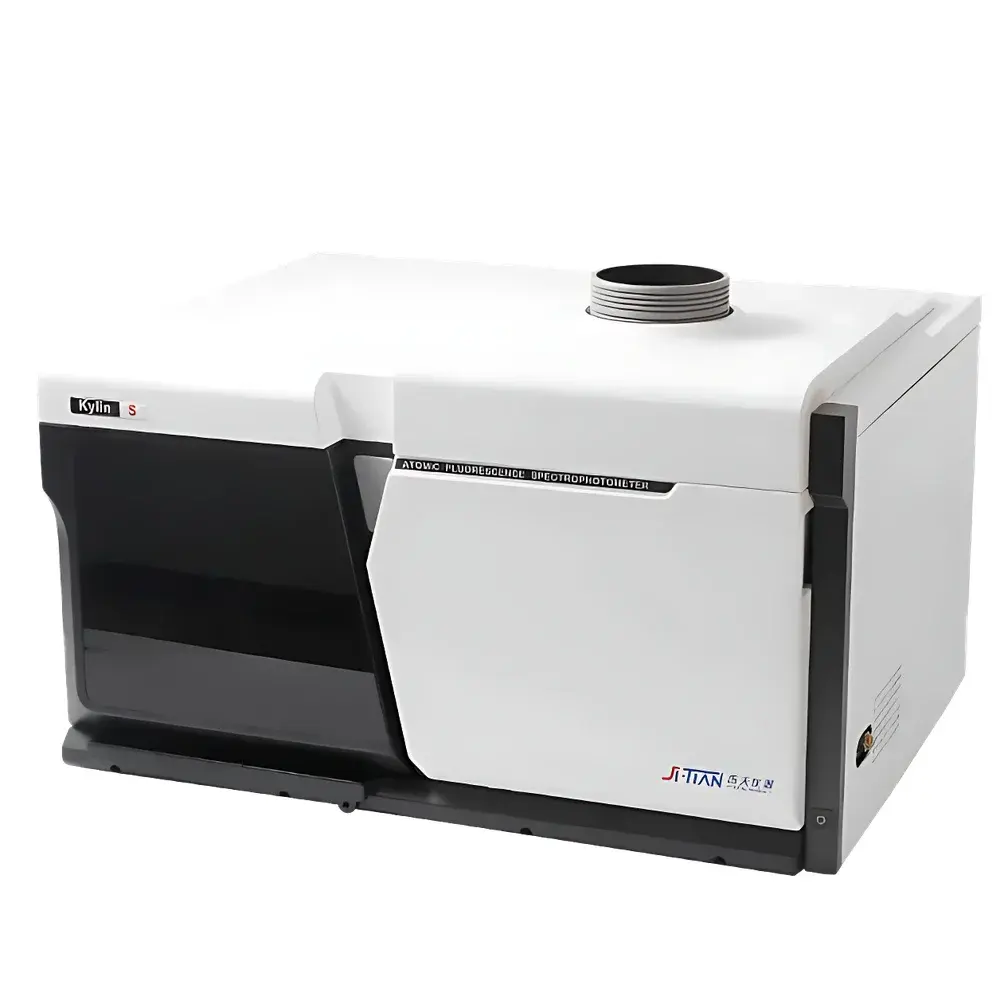
Titan Instruments Kylin S13 Triple-Channel Atomic Fluorescence Spectrometer
| Brand | Titan Instruments |
|---|---|
| Origin | Beijing, China |
| Manufacturer Type | Original Equipment Manufacturer (OEM) |
| Instrument Type | Multi-channel Atomic Fluorescence Spectrometer |
| Sample Introduction | Dual Sequential Injection Pump |
| Waste Disposal | Rear Exhaust Design |
| Hydride Generation Mode | Vapor Generation / Hydride Generation |
| Gas Flow Control | Mass Flow Controller (MFC) |
| Detectable Elements | As, Sb, Bi, Sn, Se, Te, Pb, Ge, Hg, Cd, Zn |
| Relative Standard Deviation (RSD) | <0.6% |
| Linear Dynamic Range | >3 orders of magnitude |
| Detection Limits | As, Sb, Se, Bi, Te, Hg, Sn, Pb < 0.01 µg/L |
| Photomultiplier Tube Wavelength Range | 160–320 nm |
| Atomizer Temperature Control Range | 100–350 °C |
Overview
The Titan Instruments Kylin S13 Triple-Channel Atomic Fluorescence Spectrometer is a high-performance, hydride-generation-based analytical instrument engineered for trace-level quantification of hydride-forming and cold-vapor elements in environmental, food, clinical, geological, and industrial matrices. It operates on the principle of atomic fluorescence spectroscopy (AFS), where analyte atoms—generated in situ via chemical reduction (e.g., NaBH₄ in acidic medium)—are excited by a high-intensity, element-specific hollow cathode lamp (HCL) or electrodeless discharge lamp (EDL). The resulting resonance fluorescence emission at characteristic wavelengths is collected orthogonally to minimize stray light interference and detected with a low-noise photomultiplier tube (PMT) operating within the deep UV to near-UV range (160–320 nm). The Kylin S13 implements a true triple-channel simultaneous detection architecture, enabling concurrent measurement of three elements without spectral overlap or time-sharing compromises—critical for high-throughput compliance testing under regulated workflows.
Key Features
- Triple-channel parallel detection system with full optical symmetry: all channels feature identical optical path lengths, PMT gain settings, and signal processing electronics to ensure inter-channel consistency and enable real-time reference drift correction.
- Dual sequential injection pump with integrated fluidic precision control: delivers sub-microliter volumetric accuracy (<0.2% RSD) and eliminates cross-contamination between samples via programmable wash cycles and air segmentation.
- Orthogonal dual-beam optical design: excitation beam and fluorescence collection axis are spatially separated at 90°, significantly reducing background scatter and enhancing signal-to-noise ratio (SNR), particularly for low-concentration Hg and Se analysis.
- Multi-lamp turret with intelligent lamp recognition: supports up to eight pre-aligned, plug-and-play hollow cathode lamps; automatic lamp identification and current optimization reduce setup time and eliminate manual alignment.
- Temperature-regulated quartz-trap atomizer with closed-loop PID control: dynamically adjusts atomization temperature (100–350 °C) per element to maximize atomization efficiency while minimizing interferences from matrix volatilization.
- EFC-controlled gas delivery system: mass flow controllers monitor and regulate Ar carrier gas pressure and flow rate in real time, with configurable alarm thresholds for pressure drop or flow deviation—ensuring stable plasma-free atomization conditions.
- Carbon-fiber-reinforced PTFE sampling probes: replace fragile quartz capillaries, improving mechanical durability and resistance to acid corrosion during long-term hydride generation runs.
- Comprehensive self-diagnostic suite: autonomously verifies operational status of optical module, hydride generator, atomizer heater, gas manifold, liquid level sensors, lamp power supply, and autosampler—logging fault codes and actionable diagnostics in the system event log.
Sample Compatibility & Compliance
The Kylin S13 is validated for use across solid, liquid, and semi-solid sample types following standardized digestion and pre-reduction protocols. It meets method requirements for major regulatory frameworks including: US EPA Method 1631E (Hg in water), ISO 17892-11 (geotechnical testing – As in soils), ASTM D7624-21 (Se in petroleum products), and Chinese national standards GB 5009.11-2014 (total and inorganic As in food), GB 5009.17-2014 (Hg speciation in food), HJ 694-2014 (As, Hg, Se, Sb, Bi in water), and HJ 1133-2020 (As, Se, Sb, Bi in ambient particulate matter). Its hardware architecture and firmware support GLP/GMP-compliant operation, including electronic signature-capable audit trails, user role-based access control (administrator/operator/analyst), and secure method versioning—all aligned with FDA 21 CFR Part 11 data integrity expectations.
Software & Data Management
The Kylin S13 is operated via Titan’s proprietary AFS-Studio software—a dual-language (English/Chinese), 64-bit Windows application built on a modular, database-driven architecture. It features fully compliant audit trail logging with immutable timestamps, user action tracking (e.g., method modification, calibration update, result override), and tamper-proof data archiving. Calibration curves support linear, quadratic, and weighted least-squares fitting with dynamic outlier rejection. Reporting templates are customizable per laboratory SOP, supporting multi-analyte summary tables, QC charts (Levey-Jennings, moving range), and export to PDF, CSV, or LIMS-compatible XML formats. All raw spectra, transient signals, and diagnostic logs are retained with metadata linking to sample ID, analyst, instrument configuration, and environmental conditions.
Applications
- Environmental Monitoring: Quantification of As, Hg, Sb, Se, and Bi in drinking water, wastewater effluents, soil extracts, sediment pore water, and airborne particulates (PM₂.₅/PM₁₀ filters).
- Food & Agricultural Safety: Screening of total and inorganic arsenic in rice, infant formula, seafood, wine, and animal feed; mercury in fish tissue and dairy powders; selenium in fortified cereals and supplements.
- Geochemical & Metallurgical Analysis: Determination of Ge, Te, Au, and Sb in rock digests, ore concentrates, and alloy leachates—especially where ICP-MS polyatomic interferences limit sensitivity.
- Clinical Toxicology: Measurement of As, Hg, Pb, and Se in whole blood, urine, hair, and nail clippings for occupational exposure assessment and chelation therapy monitoring.
- Pharmaceutical Quality Control: Residual catalyst metal screening (e.g., Pd, Pt) in active pharmaceutical ingredients (APIs); heavy metal impurity testing per ICH Q3D guidelines.
- Petrochemical Testing: Trace Hg, Sn, and Pb analysis in crude oil, gasoline, lubricants, and refinery catalysts—supporting ASTM D5191 and D7011 compliance.
FAQ
What hydride-forming elements can the Kylin S13 quantify simultaneously?
The instrument supports concurrent detection of any three elements from the following group: As, Sb, Bi, Se, Te, Sn, Pb, Ge, Cd, Zn, and Hg.
Does the system comply with FDA 21 CFR Part 11 requirements?
Yes—the AFS-Studio software includes electronic signatures, audit trail encryption, role-based permissions, and data integrity safeguards required for regulated environments.
Can the Kylin S13 be integrated into a laboratory information management system (LIMS)?
Yes—it supports bidirectional data exchange via standard ODBC drivers and XML-based result export with customizable field mapping.
Is method validation documentation available for regulatory submissions?
Titan Instruments provides comprehensive IQ/OQ documentation packages, including performance verification reports against certified reference materials (CRMs) such as NIST SRM 1640a (trace elements in water) and GBW(E) 080391 (soil standard).
What maintenance intervals are recommended for routine operation?
Daily: rinse lines and check reagent levels; weekly: clean quartz trap and inspect pump tubing; quarterly: calibrate gas flow controllers and verify lamp intensities using NIST-traceable standards.






