
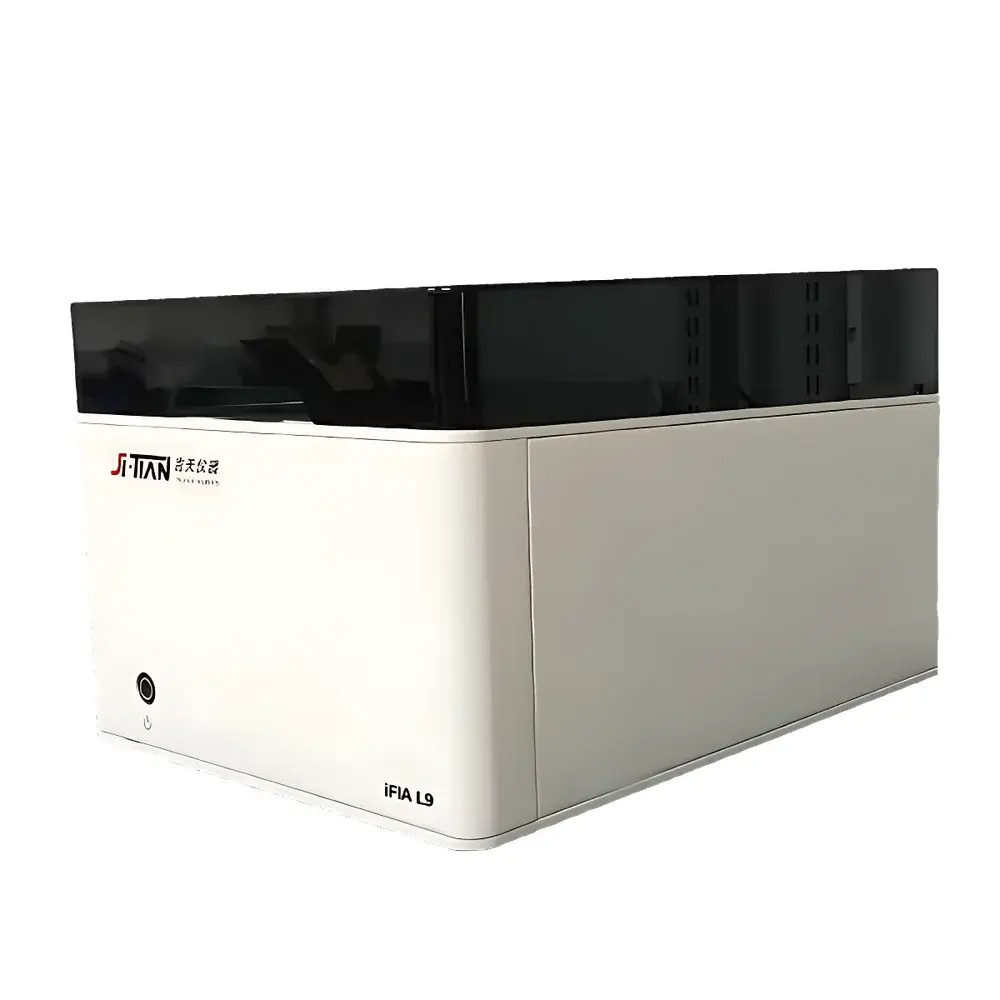
Titan Instruments L9 Fully Automated Cyanide Analyzer for Alcoholic Beverages
| Brand | Titan Instruments |
|---|---|
| Origin | Beijing, China |
| Manufacturer Type | Authorized Distributor |
| Country of Origin | China |
| Model | L9 |
| Pricing | Available Upon Request |
Overview
The Titan Instruments L9 Fully Automated Cyanide Analyzer for Alcoholic Beverages is a dedicated flow-injection analysis (FIA) system engineered for the rapid, precise, and trace-level quantification of free and weak-acid dissociable (WAD) cyanide in complex alcoholic matrices—including wine, spirits, beer, and fortified beverages. It employs a validated colorimetric methodology based on the pyridine-barbituric acid (PBA) reaction, wherein cyanide reacts under controlled acidic conditions to form a stable chromophore with maximum absorbance at 578 nm. The instrument integrates sample introduction, reagent delivery, mixing, reaction incubation, optical detection, and data processing into a single compact platform. Its design adheres to the fundamental principles of segmented flow analysis (SFA) and conforms to the analytical logic of ISO 11260:1994 (Soil quality — Determination of cyanide — Spectrophotometric method) and ASTM D7511–17 (Standard Test Method for Total Cyanide by Segmented Flow Analysis), adapted for low-viscosity, ethanol-containing samples through optimized fluidics and matrix compensation protocols.
Key Features
- Fully automated flow-injection analysis architecture with peristaltic pumping for precise, pulse-free reagent and sample transport
- Integrated dual-beam photometric detection system featuring thermally stabilized tungsten-halogen source and matched silicon photodiode detectors, minimizing baseline drift and enhancing long-term signal reproducibility
- Onboard temperature-controlled reaction coil (37 °C ± 0.5 °C) ensuring consistent kinetics for cyanide–PBA condensation across variable ethanol concentrations (up to 40% v/v)
- Automatic blank correction and real-time baseline normalization to mitigate interferences from endogenous chromophores (e.g., anthocyanins, tannins, caramel pigments)
- Modular fluidic path constructed from chemically resistant PTFE and polyether ether ketone (PEEK), certified for compatibility with acidic reagents (H3PO4/Na2EDTA) and organic solvents
- Embedded microprocessor control with deterministic timing resolution (<100 ms) for reaction segment definition and peak integration
Sample Compatibility & Compliance
The L9 analyzer is validated for direct analysis of clarified, filtered, or centrifuged alcoholic beverages without derivatization or distillation—provided ethanol content remains ≤40% v/v and turbidity <1 NTU. It supports sample dilution protocols compliant with ISO/IEC 17025:2017 requirements for measurement uncertainty estimation. Instrument performance meets the criteria for routine laboratory use under GLP (Good Laboratory Practice) frameworks and supports audit-ready data integrity features including electronic signatures, user access levels, and immutable audit trails aligned with FDA 21 CFR Part 11 expectations. Method validation documentation includes precision (RSD <4.2% at 5 µg/L CN⁻), linearity (r² ≥0.999 over 0.1–100 µg/L), and limit of detection (LOD) of 0.08 µg/L (ppb) in white wine matrix, as verified per ICH Q2(R2).
Software & Data Management
The proprietary TitanSoft L9 Control Suite provides a Windows-based interface with hierarchical user permissions (Administrator, Analyst, Viewer). It features embedded calibration curve generation using up to six non-linear regression models (linear, quadratic, cubic spline), automatic outlier rejection, and QC flagging per USP Analytical Instrument Qualification guidelines. All raw absorbance traces, method parameters, and audit logs are stored in encrypted SQLite databases with configurable auto-backup to network drives. Export formats include CSV, PDF analytical reports, and XML-compliant .cdx files compatible with LIMS integration via ODBC drivers. Software self-diagnostic routines monitor pump tubing wear, lamp intensity decay, and detector dark-current stability—triggering maintenance alerts before performance deviation exceeds ±2% of baseline specification.
Applications
- Regulatory compliance testing for cyanide in EU-regulated alcoholic beverages (Commission Regulation (EU) No 1308/2013 Annex VII, Part II)
- Raw material screening of stone-fruit-derived base spirits (e.g., apricot brandy, cherry kirsch) where amygdalin hydrolysis may release HCN
- Process monitoring during maceration and fermentation stages in red wine production
- Verification of detoxification efficacy in activated carbon or Cu²⁺-mediated cyanide removal treatments
- Reference laboratory participation in proficiency testing schemes (e.g., FAPAS® CYANIDE-IN-WINE PT rounds)
FAQ
Does the L9 require sample distillation prior to analysis?
No. The integrated acidification–gas diffusion module enables direct analysis of total cyanide in filtered alcoholic samples without manual distillation, reducing turnaround time and operator exposure risk.
Can the system quantify cyanide in high-tannin red wines?
Yes. The optical system incorporates real-time spectral compensation algorithms that correct for absorbance contributions from polyphenolic compounds, validated across Cabernet Sauvignon, Syrah, and Pinot Noir matrices.
Is method transfer supported from legacy batch-wise spectrophotometers?
Yes. TitanSoft includes a method migration wizard that maps existing standard operating procedures (SOPs) to L9 workflow steps, including reagent concentration equivalency, reaction timing alignment, and calibration bracketing logic.
What maintenance intervals are recommended for routine operation?
Peristaltic pump tubing replacement every 500 hours; optical window cleaning weekly; full fluidic path flush with 10% nitric acid monthly; annual photometric verification using NIST-traceable neutral density filters.





