
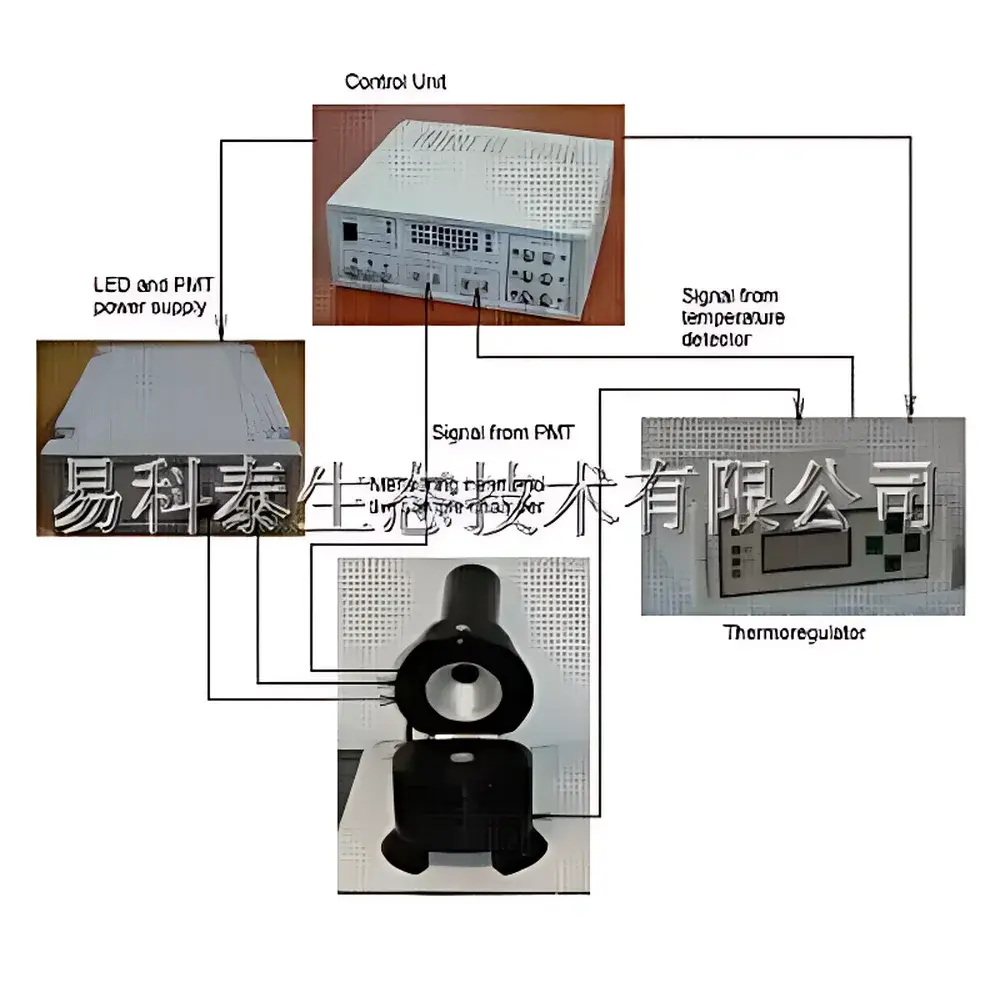
TL200/PMT Thermoluminescence Measurement System
| Origin | Europe |
|---|---|
| Manufacturer Type | Authorized Distributor |
| Origin Category | Imported |
| Model | TL200/PMT |
| Price | Upon Request |
Overview
The TL200/PMT Thermoluminescence Measurement System is a high-precision, research-grade instrument engineered for quantitative thermoluminescence (TL) analysis of photosynthetic electron transport in Photosystem II (PSII). It operates on the physical principle that light-induced charge separation in PSII reaction centers generates metastable electron–hole pairs trapped at specific energy levels within the oxygen-evolving complex (OEC), QA, and QB sites. Upon controlled linear heating, these trapped charges recombine radiatively, emitting photons detectable as thermoluminescent bands between 300 nm and 900 nm. The position (peak temperature), shape, amplitude, and thermal stability of each TL band provide direct, non-invasive insight into the energetic landscape of PSII—enabling rigorous investigation of OEC integrity, QB-site herbicide binding, QA⁻/QB⁻ redox equilibria, and PSII conformational states under physiological or stress conditions.
Designed specifically for plant physiology, algal biophysics, and photosynthesis research, the TL200/PMT delivers reproducible, low-noise TL spectra across a thermally stabilized measurement range of −25 °C to +70 °C. Its architecture integrates cryogenic-capable thermal regulation, ultra-short LED flash excitation (<10 µs), and photon-counting detection via a calibrated photomultiplier tube (PMT), ensuring compliance with fundamental requirements for quantitative TL kinetics in peer-reviewed plant science.
Key Features
- High-intensity, square-wave LED excitation source (λmax = 625 nm) delivering ≥150,000 µmol(photon)·m−2·s−1, programmable pulse width (5–150 µs) for precise single-turnover flash delivery
- Thermoregulated sample chamber with ±0.1 °C temperature accuracy, supporting both isothermal hold and linear ramp modes (0.1–2.0 °C·s−1)
- Dedicated gold-plated ½-inch copper sample holder with integrated Peltier-based cooling and auxiliary heating interfaces
- Low-noise PMT detector with spectral response 300–900 nm, software-adjustable gain, and fixed 50 ms time constant (minimum sampling interval: 100 ms)
- Integrated A/D conversion and dual-channel real-time acquisition (TL signal + temperature)
- USB interface and FluorWin 3.6 control software enabling script-driven experiment sequencing, automated data export (CSV, TXT), and GLP-compliant metadata logging
- Hardware-level overtemperature protection and ambient-light shielding to ensure measurement fidelity
Sample Compatibility & Compliance
The TL200/PMT is validated for use with intact leaf fragments, isolated thylakoid membranes, chloroplast suspensions, and unicellular algae (e.g., Chlamydomonas reinhardtii, Synechocystis sp. PCC 6803). Sample volume requirements are minimal (typically 10–50 µL suspension or ≤5 mg fresh tissue), and rapid cryo-fixation protocols (e.g., liquid N2 quenching) are fully supported. The system adheres to standard experimental frameworks described in ISO 10211 (photosynthetic performance testing), ASTM E1647 (thermoluminescence methodology), and aligns with GLP principles for traceable instrument calibration, audit-ready parameter logging, and user-defined electronic signatures in FluorWin 3.6. While not FDA 21 CFR Part 11 certified out-of-the-box, its software architecture supports post-deployment validation for regulated environments.
Software & Data Management
FluorWin 3.6 provides a modular, script-enabled environment for experiment design, execution, and post-acquisition analysis. Users define multi-step protocols—including dark adaptation, flash sequences (single/multiple turnover), cooling profiles, and thermal ramps—with full timestamping and hardware synchronization. Raw TL and temperature traces are acquired simultaneously and stored with embedded metadata (operator ID, date/time, sample ID, protocol version). Export formats include ASCII-compatible CSV and proprietary binary files compatible with MATLAB, OriginLab, and R-based analysis pipelines. The software includes built-in peak deconvolution tools for B, Q, C, and S band identification, baseline correction algorithms, and comparative overlay functions essential for mutant screening or dose–response studies.
Applications
- Quantitative assessment of PSII acceptor-side inhibition by PSII-targeting herbicides (e.g., DCMU, atrazine) via QB-band suppression and thermal shift analysis
- Functional characterization of OEC stability under abiotic stress (drought, heat, UV-B) using the S2/S3-state-related B-band
- Genetic screening of photosynthetic mutants affecting charge recombination pathways (e.g., psbA, psbD, petC knockouts)
- Early detection of biotic stress responses (pathogen infection, herbivory) through altered TL band ratios prior to visible symptom onset
- Calibration of computational models of PSII energetics by correlating TL peak temperatures with theoretical trap depths (eV)
- Complementary validation of chlorophyll fluorescence parameters (e.g., Fv/Fm, ΦPSII) with direct electron transport thermodynamics
FAQ
What is the minimum sample requirement for reliable TL signal detection?
Typical detection limits are achieved with 10–20 µg chlorophyll equivalent in thylakoid suspensions or 2–5 mg fresh leaf tissue; signal-to-noise ratio improves significantly with optimized dark adaptation (20–30 min) and cryo-quenching.
Can the TL200/PMT be upgraded to support extended temperature ranges?
The base TL200/PMT model operates from −25 °C to +70 °C. Optional modules—AC-88 water-cooling unit (down to 4 °C), CryoFab liquid nitrogen interface (−90 °C to −20 °C), and TFPE auxiliary heater (+70 °C to +190 °C)—enable field-upgradable expansion to match TL300/HT or TL400/LT configurations.
How does the LED flash system prevent multiple turnovers?
The 5–10 µs square-wave pulse ensures temporal saturation of all PSII RCs without trailing emission (“flash tail”), eliminating double-hit artifacts common in xenon-based systems. Pulse intensity and duration are independently tunable in FluorWin to match sample absorption cross-section.
Is the system compatible with third-party data analysis platforms?
Yes—raw time-series data (TL intensity vs. time/temperature) are exported in open ASCII format (CSV/TXT) with header metadata, enabling seamless import into Python (NumPy/Pandas), MATLAB, GraphPad Prism, or custom kinetic modeling environments.
What maintenance is required for long-term PMT stability?
The PMT is factory-calibrated and sealed; routine maintenance consists of periodic verification of dark current (<1 pA at 800 V) and gain linearity using internal reference LEDs. No user-replaceable optical components are required during normal operation.




