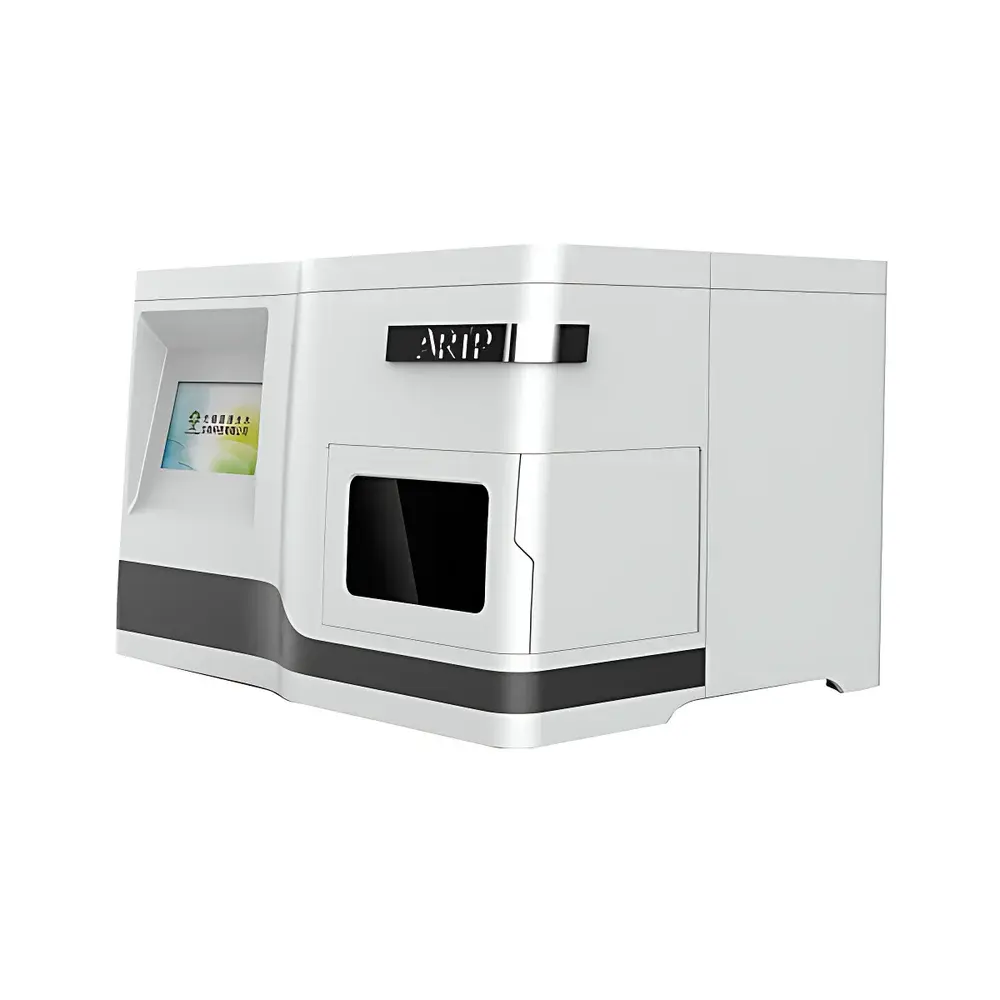
TMAXTREE ARTP-M Atmospheric-Pressure Room-Temperature Plasma Mutagenesis Instrument
| Brand | TMAXTREE |
|---|---|
| Origin | Jiangsu, China |
| Manufacturer Type | Direct Manufacturer |
| Origin Category | Domestic |
| Model | ARTP-M |
| Instrument Type | Atmospheric-Pressure Plasma Mutagenesis System |
| Function | Biological Sample Treatment |
| Discharge Technology | Atmospheric-Pressure Uniform Glow Discharge with Stable, Homogeneous Plasma Jet |
| Working Gas | Helium ≥99.999% purity |
| Mutagenesis Mode | Ambient-Pressure, Room-Temperature Plasma Exposure |
| Gas Flow Control Range | 0–15 SLM (Standard Liters per Minute) |
| Gas Flow Accuracy | ±1.0% F.S. |
| Sample-to-Nozzle Distance | 2 mm |
| Plasma Jet Temperature | ≤37 °C |
| Max. Power Consumption | 300 W |
| Cooling Requirement | External Chilled Circulation System |
| Sample Handling | Single-Sample Processing Mode |
| Applicable Organisms | Prokaryotes (e.g., bacteria, actinomycetes), Eukaryotes (e.g., yeasts, molds, microalgae, higher fungi), Plant Cells (pollen, seeds, embryonic tissues), Animal Embryos & Larvae |
Overview
The TMAXTREE ARTP-M is a purpose-built atmospheric-pressure room-temperature plasma (ARTP) mutagenesis instrument engineered for high-efficiency, non-thermal biological strain improvement. Unlike low-pressure plasma sources requiring vacuum systems and complex infrastructure, the ARTP-M operates under ambient pressure and temperature—leveraging uniform glow discharge in high-purity helium to generate a stable, laminar plasma jet rich in reactive oxygen and nitrogen species (RONS), including atomic oxygen (O), hydroxyl radicals (•OH), excited helium metastables (He*), and ozone (O₃). These chemically active species induce controlled DNA damage—including base modifications, strand breaks, and crosslinks—without significant thermal stress, enabling reproducible mutagenesis across diverse biological targets. The system’s core design principle centers on precision gas dynamics, spatially confined plasma delivery, and strict thermal management (≤37 °C at the sample interface), ensuring viability retention while maximizing mutation frequency. Developed in collaboration with Tsinghua University, the ARTP-M represents the first commercially deployed platform dedicated exclusively to ARTP-based microbial and cellular mutagenesis, supporting both academic research and industrial bioprocess development.
Key Features
- Atmospheric-pressure uniform glow discharge architecture ensures spatially homogeneous plasma flux—critical for consistent mutagenic dose distribution across heterogeneous samples such as spore suspensions or seed coats.
- High-purity helium (≥99.999%) supply enables stable plasma ignition and minimizes unwanted side reactions from impurities (e.g., nitrogen or oxygen contamination), preserving RONS selectivity and experimental reproducibility.
- Precision mass-flow control (0–15 SLM, ±1.0% F.S.) allows fine-tuned modulation of reactive species density and residence time—essential for empirical optimization of mutation spectra across taxonomically distinct organisms.
- Fixed 2 mm nozzle-to-sample distance maintains defined plasma exposure geometry, eliminating operator-dependent variability and enabling inter-laboratory protocol standardization.
- Integrated thermal management—via external chilled circulation—ensures sustained operation without localized heating, preserving membrane integrity and metabolic activity in sensitive eukaryotic cells and embryos.
- Compact benchtop footprint (W × D × H: 450 × 400 × 320 mm) and simplified gas interface reduce facility requirements—no vacuum pumps, RF shielding, or dedicated exhaust ducting are needed.
Sample Compatibility & Compliance
The ARTP-M supports broad-spectrum biological mutagenesis validated across prokaryotic and eukaryotic systems. Documented applications include Streptomyces avermitilis (23% increase in avermectin B1a titer), Chlamydomonas reinhardtii (45% total mutation rate, 25% positive mutants in growth phenotype), and Escherichia coli (99.6% threonine yield enhancement, genetically stable over 50 generations). The instrument accommodates liquid suspensions (bacterial/yeast cultures), solid-phase samples (spores, pollen, seeds), and delicate developmental stages (zebrafish embryos, plant meristems). All protocols align with OECD Guideline 471 (bacterial reverse mutation assay) principles for mutagenicity assessment and support GLP-compliant documentation when paired with traceable gas logs and timestamped exposure records. While not FDA-cleared as a medical device, the system meets CE safety standards (EN 61000-6-3, EN 61000-6-4) for laboratory electromagnetic compatibility and operational safety.
Software & Data Management
The ARTP-M operates via an embedded microcontroller-based interface with real-time display of gas flow rate, discharge voltage, and cumulative exposure time. No proprietary software installation is required; all operational parameters are manually set and logged using front-panel controls. For regulatory traceability, users are advised to integrate the instrument into laboratory information management systems (LIMS) via manual entry or external data loggers. The system supports 21 CFR Part 11 compliance when used with audit-trail-enabled LIMS platforms—ensuring electronic record integrity for GMP-aligned strain development workflows. Exportable CSV logs (gas flow, duration, date/time stamp) facilitate retrospective analysis and protocol replication across multi-site R&D programs.
Applications
- Industrial strain engineering: Rapid generation of high-yield mutants for antibiotics, organic acids, enzymes, and recombinant proteins.
- Functional genomics: Creation of phenotypically diverse libraries for forward genetic screens without prior knowledge of target genes.
- Agricultural biotechnology: Non-GMO mutagenesis of crop seeds and tissue cultures to enhance abiotic stress tolerance, nutrient use efficiency, or secondary metabolite profiles.
- Algal biotechnology: Optimization of lipid accumulation, photosynthetic efficiency, and CO₂ fixation rates in microalgal consortia.
- Comparative mutagenesis studies: Benchmarking ARTP against UV, chemical (EMS), or ion-beam mutagens in mutation spectrum, survival rate, and genomic lesion distribution.
FAQ
What biological safety precautions are required when operating the ARTP-M?
Users must wear nitrile gloves and safety goggles; helium gas cylinders require secure anchoring and leak-checked prior to each session. Although plasma jet temperature remains ≤37 °C, direct skin exposure to the active plasma zone is prohibited due to potential UV emission (200–280 nm range) from helium excimers.
Can the ARTP-M be used for mammalian cell lines?
Published literature reports limited success with adherent mammalian cells due to sensitivity to RONS-induced oxidative stress; suspension-adapted hybridomas or stem cell progenitors may be viable candidates—but require empirical dose calibration and clonogenic survival assays.
Is helium the only compatible working gas?
Helium is mandatory for stable uniform glow discharge at atmospheric pressure. Substitution with argon or nitrogen results in filamentary arcing, thermal spikes (>100 °C), and irreproducible mutagenesis—invalidating comparative studies.
How is mutagenesis dose quantified and standardized?
Dose is defined as the product of gas flow rate (SLM), exposure time (s), and nominal power input (W); absolute RONS concentration is inferred indirectly via survival curves and mutation frequency assays—consistent with ISO 11137-1:2018 guidance for non-thermal biological agent dosimetry.
Does the ARTP-M require routine calibration?
The mass flow controller is factory-calibrated and requires no user recalibration; annual verification against NIST-traceable flow standards is recommended for GLP/GMP environments.