
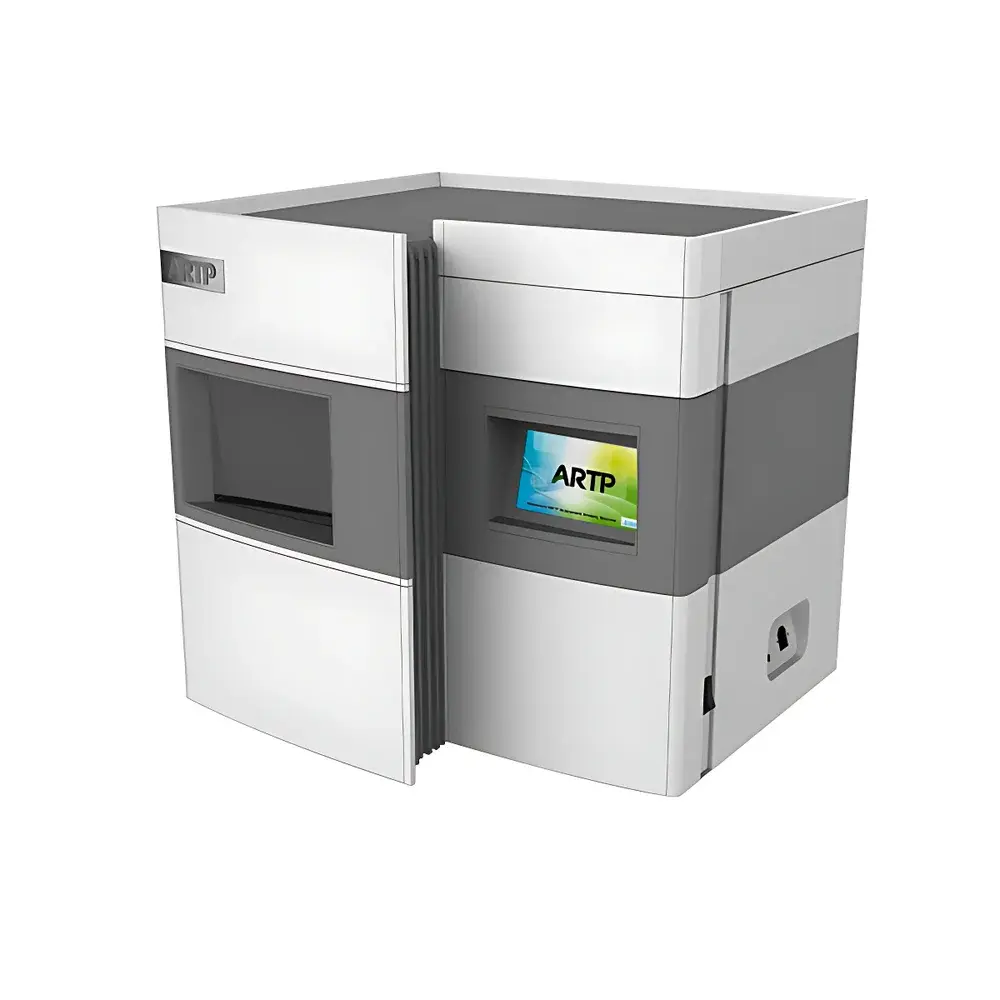
TMAXTREE ARTP Mutagenic Breeding Instrument
| Brand | TMAXTREE |
|---|---|
| Origin | Jiangsu, China |
| Manufacturer Type | Direct Manufacturer |
| Product Category | Domestic |
| Model | ARTP |
| Instrument Type | Atmospheric-Pressure Room-Temperature Plasma Mutagenesis System |
| Function | Microbial and Cellular Sample Treatment |
| Discharge Technology | Atmospheric-pressure uniform glow discharge with stable, homogeneous plasma jet |
| Working Gas | Helium ≥99.999% purity |
| Mutagenesis Mode | Atmospheric-pressure room-temperature plasma mutagenesis |
| Gas Flow Control Range | 0–15 SLM (Standard Liters per Minute) |
| Gas Flow Accuracy | ±1.0% F.S. |
| Sample Treatment Distance | 2 mm |
| Plasma Jet Temperature | ≤37 °C |
| Total Power Consumption | ≤500 W |
| Sample Throughput | 6-position automated sequential treatment and collection |
| Applicable Organisms | Prokaryotes (e.g., bacteria, actinomycetes), eukaryotes (e.g., yeasts, molds, algae, higher fungi), plant cells (pollen, seeds, embryonic tissues), and animal zygotes/embryos |
| Regulatory Compliance | Designed for GLP-compliant strain improvement workflows |
Overview
The TMAXTREE ARTP Mutagenic Breeding Instrument is an engineered platform for non-transgenic, physical mutagenesis based on atmospheric-pressure room-temperature plasma (ARTP) technology. Unlike low-pressure plasma sources requiring vacuum systems, ARTP generates a stable, uniform glow discharge in ambient air using high-purity helium gas—producing a dense flux of reactive oxygen and nitrogen species (RONS), UV photons, and weak electric fields at near-physiological temperatures (≤37 °C). This enables precise, controllable DNA damage without thermal denaturation or secondary contamination, making it ideal for microbial strain improvement, enzyme engineering, and functional genomics studies where genetic integrity and biosafety are critical. The system was co-developed with Tsinghua University and represents the first commercially deployed instrument dedicated to ARTP-mediated mutagenesis, validated across >1,000 peer-reviewed publications and patents as of 2022.
Key Features
- Atmospheric-pressure uniform glow discharge architecture ensures spatially homogeneous plasma jet delivery—eliminating hot spots and enabling reproducible dose-response relationships across biological samples.
- High-purity helium gas supply (≥99.999%) optimized for maximal RONS generation while minimizing oxidative side reactions and sample desiccation.
- Precision mass flow control (0–15 SLM, ±1.0% F.S.) enables fine-tuned exposure dosimetry, essential for establishing mutagenesis calibration curves and inter-laboratory comparability.
- Integrated 6-position sample carousel supports automated sequential treatment and cryo-collection—reducing operator variability and enabling high-throughput mutant library construction (10⁴–10⁶ variants per run).
- Real-time thermal monitoring confirms plasma jet surface temperature remains ≤37 °C during operation, preserving cell viability and avoiding heat-induced stress artifacts.
- Compact benchtop footprint (W × D × H: 480 × 420 × 360 mm) and plug-and-play helium interface simplify integration into BSL-1/BSL-2 labs without infrastructure modification.
Sample Compatibility & Compliance
The ARTP instrument demonstrates broad compatibility across taxonomic domains: prokaryotes (e.g., Escherichia coli, Streptomyces spp.), unicellular and filamentous eukaryotes (e.g., Saccharomyces cerevisiae, Aspergillus niger, Chlorella vulgaris), plant-derived materials (pollen, callus, embryogenic suspension cultures), and early-stage animal embryos (zebrafish, silkworm). All protocols adhere to OECD Guideline 203 (mutagenicity testing) and align with ISO 16140-2:2021 for validation of microbiological methods. The system’s non-GMO approach satisfies regulatory requirements for industrial biocatalyst development under FDA 21 CFR Part 11 (when paired with compliant LIMS), EU REACH Annex VII, and China’s GB/T 27405-2008 standards for laboratory quality assurance.
Software & Data Management
Instrument operation is managed via a dedicated Windows-based control interface supporting parameter logging (gas flow, exposure time, position index), timestamped event tracking, and CSV export for downstream statistical analysis. Audit trails record all user actions—including method changes, calibration events, and session start/stop—with SHA-256 hashing for integrity verification. Raw operational data comply with ALCOA+ principles (Attributable, Legible, Contemporaneous, Original, Accurate, Complete, Consistent, Enduring, Available) and can be integrated into ELN platforms (e.g., LabArchives, Benchling) via RESTful API. No cloud storage or remote telemetry is enabled by default—ensuring full data sovereignty per GDPR and CCPA requirements.
Applications
- Microbial strain enhancement: Documented 31.6% positive mutation rate in Methylobacterium extorquens AM1 for pyrroloquinoline quinone (PQQ) overproduction; 82% activity increase in Streptomyces glutaminase mutants.
- Enzyme engineering: Generation of thermostable and pH-tolerant variants of cellulases, lipases, and phytases without recombinant DNA manipulation.
- Secondary metabolite diversification: Accelerated discovery of novel polyketide and nonribosomal peptide analogs in actinomycete libraries.
- Plant tissue mutagenesis: Efficient induction of heritable phenotypic variation in Arabidopsis thaliana seed populations and rice callus lines.
- Functional genomics screening: Coupling with droplet microfluidics and FACS for phenotype-genotype linkage in pooled mutant screens.
FAQ
Is helium the only permissible working gas?
Yes—helium ≥99.999% purity is required to sustain stable uniform glow discharge at atmospheric pressure. Nitrogen or argon result in arc transition and thermal runaway.
What is the maximum recommended exposure duration per sample?
Typical protocols range from 10 to 120 seconds, calibrated empirically per organism using survival rate and mutation frequency assays (e.g., rifampicin resistance in E. coli).
Can the system be used for mammalian cell lines?
Limited validation exists for adherent lines (e.g., CHO-K1); suspension cultures show lower viability due to shear sensitivity. Primary optimization is recommended prior to routine use.
Does the instrument include biological safety certification?
It carries CE marking for electromagnetic compatibility (EMC Directive 2014/30/EU) and RoHS compliance. Biosafety classification depends on user-defined containment level per local IBC guidelines.
How is dose quantified in ARTP mutagenesis?
Dose is defined as the product of helium flow rate (SLM), exposure time (s), and plasma power density (W/cm²), normalized to viable cell count pre- and post-treatment. Standard operating procedures include parallel colony-forming unit (CFU) titration.




