
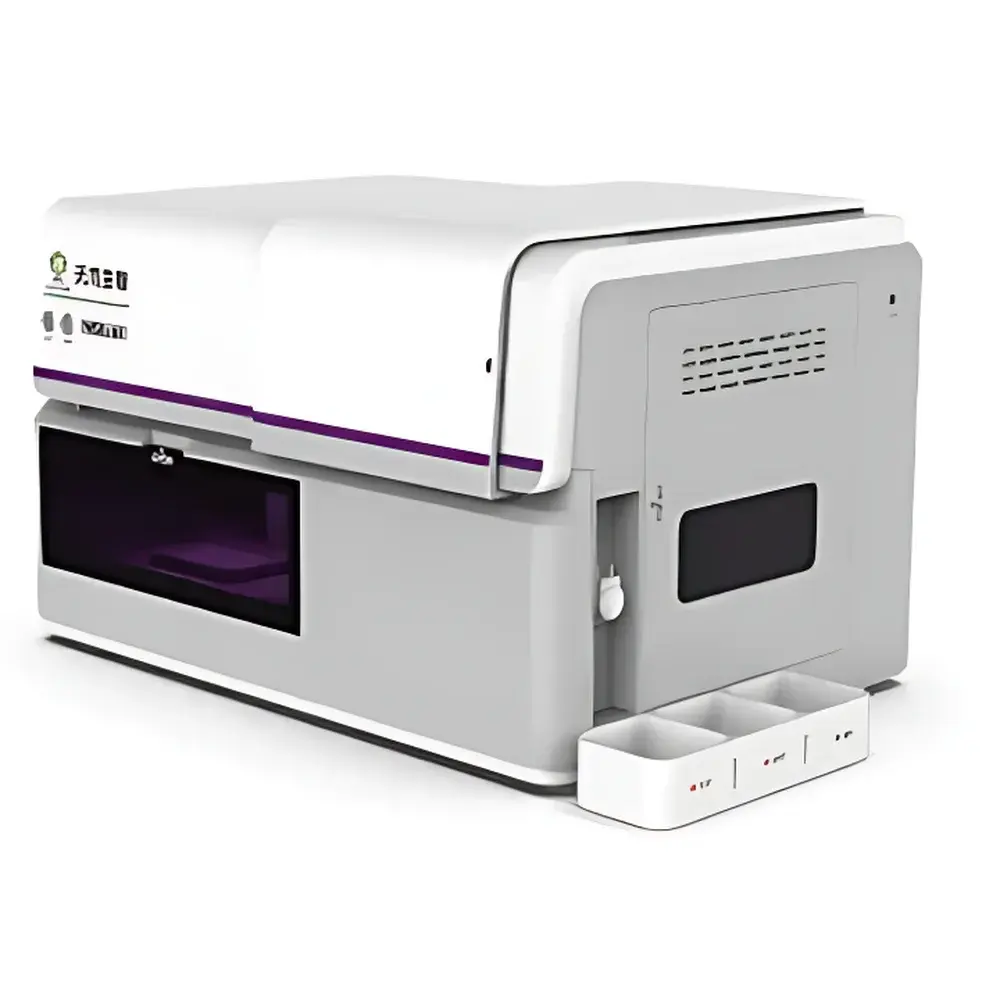
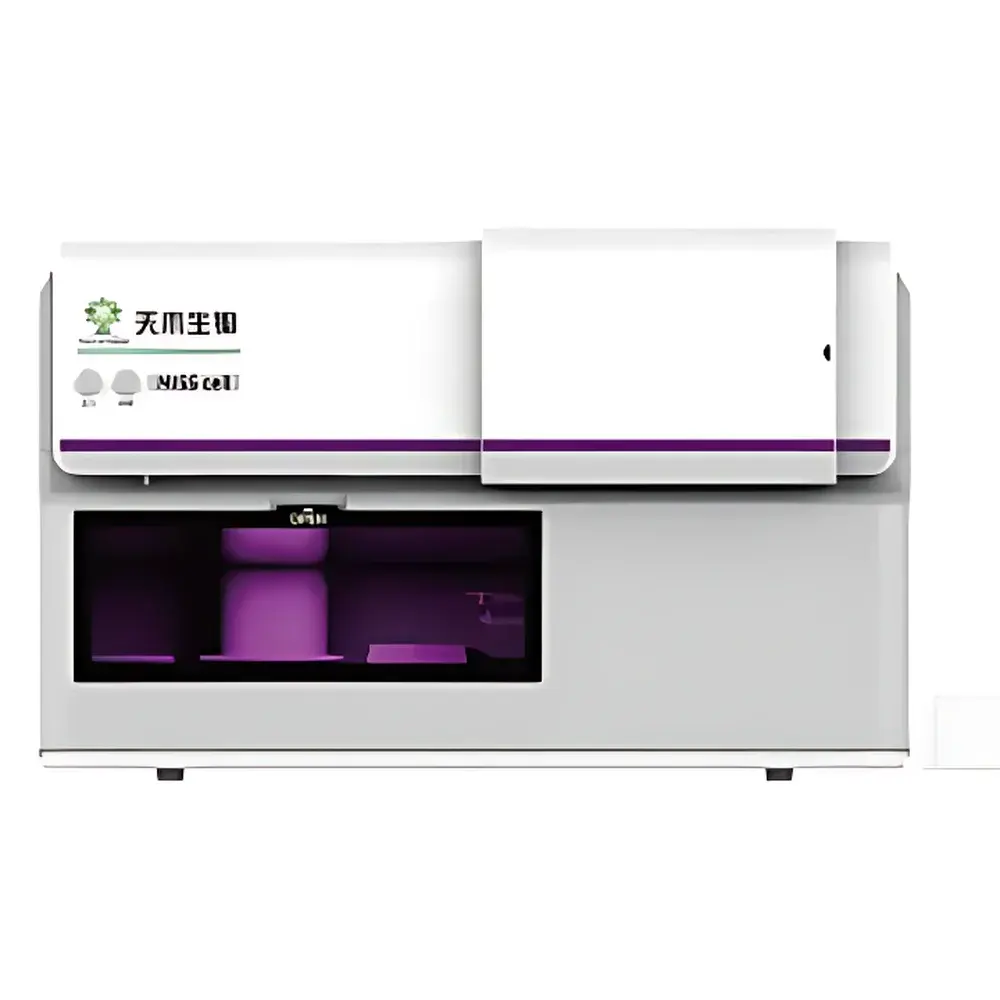
TMAXTREE MISS cell High-Throughput Microliter-Droplet Single-Cell Sorting System
| Brand | TMAXTREE |
|---|---|
| Origin | Jiangsu, China |
| Manufacturer Type | Direct Manufacturer |
| Model | MISS cell |
| Type | Fully Automated |
| Sorting Throughput | 1800–2500 droplets/h |
| Total Sortable Cells per Run | 5,000–10,000 |
| Droplet Processing Capacity | 5,000 droplets/run |
| Incubation Duration | 0–8 days |
| Droplet Volume | 1–4 µL |
| Droplet Generation Rate | 5,000–10,000 droplets/h |
| Detection Modalities | Optical Density (OD), Fluorescence, Chemiluminescence (multi-wavelength excitation & simultaneous detection) |
| Chip Material | Biocompatible polymer |
| Cultivation Vessel | Gas-permeable polymer tubing with optional O₂ partial pressure control |
Overview
The TMAXTREE MISS cell is a fully automated, microliter-scale droplet-based single-cell sorting platform engineered for high-fidelity isolation, cultivation, and functional phenotyping of uncultured or low-abundance microorganisms at the single-cell level. Leveraging deterministic microfluidic encapsulation, the system generates monodisperse aqueous droplets (1–4 µL) in an inert carrier oil phase, each containing a single microbial cell—bacterial, yeast, microalgal, or filamentous spore—within a biocompatible polymer chip. Unlike conventional FACS-based sorters that rely on suspension viability and optical scatter, MISS cell operates on a cultivation-coupled selection principle: droplets serve as individual micro-bioreactors, enabling extended on-chip incubation (0–8 days) under controlled gas-permeable conditions. Integrated multi-modal optical detection—simultaneous OD, fluorescence, and chemiluminescence readouts across configurable excitation/emission bands—enables real-time monitoring of growth kinetics, metabolic activity, and reporter expression. Upon identification of target phenotypes, electrostatic or piezoelectric actuation triggers precise droplet sorting into standard SBS-format multiwell plates, with dual-replicate deposition ensuring biological redundancy and downstream assay robustness.
Key Features
- Fully automated end-to-end workflow—from droplet generation to plate deposition—minimizing manual intervention and operator-induced variability.
- Biocompatible polymer microfluidic chips designed for low non-specific adsorption, high chemical resistance, and reproducible droplet formation across >100 runs.
- Gas-permeable tubing-based incubation module supporting tunable O₂ partial pressure (optional configuration), critical for aerobic, microaerophilic, and facultative anaerobic cultivations.
- Multi-parametric optical detection engine with synchronized acquisition of OD600, up to three fluorescence channels (e.g., GFP/mCherry/CFP), and chemiluminescent signal intensity—calibrated against NIST-traceable standards.
- Dual-replicate sorting architecture depositing each identified positive droplet into two adjacent wells of a 96- or 384-well plate, enabling parallel validation, archiving, and library expansion.
- On-board droplet tracking via integrated high-speed imaging and centroid-based trajectory prediction, ensuring sorting accuracy >99.2% (validated using fluorescent bead standards).
Sample Compatibility & Compliance
The MISS cell accommodates diverse microbial morphologies—including coccoid and rod-shaped bacteria, budding yeasts, unicellular microalgae, and filamentous fungal spores—without requiring enzymatic digestion or mechanical shearing. Its gentle encapsulation preserves cell integrity and native physiology, making it suitable for strain isolation from complex environmental matrices (soil, seawater, activated sludge, rhizosphere). All wetted components comply with USP Class VI biocompatibility requirements; chip fabrication adheres to ISO 13485 cleanroom protocols. The system supports GLP-compliant operation through audit-trail-enabled software logging (user actions, instrument parameters, timestamps), and data export formats conform to MIAME and MIAPE metadata standards. While not FDA-cleared, its architecture aligns with principles outlined in ASTM E2876 (Standard Guide for Microbial Single-Cell Isolation) and ISO 17994 (Microbiology — Methods for enumerating microorganisms).
Software & Data Management
The proprietary MISS Control Suite provides intuitive graphical workflow configuration, real-time droplet visualization, and threshold-based gating for phenotype classification. All optical data are stored in HDF5 format with embedded metadata (acquisition time, laser power, gain settings, temperature logs). The software supports batch processing of time-series datasets, kinetic curve fitting (e.g., logistic growth modeling), and export to common bioinformatics pipelines (e.g., QIIME2, Mothur) via CSV/TSV. Audit trails meet 21 CFR Part 11 requirements for electronic records and signatures when deployed in regulated environments; role-based access control (RBAC) enforces user privilege segregation. Raw image stacks and processed droplet event lists are automatically backed up to network-attached storage with SHA-256 checksum verification.
Applications
- Recovery of “microbial dark matter” from environmental samples via cultivation-linked metagenomics (CLM).
- High-throughput isolation of antibiotic-producing actinomycetes or extremophiles with novel biosynthetic gene clusters.
- Single-spore isolation and phenotypic screening of filamentous fungi for enzyme secretion or secondary metabolite production.
- Functional annotation of uncultured taxa through growth-coupled reporter assays (e.g., promoter-GFP fusions).
- Longitudinal monitoring of microbial community dynamics during micro-droplet co-culture experiments.
- Generation of clonal strain libraries for synthetic biology chassis development and adaptive laboratory evolution (ALE) studies.
FAQ
What is the minimum viable cell concentration required for reliable single-cell encapsulation?
For Poisson-distributed loading at >90% single-cell occupancy per droplet, input suspensions should be adjusted to 0.5–1.0 cells per droplet volume—typically 10³–10⁴ CFU/mL for 2 µL droplets.
Can the system handle viscous or particulate-laden samples (e.g., soil lysates)?
Yes; integrated inline filtration (5–10 µm pore size) and programmable flow-rate ramping mitigate clogging. Pre-filtration through 0.22 µm filters is recommended for highly turbid samples.
Is remote monitoring and control supported?
The system includes Ethernet connectivity and RESTful API endpoints for integration with LIMS and centralized lab automation platforms; live status dashboards are accessible via secure HTTPS.
How is cross-contamination between droplets prevented during incubation?
Droplets are physically isolated by fluorinated oil barriers with interfacial tension >15 mN/m; no coalescence has been observed over 8-day incubations at 30°C, as verified by confocal microscopy and PCR-based contamination assays.
Does the platform support custom chip designs for specialized applications?
TMAXTREE offers OEM chip design services under NDA; standard chips are compatible with third-party high-content imaging systems for post-sort phenotypic validation.



