
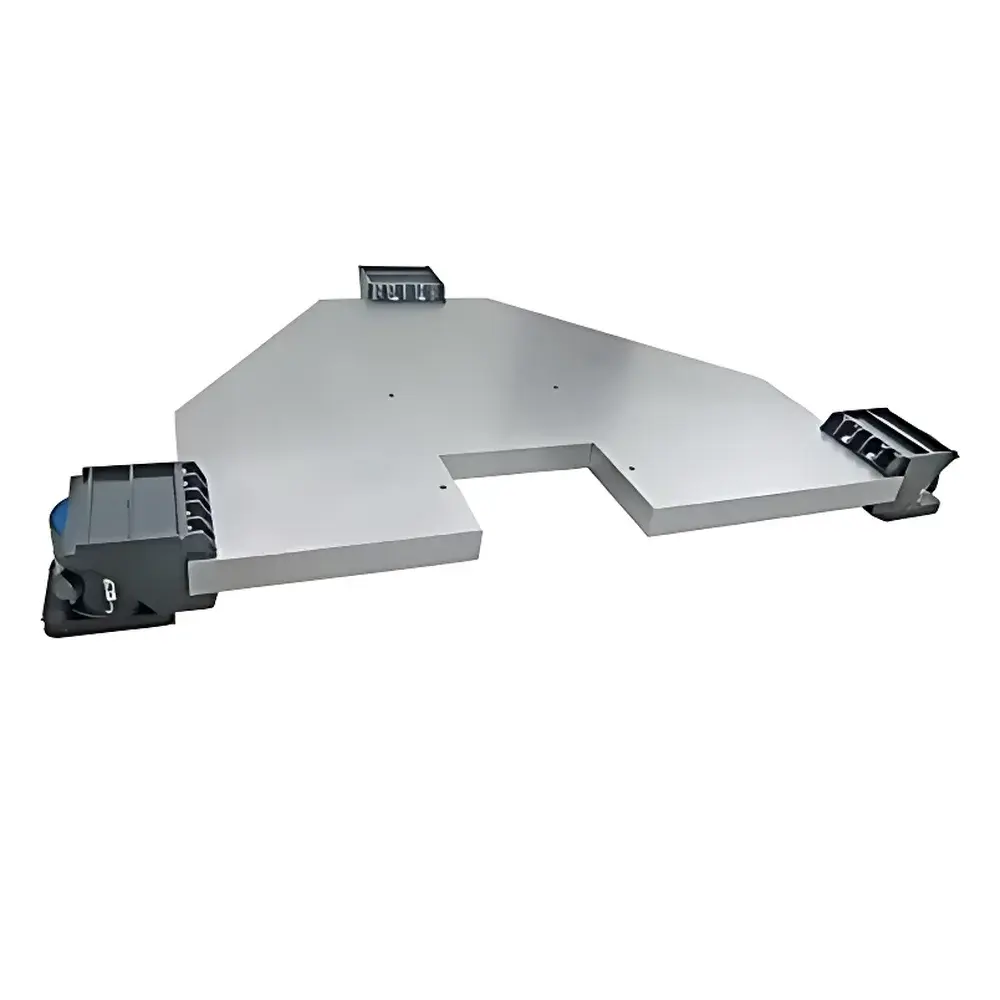
TMC STACIS Floor Platform – Active Vibration Isolation Optical Table for Ground-Mounted High-Sensitivity Instruments
| Brand | TMC |
|---|---|
| Origin | USA |
| Model | STACIS Floor Platform 65 |
| Compliance | ASTM E1492, ISO 20486, SEMI S2 |
| Load Capacity | Up to 2,500 kg (configurable) |
| Active Isolation Bandwidth | 0.6–150 Hz |
| Residual Vibration | < 10 nm RMS (1–100 Hz) |
| Platform Material | 304 Stainless Steel |
| Footprint Customization | Yes, full dimensional and cutout flexibility |
| Controller | STACIS II Digital Feedback System with Ethernet/RS-232 Interface |
| Power Requirement | 100–240 VAC, 50/60 Hz |
| Environmental Operating Range | 15–30 °C, < 70% RH non-condensing |
Overview
The TMC STACIS Floor Platform is an engineered active vibration isolation solution designed specifically for high-sensitivity optical, metrological, and nanoscale instrumentation installed directly on laboratory floor surfaces. Unlike passive air-spring optical tables or conventional inertial mass platforms, the STACIS Floor Platform employs a real-time, closed-loop piezoelectric actuation system that senses ground-borne vibrations—primarily from building infrastructure (HVAC, footfall, subfloor resonance, and low-frequency seismic noise)—and generates counteracting forces with sub-millisecond latency. Its core architecture separates the inertial platform mass from the active isolation mechanism: stainless steel tabletops are mechanically decoupled from the STACIS III-series piezoelectric actuators mounted beneath a rigid support frame, enabling stable operation even under top-heavy, tall-profile instruments such as electron microscopes, AFMs, interferometers, and lithography tools. This configuration eliminates gravitational instability inherent in elevated pneumatic isolators and avoids mechanical coupling issues associated with stacking multiple passive systems.
Key Features
- Ground-level installation geometry: raises instrumentation only 125–175 mm above finished floor level—minimizing ergonomic impact and preserving facility access requirements.
- Modular, non-integrated actuator design: STACIS piezo stacks are mounted externally to the platform structure, permitting full customization of table dimensions, cutouts, mounting hole patterns, and material thickness without compromising control loop integrity.
- True broadband active isolation: delivers >40 dB attenuation from 0.6 Hz upward, with no low-frequency amplification—a critical differentiator versus feedback-limited or hybrid passive-active systems.
- Backward-compatible integration: operates seamlessly beneath instruments equipped with internal pneumatic or passive elastomeric isolators; no modification to OEM suspension systems required.
- Digital controller with audit-ready logging: STACIS II controller supports time-stamped vibration spectra, system health diagnostics, gain calibration history, and exportable CSV data—fully compliant with GLP/GMP documentation standards per FDA 21 CFR Part 11 when configured with user authentication and electronic signature modules.
Sample Compatibility & Compliance
The STACIS Floor Platform accommodates instruments ranging from compact laser alignment stations (< 200 kg) to multi-ton transmission electron microscopes (TEMs) and synchrotron beamline endstations. It has been validated across diverse floor substrates—including structural concrete slabs, suspended wood joist assemblies, raised access floors, and epoxy-coated tile systems—using TMC’s proprietary TEMS (Tool Environment Measurement System) field survey protocol. All configurations conform to ASTM E1492 (Standard Practice for Vibration Measurements on Sensitive Equipment), ISO 20486 (Vibration Criteria for Precision Equipment), and SEMI S2 (Safety Guidelines for Semiconductor Manufacturing Equipment). Platform surface flatness is maintained at ≤15 µm/m over any 1 m² area, and thermal drift is stabilized to < 0.5 µm/°C via thermally symmetric stainless steel construction.
Software & Data Management
The STACIS II controller firmware provides native Ethernet and RS-232 connectivity for remote monitoring and parameter adjustment via TMC’s STACIS Control Suite (Windows/Linux compatible). Real-time spectral analysis (FFT up to 1024 lines, 1–200 Hz span) is displayed alongside RMS displacement, velocity, and acceleration metrics. All system logs—including sensor excursions, actuator saturation events, and manual tuning actions—are timestamped and stored onboard with 32 MB non-volatile memory. Export functions support .csv and .tdms formats for integration into LIMS or enterprise QA databases. Optional validation packages include IQ/OQ documentation templates aligned with ISO/IEC 17025 and manufacturer-specific instrument qualification protocols.
Applications
- Scanning/transmission electron microscopy (SEM/TEM) requiring sub-nanometer positional stability during long-exposure imaging or EDS mapping.
- Atomic force microscopy (AFM) and scanning probe lithography where tip-sample interaction forces are compromised by vertical floor motion > 5 nm.
- Optical interferometry, gravitational wave detector test benches, and quantum optics setups demanding phase stability below λ/100 over 10-second integration windows.
- Photolithography steppers and mask aligners in semiconductor R&D cleanrooms where sub-100 nm overlay accuracy depends on mechanical isolation below 2 Hz.
- Calibration laboratories performing ISO 10360-compliant CMM verification under ANSI B89.4.1 standards, where environmental vibration contributes measurably to length measurement uncertainty budgets.
FAQ
Can the STACIS Floor Platform be installed on a raised access floor?
Yes—platform support frames are engineered with adjustable leveling feet and distributed load distribution plates to accommodate deflection characteristics of modular raised flooring systems. Structural analysis reports are available upon request.
Is site vibration survey mandatory before ordering?
While not strictly mandatory, TMC strongly recommends a TEMS field survey for installations where floor velocity exceeds 25 µm/s RMS (1–100 Hz) or where instruments require isolation below 1 Hz. Survey data informs optimal actuator count, controller gain settings, and damping configuration.
Does STACIS require periodic recalibration?
No routine recalibration is required. The system performs self-diagnostic checks at power-on and continuously monitors sensor linearity and actuator response. Annual verification using NIST-traceable shaker calibration is recommended for ISO 17025-accredited labs.
Can I integrate STACIS with my existing lab building management system (BMS)?
Yes—the STACIS II controller supports Modbus TCP and OPC UA protocols via optional gateway modules, enabling status reporting, alarm forwarding, and remote shutdown commands within enterprise SCADA environments.






