
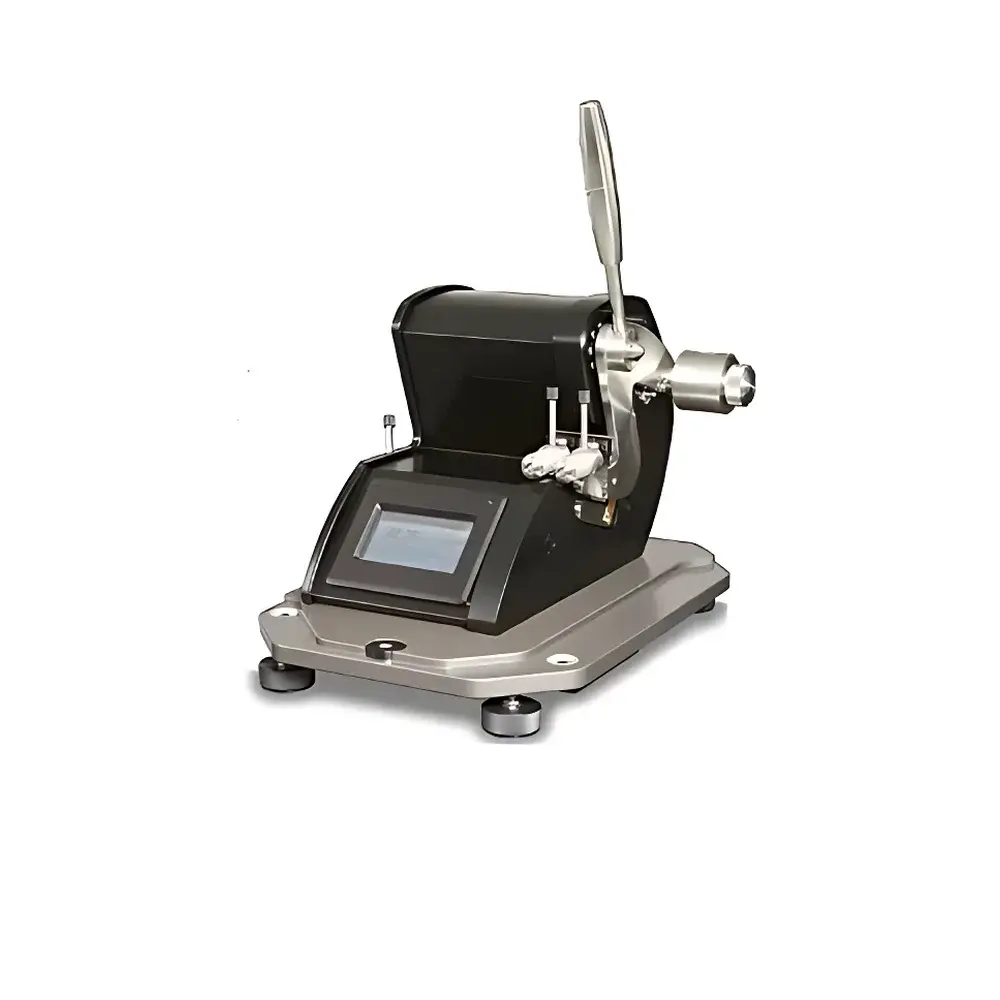
TMI RR/ETT Elmendorf Tear Tester
| Brand | TMI |
|---|---|
| Origin | United Kingdom |
| Model | RR/ETT |
| Sample Capacity | 1–16 specimens |
| Max. Specimen Thickness | 5 mm |
| Specimen Length | 15 mm or 20 mm |
| Tear Length | 43 mm |
| Pendulum Weights | 8 N, 16 N, 32 N, 64 N |
| Pendulum Accuracy | ±0.2% of full-scale capacity |
| Display | LCD touchscreen with statistical analysis (max/min/mean/SD/CV) |
| Data Storage | Up to 100 tests on-device |
| Units | N, cN, mN, kgf, gf, lbf, ozf |
| Interfaces | RS232 for LIMS integration |
| Dimensions (L×W×H) | 40 × 50 × 55 cm |
| Weight | 57 kg |
Overview
The TMI RR/ETT Elmendorf Tear Tester is a precision-engineered instrument designed to quantify the tear resistance of flexible sheet materials using the standardized Elmendorf pendulum method (ISO 1974, ASTM D1922, TAPPI T414, GB/T 455). It operates on the principle of energy absorption: a weighted pendulum is released from a fixed height to propagate a controlled tear through a pre-notched specimen clamped in a fixed geometry. The energy required to extend the tear—measured as the reduction in pendulum swing amplitude—is directly converted into tear force (in Newtons or equivalent units). This gravimetric, mechanical method ensures high reproducibility without reliance on servo-controlled actuators or real-time load cells, making it especially suitable for QC laboratories requiring robust, low-maintenance compliance testing across textile, nonwoven, paperboard, film, and thin plastic substrates.
Key Features
- Integrated rotary cam-lock lower jaw system enabling rapid, repeatable specimen clamping with minimal operator intervention.
- Automatic pendulum weight identification and dynamic zero-point calibration prior to each test cycle, eliminating manual offset adjustments.
- Dual-hand safety interlock mechanism: both hands must simultaneously engage release levers to initiate pendulum swing; the pendulum is automatically arrested post-test to prevent uncontrolled motion.
- Onboard LCD touchscreen interface supporting real-time statistical evaluation—including maximum, minimum, mean, standard deviation, and coefficient of variation—calculated directly from raw tear energy data.
- Full suite of certified pendulum weights (8 N, 16 N, 32 N, 64 N) compliant with ISO and ASTM reference standards; optional “E”-scale pendulum kit extends upper range to 128 N with dedicated calibration weights and interchangeable jaw faces.
- Built-in automatic energy-loss compensation: measures and corrects for air resistance and bearing friction during no-load swings, ensuring traceable accuracy per ISO 1974 Annex A.
- Standard longitudinal cutting blade and four textile specimen templates included; optional PC-based software enables secure data export, audit-trail generation, and long-term archiving aligned with GLP/GMP documentation requirements.
Sample Compatibility & Compliance
The RR/ETT accommodates specimens up to 5 mm thick and supports both 15 mm and 20 mm initial slit lengths, conforming to dimensional tolerances specified in ISO 1974 and ASTM D1922. Its universal jaw geometry accepts woven fabrics, spunbond/meltblown nonwovens, kraft paper, corrugated board, metallized films, and laminated packaging materials. All mechanical components—including pendulum arms, knife edges, and clamping surfaces—are manufactured to metrological grade tolerances and validated against national standards (UKAS-accredited calibration certificates available). The instrument meets CE marking requirements and supports compliance workflows for ISO/IEC 17025-accredited testing laboratories, including full traceability of calibration history and measurement uncertainty budgets.
Software & Data Management
While fully functional as a standalone unit, the RR/ETT supports bidirectional RS232 communication with laboratory information management systems (LIMS) and enterprise QA databases. Optional TMI Elmendorf Suite software provides 21 CFR Part 11-compliant user access control, electronic signatures, and immutable audit trails for all test executions, parameter changes, and data exports. Raw torque-integrated energy values are logged with timestamps, operator IDs, and environmental metadata (if integrated with external温/humidity sensors). Data can be exported in CSV or PDF formats compatible with internal quality review protocols and regulatory submissions.
Applications
This instrument is routinely deployed in R&D labs evaluating fiber entanglement efficiency in spunlace nonwovens; in paper mills validating tensile integrity of recycled linerboard; in medical device packaging facilities verifying seal tear performance of Tyvek® pouches; and in automotive interior suppliers assessing durability of headliner substrates under simulated service conditions. Its mechanical simplicity and ISO-aligned methodology make it a preferred choice for third-party certification bodies conducting audits under ISO 9001, IATF 16949, and FDA QSR frameworks.
FAQ
Does the RR/ETT require annual recalibration?
Yes—pendulum moment-of-inertia verification and knife-edge wear assessment should be performed annually by an accredited service provider; TMI recommends UKAS-traceable recalibration every 12 months.
Can the instrument test specimens thicker than 5 mm?
No—exceeding 5 mm violates the fundamental geometry assumptions of the Elmendorf method and invalidates compliance with ISO 1974; alternative methods (e.g., trouser tear or tongue tear per ASTM D624) are recommended for thicker composites.
Is the touchscreen interface programmable for custom test sequences?
No—the onboard firmware executes only standardized single-swing tear protocols; sequence customization requires the optional PC software with scriptable test templates.
What is the typical uncertainty budget for a certified 64 N pendulum?
When operated within specified environmental conditions (23 ± 2 °C, 50 ± 5 % RH) and using certified reference weights, expanded uncertainty (k=2) is ≤ ±0.4 % of reading, consistent with ISO/IEC 17025 Clause 7.6.3.
Does the RS232 interface support Modbus or proprietary ASCII protocols?
It uses standard ASCII command-response protocol defined in TMI Technical Note TN-RR-003; Modbus RTU implementation requires an external protocol converter.



