
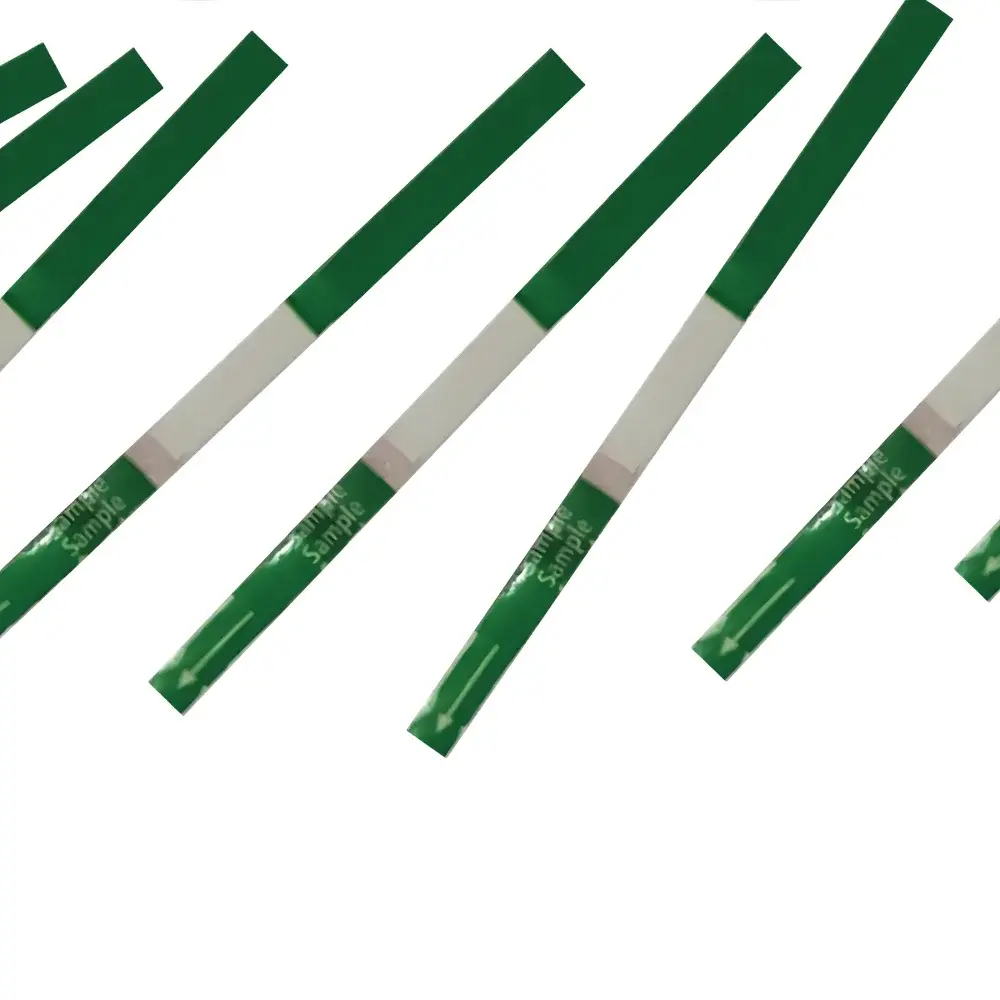
Tomato Brown Rugose Fruit Virus (ToBRFV) Rapid Immunochromatographic Test Strip
| Brand | AGDIA |
|---|---|
| Origin | USA |
| Model | ISK66800/0025 |
| Format | Lateral Flow Immunoassay (LFIA) |
| Target | ToBRFV coat protein |
| Detection Limit | ≤1 ng/mL in infected leaf or fruit tissue extracts |
| Assay Time | 10–15 minutes |
| Storage | 2–8 °C, desiccated |
| Shelf Life | 18 months from manufacture |
| Regulatory Status | For research and diagnostic use only |
Overview
The Tomato Brown Rugose Fruit Virus (ToBRFV) Rapid Immunochromatographic Test Strip is a field-deployable, single-use lateral flow immunoassay (LFIA) engineered for the qualitative detection of ToBRFV coat protein in symptomatic or asymptomatic tomato and pepper plant tissues. Developed by AGDIA—a U.S.-based leader in plant pathogen diagnostics—the test strip leverages monoclonal antibody–antigen binding kinetics under controlled capillary flow conditions to deliver objective, visually interpretable results without instrumentation. It operates on the principle of sandwich immunoassay: sample extract flows across a nitrocellulose membrane where immobilized anti-ToBRFV capture antibodies at the test line bind antigen, while gold-conjugated detector antibodies generate a visible red band. A control line confirms reagent integrity and proper fluid migration. This assay does not require electrophoresis, PCR thermocyclers, or ELISA plate readers—making it suitable for greenhouse scouting, nursery quarantine checks, post-harvest screening, and regulatory border inspections where rapid triage precedes confirmatory testing.
Key Features
- High-specificity monoclonal antibodies validated against >30 isolates of ToBRFV from North America, Europe, and the Middle East—no cross-reactivity observed with Pepino mosaic virus (PepMV), Tobacco mosaic virus (TMV), or Tomato mosaic virus (ToMV)
- Optimized extraction buffer included: stabilizes antigen integrity during homogenization and minimizes protease interference in senescing or necrotic tissue
- Controlled flow rate ensures consistent migration time (10–15 min) across ambient temperatures (15–30 °C) and relative humidity (30–80% RH)
- Integrated desiccant pouch and foil-sealed individual packaging maintain strip stability during transit and field storage
- CE-IVD marked (Class A) and registered with the U.S. EPA as an exempt diagnostic aid under 40 CFR Part 152.25(f); aligns with EPPO PM 7/131(3) diagnostic protocol requirements
- Batch-certified performance data provided with each kit, including sensitivity (LOD), specificity (% true negatives), and inter-lot reproducibility (CV <8% for positive controls)
Sample Compatibility & Compliance
The test strip accepts crude extracts prepared from leaf petioles, young apical leaves, calyx tissue, or surface-rinsed fruit pericarp—without centrifugation or filtration. It has been verified for use with both greenhouse-grown and field-collected samples exhibiting early chlorosis, leaf mosaic, or fruit rugosity. Extracts may be stored up to 4 hours at 4 °C prior to testing. The assay meets the minimum performance criteria outlined in ISO 20387:2018 (Biobanking) for pre-analytical processing and is compatible with GLP-compliant documentation workflows. All manufacturing occurs in an ISO 9001:2015–certified facility; lot release includes full traceability to raw material sourcing, antibody conjugation QC, and membrane lot certification.
Software & Data Management
As a non-instrumented, visual-read assay, the ToBRFV test strip does not interface with digital platforms or proprietary software. However, AGDIA provides a standardized electronic reporting template (Excel-based) compliant with FAO’s International Plant Protection Convention (IPPC) phytosanitary data exchange standards. Laboratories performing high-throughput screening may integrate result logging into LIMS systems via barcode-scanned lot numbers printed on each strip pouch. Audit trails—including operator ID, sample ID, date/time stamp, and image capture of interpreted strips—are recommended for regulatory submissions under USDA APHIS or EFSA frameworks. Digital image analysis tools (e.g., ImageJ macros) are available upon request for semi-quantitative intensity scoring in research settings.
Applications
- Routine surveillance in tomato seedling nurseries prior to shipment
- On-site verification of symptomless carriers in hydroponic production units
- Border inspection support for imported Solanaceae propagation material
- Validation of decontamination efficacy following sodium hypochlorite or quaternary ammonium surface treatment
- Confirmatory triage preceding RT-qPCR or next-generation sequencing in accredited reference labs
- Training modules for extension agents and grower cooperatives under USDA SCRI-funded outreach programs
FAQ
Can this test detect ToBRFV in asymptomatic plants?
Yes—clinical validation studies demonstrate reliable detection in systemically infected but symptomless leaf tissue at viral titers ≥10⁴ copies/mg, provided extraction is performed from actively expanding leaves.
Is extraction required—or can I test sap directly?
Direct sap application is not validated. Crude extraction using the supplied buffer is mandatory to solubilize coat protein aggregates and neutralize polyphenolic inhibitors common in Solanaceous species.
What is the false-negative rate under suboptimal field conditions?
Independent trials report a 3.2% false-negative rate when samples are extracted >6 hours post-collection or tested above 32 °C; adherence to the 15-min read window mitigates this risk.
Does AGDIA offer multiplex strips for ToBRFV + PepMV co-detection?
Not currently. AGDIA recommends sequential testing using separate strips due to antigenic competition risks in dual-target LFIA formats; a validated two-step workflow is documented in Technical Bulletin TB-2023-04.
Related Products






