
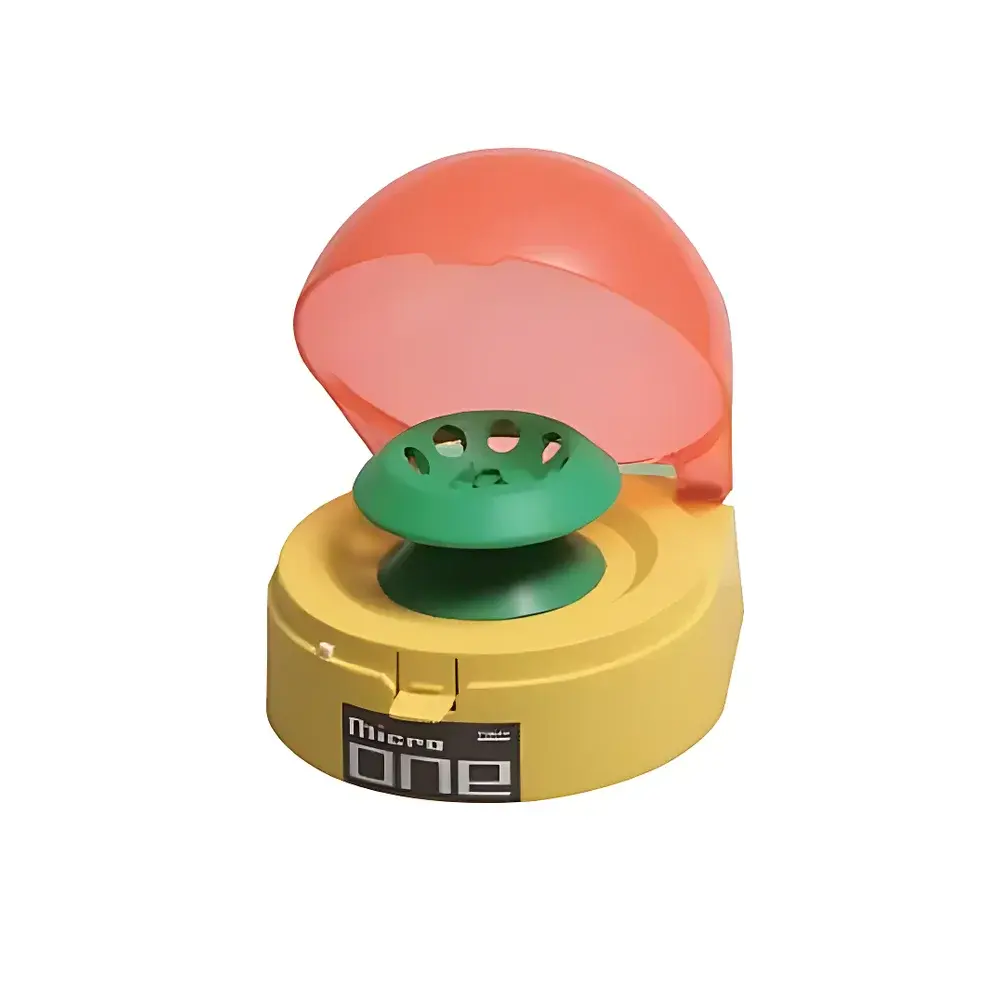
TOMY MicroOne Portable Microcentrifuge
| Origin | Japan |
|---|---|
| Manufacturer Type | Authorized Distributor |
| Origin Category | Imported |
| Model | MicroOne |
| Pricing | Available Upon Request |
| Max Speed | 6200 rpm (±20%) |
| Rotor Capacity | 0.2 mL × 8-tube strip or 1.5–2.2 mL × 8 tubes |
| Max RCF | 1200–2910 × g |
| Temperature Range | Ambient |
| Acceleration Time | ≤5 s to ≥5000 rpm |
| Brake Time | 2 s (lid open), 10 s (lid closed) |
| Power Supply | 220 V, 50/60 Hz, Single-phase |
| Power Consumption | 153 W |
| Dimensions (W×D×H) | 123 mm × 173 mm × 153 mm |
Overview
The TOMY MicroOne is a compact, benchtop microcentrifuge engineered for rapid, low-speed separation of small-volume samples in routine laboratory workflows. Designed around the principles of fixed-angle rotor centrifugation, it delivers precise and reproducible sedimentation forces via controlled angular acceleration and deceleration profiles. Its core application domain includes quick pelleting of PCR tubes, spin-down of column-based purification reagents, clarification of microvolume biological suspensions (e.g., bacterial lysates, cell debris, or enzyme reaction mixtures), and preparation of samples for downstream analysis such as electrophoresis, spectrophotometry, or mass spectrometry. Unlike high-speed or refrigerated centrifuges, the MicroOne operates at ambient temperature and prioritizes operational simplicity, footprint minimization, and energy efficiency—making it ideal for shared lab spaces, teaching laboratories, field-deployable setups, and QC/QA stations where rapid turnaround of 0.2–2.2 mL samples is required.
Key Features
- Modular rotor system: Interchangeable rotors support two standardized configurations: an 8-position fixed-angle rotor for 1.5–2.2 mL microtubes (max 6000 rpm, RCF up to 2910 × g) and a dedicated 0.2 mL tube strip rotor (max 6200 rpm, RCF up to 2690 × g), ensuring compatibility with common PCR and qPCR consumables.
- Rapid dynamic response: Achieves ≥5000 rpm within 5 seconds; deceleration is intelligently managed—mechanical braking halts rotation in ≤2 seconds upon lid opening (safety-interlocked), and ≤10 seconds when lid remains closed, minimizing wait time between runs.
- Compact ergonomic design: Footprint of only 123 mm × 173 mm and height of 153 mm enables placement on crowded benches, inside biosafety cabinets, or transportable storage units without compromising stability or vibration control.
- Energy-efficient operation: Rated at 153 W under full load, compliant with IEC 61000-3-2 harmonic emission standards; single-phase 220 V, 50/60 Hz input eliminates need for special power conditioning in most regional lab environments.
- Safety-certified construction: Features automatic rotor imbalance detection, lid-lock interlock with mechanical and electronic redundancy, and UL/CSA-compliant enclosure materials meeting IEC 61010-1 requirements for Class II laboratory equipment.
Sample Compatibility & Compliance
The MicroOne accommodates standard polypropylene and polyethylene microcentrifuge tubes (1.5 mL and 2.2 mL) and 0.2 mL PCR strip formats conforming to ANSI/SBS dimensional specifications. It supports common buffer systems—including Tris-HCl, PBS, guanidine-based lysis solutions, and ethanol precipitation mixtures—without risk of tube deformation or leakage under specified RCF limits. The device complies with ISO 13485-aligned manufacturing controls (as verified by TOMY’s authorized distributor quality documentation), and its electrical safety certification aligns with IEC 61010-1:2010 + A1:2019. While not designed for GLP/GMP-critical applications requiring audit trails or electronic records, its mechanical consistency and repeatable run parameters support adherence to internal SOPs aligned with ISO/IEC 17025 clause 7.2.2 (method validation for routine testing).
Software & Data Management
The MicroOne is a stand-alone, microprocessor-controlled instrument with no embedded software, network interface, or data logging capability. All operational parameters are set manually via tactile push-button controls and displayed on a dual-segment LED screen showing real-time rpm and countdown timer. This architecture ensures deterministic behavior, zero firmware update dependencies, and immunity to cybersecurity vulnerabilities—critical for regulated environments where validation of software components would otherwise require extensive IQ/OQ/PQ documentation. Run records must be maintained manually per laboratory record-keeping SOPs; however, the consistent acceleration/deceleration profile and fixed rotor geometry support high inter-run reproducibility essential for method transfer across instruments.
Applications
- Spin-down of enzymatic digestion or ligation reactions prior to gel loading
- Rapid clarification of lysates in plasmid miniprep or genomic DNA isolation workflows
- Centrifugal separation of binding beads (e.g., magnetic or silica-based) in nucleic acid extraction kits
- Removal of precipitated contaminants from protein samples before SDS-PAGE or HPLC injection
- Quick sedimentation of cell pellets in microbiology teaching labs using 1.5 mL Eppendorf-style tubes
- Preparation of calibration standards for UV-Vis or fluorescence assays requiring particulate-free supernatants
FAQ
Is the MicroOne suitable for clinical diagnostic use under CLIA or CAP guidelines?
The MicroOne meets general electrical and mechanical safety standards but lacks features required for regulated diagnostic environments—such as electronic audit trails, user access control, or integrated calibration verification. It may be used in pre-analytical sample processing if validated per laboratory-specific protocols.
Can I use non-TOMY rotors or adapters with this centrifuge?
No. Only TOMY-certified rotors are validated for balance, thermal tolerance, and structural integrity at rated speeds. Use of third-party components voids warranty and compromises safety compliance.
Does the MicroOne generate significant noise or vibration during operation?
Operating noise is ≤52 dB(A) at 1 m distance; vibration is minimized through precision-balanced rotor assembly and rubberized anti-slip feet, enabling stable use on laminate or stainless-steel work surfaces without anchoring.
What maintenance is required for long-term reliability?
Routine cleaning of the rotor chamber and lid seal with 70% ethanol; annual visual inspection of rotor threads and lid latch mechanism; no lubrication or recalibration is required under normal usage conditions.
Is there a service manual or technical support available outside Japan?
Authorized distributors provide multilingual technical documentation and access to TOMY’s global service network for repair, calibration verification, and spare parts fulfillment—subject to regional regulatory availability.



