
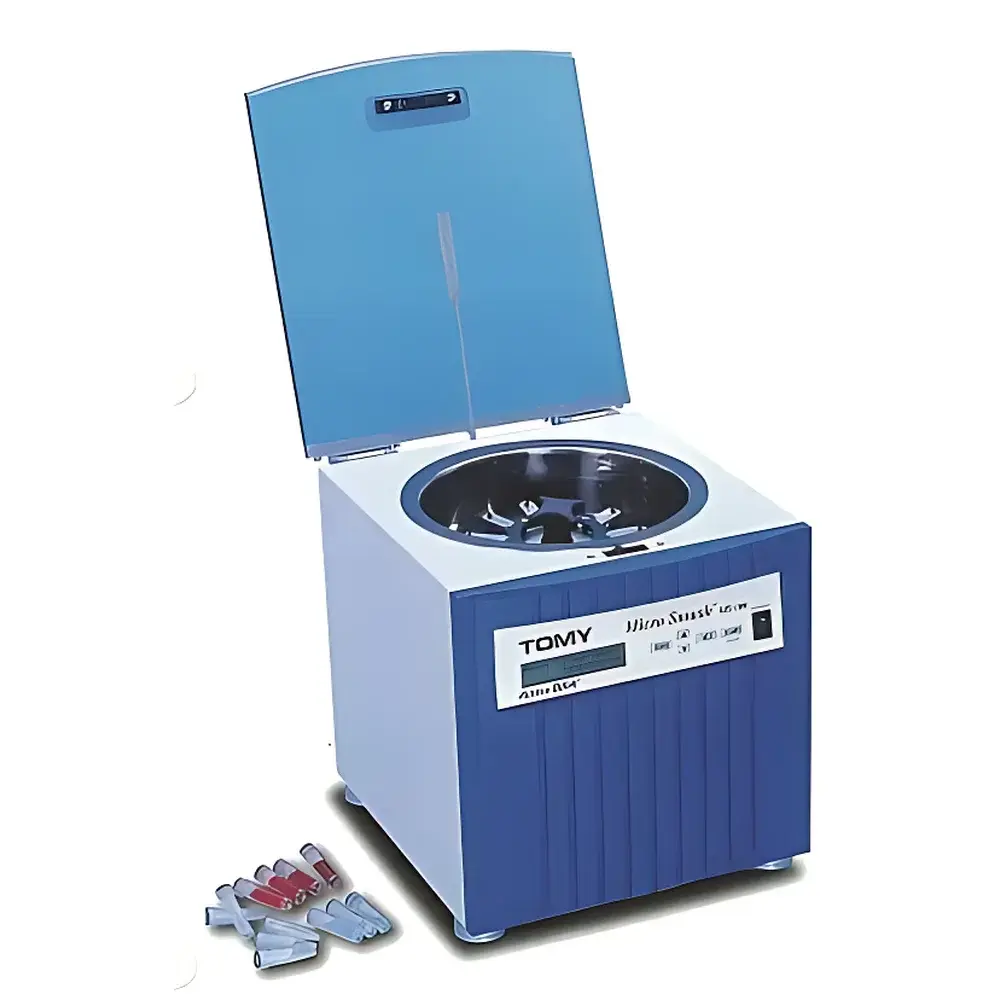
TOMY MS-100 Bead-Based Tissue Disruptor and Homogenizer
| Brand | TOMY |
|---|---|
| Origin | Japan |
| Model | MS-100 |
| Drive Type | Brushless Inverter Motor |
| Speed Range | 2000–5500 rpm (100 rpm increments) |
| Time Setting | 1–300 s (1–100 s above 5100 rpm) |
| Sample Capacity | 12 × 2.0 mL tubes |
| Motion Principle | Microprocessor-Controlled 3D Rotational High-Speed Motion (Patented) |
| Safety Features | Lid-Open Detection, Motor Overheat Protection, Abnormal Rotation Detection |
| Display | Backlit LCD |
| Dimensions | 280 W × 320 D × 305 H mm |
| Weight | ~17 kg |
| Power Supply | AC 120 V, 3 A, 50/60 Hz, 1P |
Overview
The TOMY MS-100 Bead-Based Tissue Disruptor and Homogenizer is an engineered benchtop solution for reproducible mechanical lysis of resilient biological matrices—including fibrous tissues (e.g., muscle, plant stems), Gram-positive bacteria, yeast, spores, and biofilm-embedded cells—using high-energy bead-beating via patented 3D rotational motion. Unlike conventional vortexers or orbital shakers, the MS-100 applies simultaneous multi-axis acceleration to sample tubes, generating intense collision dynamics between ceramic or steel beads and cellular material. This principle leverages inertial shear forces and impact energy transfer rather than thermal or enzymatic mechanisms, ensuring minimal nucleic acid degradation and protein denaturation when protocols are optimized. Designed for routine use in molecular biology labs, bioprocessing QC environments, and academic core facilities, the system delivers consistent homogenization across heterogeneous samples without requiring liquid nitrogen or sonication-based infrastructure.
Key Features
- Patented 3D rotational high-speed motion mechanism ensures uniform energy distribution across all 12 positions—eliminating positional bias common in linear or single-axis disruptors.
- Brushless inverter motor provides stable torque delivery across the full speed range (2000–5500 rpm), with no carbon dust generation and zero scheduled brush replacement—critical for cleanroom-compatible and GLP-aligned workflows.
- Five pre-programmed protocols plus user-defined method storage enable rapid recall of validated conditions for specific sample types (e.g., Arabidopsis thaliana leaf tissue, Bacillus subtilis pellets, mouse liver).
- Intuitive front-panel control with backlit LCD display supports real-time monitoring of speed, time, and active protocol status—even under low-light hood conditions.
- Ergonomic tube holder design features a central locking knob for secure, one-handed 2.0 mL tube fixation; the transparent polycarbonate lid permits visual verification of bead suspension behavior and sample integrity during operation.
- Integrated safety architecture includes lid-open interlock, real-time motor temperature sensing, and rotational anomaly detection—automatically halting operation if deviation exceeds ISO 13857-compliant thresholds.
Sample Compatibility & Compliance
The MS-100 accommodates standard 2.0 mL microcentrifuge tubes containing up to 500 µL of sample volume with appropriate bead loading (e.g., 0.1 mm zirconia/silica for RNA extraction; 0.5 mm stainless steel for tough bacterial cell walls). It is compatible with common lysis buffers (e.g., RLT, CTAB, SDS-based formulations) and cryogenic additives (e.g., liquid nitrogen pre-chilling of tubes). The device meets IEC 61010-1:2010 requirements for laboratory electrical equipment safety and conforms to electromagnetic compatibility standards per EN 61326-1. While not certified as medical device hardware, its operational repeatability and audit-ready parameter logging support alignment with ISO/IEC 17025 quality systems and FDA 21 CFR Part 11–compliant data management when integrated with validated third-party software.
Software & Data Management
The MS-100 operates as a standalone instrument with embedded firmware; no PC connection is required for basic operation. However, its digital interface enables optional integration with laboratory information management systems (LIMS) via RS-232 or USB-to-serial adapters (cable sold separately). All executed protocols—including speed, duration, and timestamp—are retained in non-volatile memory for up to 100 runs, supporting traceability in regulated environments. For enhanced documentation, users may export logs to CSV format using TOMY’s optional MS-Link utility (v2.1+), which enforces electronic signature capture and change history tracking compliant with ALCOA+ principles.
Applications
- Routine genomic DNA and total RNA isolation from fibrous plant tissues and animal organs.
- Preparation of intracellular protein extracts from recalcitrant microbes including Mycobacterium tuberculosis and Streptomyces coelicolor.
- Microbial community disruption for metagenomic library construction from soil, sediment, and biofilm samples.
- Homogenization of frozen tissue sections prior to metabolite profiling (LC-MS/GC-MS).
- Cell lysis validation studies under ISO 13485–aligned biomanufacturing process development.
FAQ
Is the MS-100 suitable for BSL-2 or higher containment applications?
Yes—when used with sealed, O-ring–equipped tubes and operated inside a biosafety cabinet, the system complies with CDC/NIH BMBL-5 recommendations for mechanical lysis of moderate-risk agents.
Can I use it with 0.5 mL or 15 mL tubes?
No—the MS-100 is mechanically engineered exclusively for 2.0 mL conical microcentrifuge tubes; alternative tube formats require adapter kits not supplied by TOMY and are not validated for safety or performance.
Does the device support continuous operation mode?
No—it is designed for discrete timed cycles only; duty cycle limitations prevent sustained >300 s operation without ≥5 min cooling intervals to maintain motor thermal stability.
What maintenance is required beyond routine cleaning?
None—brushless motor architecture eliminates scheduled wear-part replacement; periodic inspection of tube holder integrity and lid seal condition is recommended per ISO 15197 preventive maintenance guidelines.
How does the 3D motion differ from planetary or vortex-based homogenizers?
Planetary mixers induce elliptical orbits; vortexers generate uniaxial oscillation. The MS-100’s triaxial rotation creates chaotic yet statistically uniform kinetic energy profiles—validated by ASTM E2918-13 bead impact mapping protocols—to reduce coefficient of variation in lysate yield below 4.2% (n=48, inter-run CV).



