
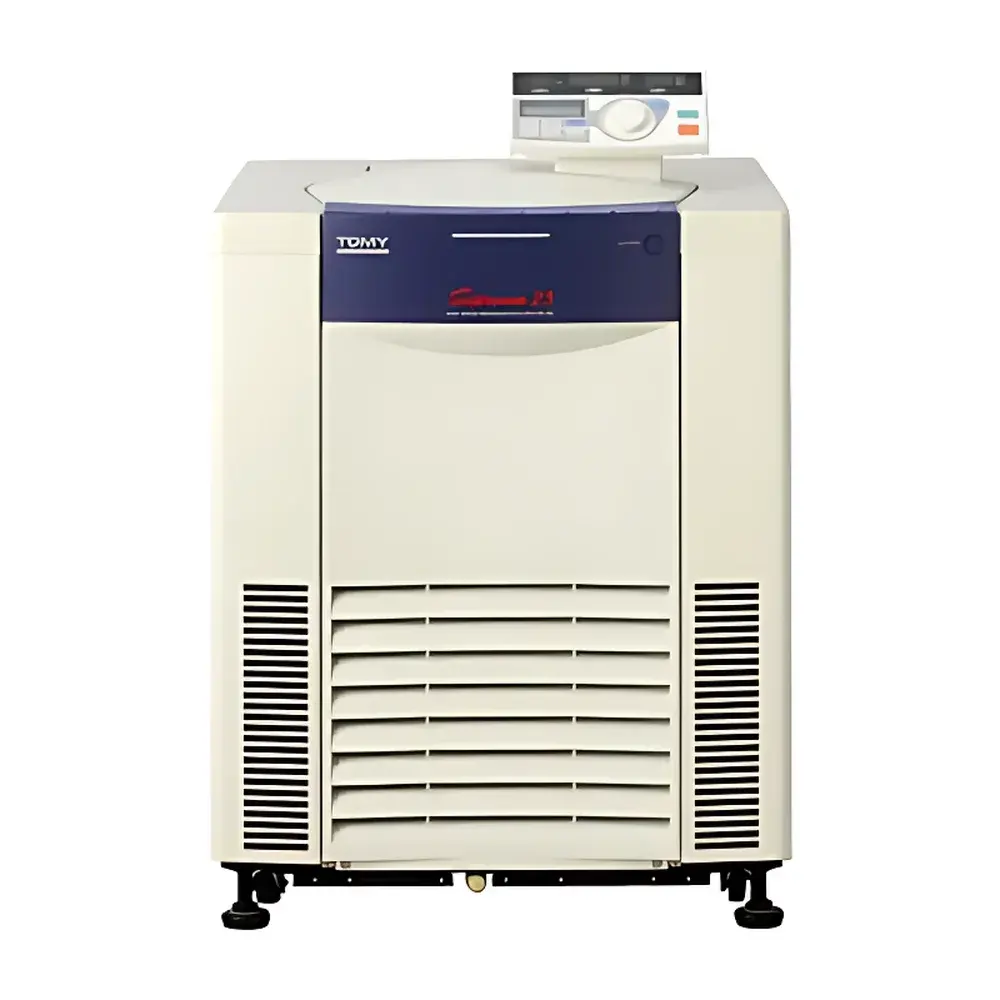
TOMY Suprema25/23/21 High-Capacity Floor-Standing Refrigerated Centrifuge
| Brand | TOMY |
|---|---|
| Origin | Japan |
| Model | Suprema25 / Suprema23 / Suprema21 |
| Max Speed | 25,000 rpm / 23,000 rpm / 21,000 rpm |
| Max RCF | 60,110 × g / 51,420 × g / 46,850 × g |
| Max Capacity | 6 × 1000 mL / 4 × 1000 mL / — |
| Temperature Range | −9 to +35 °C |
| Acceleration/Deceleration | 10-step each |
| Drive System | Direct-drive induction motor |
| Refrigerant | HFC R404A |
| Power Supply | AC 220–240 V, 50/60 Hz, 30 A |
| Dimensions (W×D×H) | 715×794×1017 mm (Suprema25) / 570×794×1017 mm (Suprema23/21) |
| Net Weight | 265 kg / 265 kg / 215 kg |
| Safety | Rotor recognition, lid interlock, imbalance detection, overspeed protection, motor current & temperature monitoring |
| Compliance | Designed for GLP/GMP-aligned workflows |
Overview
The TOMY Suprema25/23/21 series represents a class of high-capacity, floor-standing refrigerated centrifuges engineered for demanding preparative and process-scale separation tasks in pharmaceutical development, bioprocessing, clinical diagnostics, and academic core facilities. These instruments operate on the principle of sedimentation under controlled gravitational force (RCF), where rotational motion generates centrifugal acceleration that separates particles—such as cells, organelles, macromolecular complexes, or precipitated analytes—based on differences in density, size, and shape. The Suprema platform integrates direct-drive induction motor technology, eliminating belt wear and ensuring long-term torque stability and speed reproducibility across extended operational cycles. Its refrigerated architecture maintains precise thermal control (−9 to +35 °C) during high-speed runs, critical for preserving thermolabile biological samples—including viral vectors, exosomes, and primary cell lysates—without compromising rotor integrity or sample viability.
Key Features
- Ultra-fast acceleration and deceleration profiles: 10 programmable acceleration and deceleration steps enable rapid ramp-up and controlled braking, reducing total run time by up to 50% compared to prior-generation models.
- Intuitive rainbow LED status interface: Provides real-time visual feedback on operational phase (acceleration, hold, deceleration), temperature stability, and safety interlock status—enhancing situational awareness in high-throughput labs.
- Advanced memory architecture: Each rotor type supports three dedicated memory slots; the full menu system stores up to 99 user-defined protocols, including speed, RCF, time, temperature, and brake profile settings.
- High-precision parameter control: Speed resolution of 100 rpm; RCF adjustment in 10 × g increments; temperature setpoint accuracy ±1 °C; timer resolution spanning seconds (0–50 s), minutes (0:01–9:59), and hours (10–24 h).
- Comprehensive safety ecosystem: Integrated rotor recognition system prevents unauthorized or mismatched rotor use; lid interlock ensures mechanical and electrical inhibition during door opening; continuous monitoring of motor current, temperature deviation, imbalance, and overspeed conditions triggers immediate shutdown with event logging.
- Eco-conscious refrigeration: Uses HFC R404A refrigerant compliant with current international environmental directives for low ozone depletion potential (ODP = 0) and moderate global warming potential (GWP).
Sample Compatibility & Compliance
The Suprema series accommodates a broad range of sample formats through interchangeable rotors—including fixed-angle, swinging-bucket, and continuous-flow configurations—with maximum capacities reaching 6 × 1000 mL (Suprema25, NA-600C rotor) and 4 × 1000 mL (Suprema23, NA-400 rotor). Rotors are certified to ISO 15529:2017 (centrifuge rotor safety standards) and undergo full traceable fatigue testing. Instrument firmware supports automatic RCF calculation based on entered rotor radius and speed, minimizing manual error. While the hardware itself does not embed electronic signatures or audit trails, its deterministic behavior, repeatable calibration points, and compatibility with external LIMS or ELN systems facilitate alignment with GLP, GMP, and FDA 21 CFR Part 11 requirements when deployed within validated laboratory informatics frameworks.
Software & Data Management
Operation is managed via an embedded microprocessor-controlled interface with backlit LCD display capable of storing historical run logs—including date/time stamp, rotor ID, speed, RCF, temperature, duration, and any triggered safety events. All parameters are retained even after power loss. The “Memory” and “Menu” keys allow rapid recall and editing of stored protocols without re-entry. Optional BART code scanning enables automated configuration of speed, radius, and timestamp upon rotor installation—reducing setup variability in multi-user environments. Raw data export is supported via USB port (device not included); integration with TOMY’s optional CentriLink software enables remote monitoring, batch reporting, and CSV-based export for statistical process analysis.
Applications
- Large-volume cell harvesting (e.g., CHO, HEK293, hybridoma cultures) at industrial scale
- Clarification of fermentation broths and lysates prior to chromatography or filtration
- Isolation of extracellular vesicles (EVs), lipoproteins, and ribonucleoprotein complexes
- Preparative ultracentrifugation of subcellular fractions using swing-out rotors
- Continuous-flow processing of blood derivatives, plasma components, or vaccine intermediates
- Stability testing of biologics under controlled thermal stress conditions
FAQ
What is the difference between RCF and RPM, and why does the Suprema series allow both units?
RCF (relative centrifugal force, expressed in × g) reflects the actual gravitational force applied to the sample and depends on both rotational speed (RPM) and rotor radius. The Suprema interface permits dual-mode input so users can either directly specify target g-force—ensuring method transferability across different rotors—or enter RPM for legacy protocol compatibility.
Can the Suprema centrifuge be used for sterile processing applications?
While the instrument itself is not classified as aseptic equipment, its sealed refrigeration system, smooth stainless-steel chamber surfaces, and absence of internal air recirculation pathways support post-run decontamination per ISO 14644-1 Class 7 cleanroom maintenance protocols. Use with autoclavable rotors and validated cleaning agents is recommended.
Is rotor calibration required before first use?
Each TOMY rotor ships with individual certification documentation verifying balance tolerance, burst speed margin, and dimensional compliance. No field calibration is needed; however, users must register rotor IDs in the instrument memory to activate full safety interlocks and auto-RCF calculation.
How does the direct-drive motor improve long-term reliability compared to belt-driven systems?
Elimination of mechanical transmission components removes sources of slippage, vibration-induced misalignment, and scheduled belt replacement—resulting in higher speed stability (< ±50 rpm over 8-hour runs), reduced acoustic noise ( 25,000 hours).



