
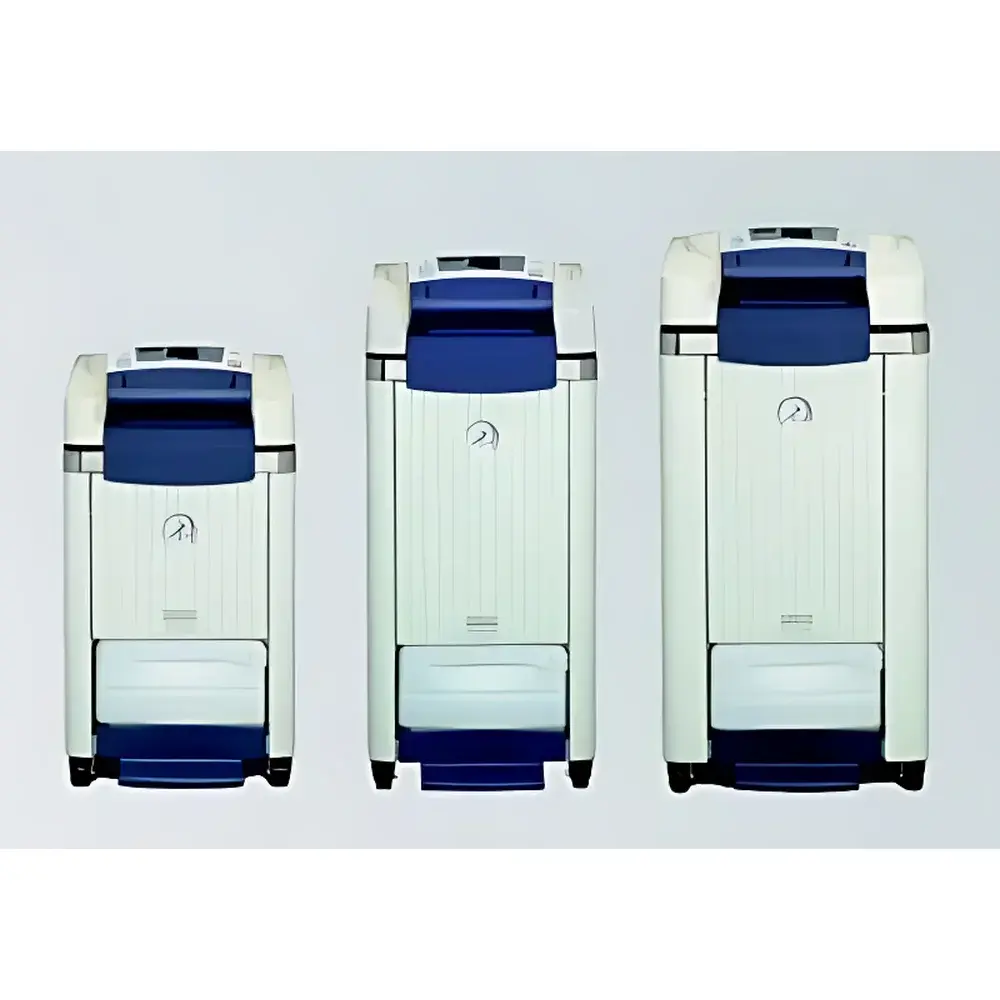
TOMY SX300/SX500/SX700 Series Fully Automatic High-Pressure Steam Sterilizers
| Brand | TOMY |
|---|---|
| Origin | Japan |
| Model(s) | SX300, SX500, SX700 |
| Sterilization Temp Range | 105–135°C (0.019–0.212 MPa) |
| Heating Temp Range | 45–104°C (0–0.015 MPa) |
| Holding Temp Range | 45–95°C |
| Max Working Pressure | 0.25–0.263 MPa |
| Chamber Capacity | 44 L / 58 L / 79 L (effective volume) |
| Chamber Material | SUS304 stainless steel |
| Temperature Sensor | Separated-type RTD probe positioned at chamber center |
| Pressure Sensor | Dual-balance diaphragm pressure transducer system |
| Water Level Detection | Conductivity-based automatic low-water sensor with auto-shutdown |
| Cooling System | Two-stage adjustable forced-air fan (reduces 121°C → 97°C in ≤12 min for 3 L load) |
| Safety Features | Dual interlocked lid mechanism, overpressure relief valve, thermal cut-off, ground-fault circuit interrupter, lid-temperature sensor, pressure safety valve |
| Power Supply | 230 VAC, 50 Hz |
| Input Power | 1.5 kW / 2.0 kW / 3.0 kW |
| Compliance | JIS B 8225, Japanese Pressure Vessel Safety Regulations (Type Approval certified), GLP/GMP-ready data traceability support |
Overview
The TOMY SX300, SX500, and SX700 Series are fully automatic high-pressure steam sterilizers engineered for precision, reliability, and regulatory compliance in research laboratories, clinical diagnostics, pharmaceutical QC, and biosafety facilities. Based on saturated steam under controlled pressure—governed by the fundamental thermodynamic relationship between temperature and vapor pressure—these units deliver validated microbial inactivation across a wide operational envelope (105–135°C at 0.019–0.212 MPa). Unlike basic gravity-displacement autoclaves, the SX series incorporates dual-balance pressure sensing architecture to maintain uniform chamber pressure distribution, enabling reproducible sterilization cycles and extending utility into non-standard applications such as aqueous sample digestion, controlled thermal dissolution, and equilibrium-based hydrolysis protocols. Each model meets Japanese Industrial Standard JIS B 8225 for pressure vessel design and is certified under Japan’s stringent Pressure Vessel Safety Law, with formal Type Approval issued to both manufacturer and vessel fabricator—ensuring structural integrity, long-term fatigue resistance, and documented traceability from production to commissioning.
Key Features
- Separate-location RTD temperature sensor mounted centrally within the chamber—physically isolated from the heating jacket—to provide real-time, spatially representative thermal measurement unaffected by jacket transient overshoot.
- Conductivity-based water level detection system continuously monitors reservoir status; triggers audible/visual alarm and immediate power cutoff upon detection of critically low water volume—eliminating risk of dry-heating failure.
- Foot-operated lid actuation mechanism enables hands-free opening/closing, optimizing workflow ergonomics and minimizing cross-contamination risk during high-throughput operations.
- Two-stage variable-speed forced-air cooling system reduces post-cycle cooldown time by up to 50%; achieves 121°C → 97°C transition in ≤12 minutes for standardized 3 L aqueous loads (ambient 25°C).
- Integrated dual-balance diaphragm pressure transducer system ensures stable, drift-resistant pressure monitoring and supports auxiliary applications requiring precise pressure equilibrium control (e.g., EPA Method 3050B digestion, ISO 11134 validation studies).
- Lid interlock with mechanical and electronic redundancy prevents accidental opening during pressurized operation; lid-temperature sensor verifies safe surface temperature (<45°C) prior to release.
- Configurable delayed start function (1–99 hours) and programmable hold times (1–99 hours or fixed 4-hour mode) support unattended overnight processing and staggered batch scheduling.
- High-visibility status indicators change color (green/yellow/red) based on real-time pressure state—providing intuitive visual feedback without requiring panel interaction.
Sample Compatibility & Compliance
The SX series accommodates standard laboratory vessels—including glassware, stainless-steel baskets, wrapped instruments, liquid media in sealed bottles, and porous loads—within its SUS304 cylindrical chambers (44 L / 58 L / 79 L effective volume). Chamber geometry and steam circulation dynamics are validated per ISO 17665-1 for porous load penetration and heat distribution uniformity. Optional ST-Zero biohazard sterilization containers (designed for integration inside Class II biological safety cabinets) allow secure transfer and in-situ sterilization of pipette tips, Petri dishes, and disposable labware without disrupting laminar airflow. All models comply with Japanese Ministry of Health, Labour and Welfare (MHLW) requirements for medical device reprocessing and support GLP/GMP documentation workflows via optional analog/digital output interfaces (0–5 V or 4–20 mA) compatible with third-party data loggers. Pressure vessel certification includes dual documentation: Manufacturer Certificate of Conformance and Fabricator Type Approval—fully auditable for FDA 21 CFR Part 11-compliant environments when paired with validated electronic record systems.
Software & Data Management
While the SX series operates via an intuitive front-panel interface with digital temperature/pressure display and manual cycle programming, it is designed for seamless integration into regulated data ecosystems. Analog outputs for chamber temperature and pressure enable connection to external chart recorders or SCADA systems. For full audit trail capability, users may connect calibrated external data loggers (e.g., compliant with ASTM E2500 or ISO/IEC 17025) to capture time-stamped, sensor-independent thermal profiles. The independent placement of the RTD probe and separate signal path ensure data integrity: chamber temperature readings remain traceable even if internal controller firmware is reset or updated. Cycle logs—including start time, setpoint, actual profile, duration, and fault codes—are retained in non-volatile memory and can be manually exported via USB or printed using optional thermal printer modules. All firmware versions undergo formal revision control per IEC 62304, and update histories are maintained in the device’s service log.
Applications
These sterilizers serve mission-critical functions across multiple domains: terminal sterilization of surgical instruments and reusable labware in hospital central supply departments; depyrogenation and media preparation in pharmaceutical manufacturing (aligned with USP and EU Annex 1); routine decontamination of microbiological waste in BSL-2/BSL-3 labs; thermal pretreatment of environmental samples (soil, sludge, wastewater) prior to heavy metal analysis (EPA 3050B, ISO 11466); and controlled thermal aging studies in materials science. The SX500H variant—specifically engineered for installations above 2,000 m elevation—compensates for reduced atmospheric pressure via adaptive PID tuning and enhanced steam saturation algorithms, ensuring consistent lethality (F0) values regardless of geographic location. Academic core facilities leverage the dual-pressure-sensor architecture for teaching advanced thermodynamics concepts, including phase-equilibrium mapping and Clausius–Clapeyron behavior under constrained vapor environments.
FAQ
What pressure vessel certifications do the SX models hold?
All SX units carry formal Type Approval under Japan’s Pressure Vessel Safety Law, with certificates issued separately to the manufacturer (TOMY Digital Biology Co., Ltd.) and the certified pressure vessel fabricator—fully traceable and accepted for import registration in EU, North America, and APAC markets.
Can the SX series be used for applications beyond sterilization?
Yes. The dual-balance pressure sensor system and precise temperature control enable validated use in thermal digestion (e.g., ISO 11466 soil digestion), controlled dissolution testing, and equilibrium-based hydrolysis—provided user-defined protocols undergo internal validation per ISO/IEC 17025.
Is remote monitoring or network connectivity supported?
The base configuration provides analog outputs (0–5 V) for temperature and pressure; Ethernet or Wi-Fi connectivity requires third-party industrial gateways configured per ISA-95 or OPC UA standards—no proprietary cloud platform is embedded.
How is temperature calibration verified?
Each unit ships with NIST-traceable calibration documentation for the internal RTD sensor. Users may perform field verification using a secondary reference thermometer inserted through the chamber’s dedicated calibration port (accessory kit available).
What maintenance intervals are recommended?
Preventive maintenance is advised every 12 months or after 1,000 cycles—performed by TOMY-certified engineers. Key tasks include pressure transducer zero-check, door gasket inspection, safety valve functional test, and conductivity sensor cleaning per JIS B 8225 Annex D protocols.



