
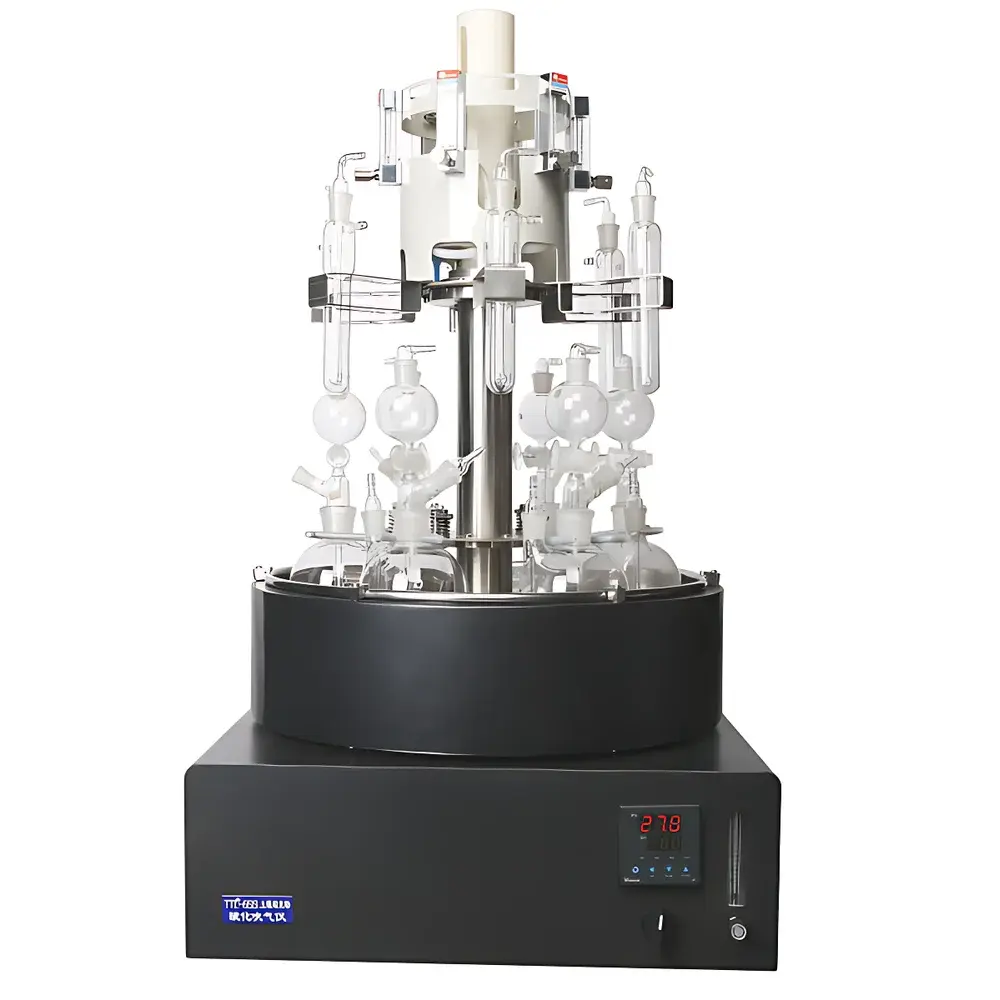
Tongtai Lian TTL-6HS Sulfide Acidification and Purge Apparatus
| Brand | Tongtai Lian (TTL) |
|---|---|
| Origin | Beijing, China |
| Manufacturer Type | Direct Manufacturer |
| Regional Category | Domestic (China) |
| Model | TTL-6HS |
| Instrument Type | Laboratory Benchtop System |
| Compliance | Designed per HJ 1226–2021 (PRC National Ecological and Environmental Standard) |
| Construction Materials | 316 Stainless Steel Frame + PTFE-Coated Components |
| Heating Method | Integrated Constant-Temperature Water Bath |
| Sample Capacity | 6 Independent Reaction Vessels |
| Gas Control | Individual Mass Flow Regulation per Channel (N₂) |
| Vertical Travel Range | 100 ± 2 mm |
| Sample Rack | Rotatable Circular Platform with Radial Mounting |
| Drainage | Stainless Steel Ball Valve |
| Electrical Isolation | Separated Water Bath and Control Unit Architecture |
| Corrosion Resistance | Certified for HCl, H₂SO₄, and NaOH Exposure (pH 1–14, ≤80 °C) |
Overview
The Tongtai Lian TTL-6HS Sulfide Acidification and Purge Apparatus is a purpose-built laboratory system engineered for compliant sample preparation in accordance with HJ 1226–2021, the official People’s Republic of China national standard for sulfide determination in water matrices using the methylene blue spectrophotometric method. It implements a controlled acidification–nitrogen purge–absorption workflow to quantitatively convert dissolved sulfide (S²⁻, HS⁻) and acid-volatile sulfides (AVS) into gaseous H₂S, which is then trapped in alkaline absorbent solution for downstream colorimetric analysis. The instrument is designed for reproducible, operator-independent execution of the critical pre-analytical step—eliminating manual variability inherent in open-beaker or clamp-based acidification setups. Its architecture prioritizes chemical inertness, thermal uniformity, and gas flow integrity across all six parallel reaction channels, ensuring metrological consistency required for regulatory environmental testing in municipal, industrial, and research laboratories.
Key Features
- Constant-temperature water bath with PID-controlled heating (range: ambient to 80 °C, stability ±0.5 °C), featuring uniform thermal distribution across the entire circular bath volume.
- Motor-driven vertical lift mechanism for the sample rack and gas distribution manifold, enabling precise positioning over reaction vessels with repeatable 100 ± 2 mm travel range.
- Internally routed nitrogen supply lines passing through the central support shaft—eliminating external tubing entanglement and minimizing dead volume and contamination risk.
- Rotatable circular sample platform mounted concentrically on the main axis; allows unrestricted angular adjustment for ergonomic front-facing vessel loading and unloading without repositioning the unit.
- Independent mass flow control for each of the six sample positions, implemented via calibrated needle valves and individual borosilicate glass rotameters (range: 0–10 L/min, ±2% full-scale accuracy).
- Integrated total gas flow meter for real-time monitoring of aggregate nitrogen consumption during purge cycles.
- Stainless steel (316 grade) chassis and PTFE-coated internal surfaces ensure long-term resistance to aggressive acidic (e.g., phosphoric or hydrochloric acid) and alkaline reagents used in sulfide liberation and trapping steps.
- Modular design separates the water bath vessel from the electronic control panel and power supply, reducing thermal stress on sensitive circuitry and extending service life under continuous operation.
- Front-access stainless steel ball valve enables rapid, spill-free drainage of the bath for cleaning, calibration verification, or maintenance.
Sample Compatibility & Compliance
The TTL-6HS supports standard 100–500 mL gas-washing bottles, 250 mL volumetric flasks, and custom absorption traps conforming to HJ 1226–2021 dimensional and sealing specifications. It accommodates aqueous matrices including surface water, groundwater, domestic wastewater, and industrial effluents with suspended solids content ≤100 mg/L. All wetted components comply with ISO 8502-3 for surface cleanliness and pass ASTM B117 salt-spray corrosion testing (168 h). The system’s operational parameters align with GLP documentation requirements: time-stamped purge duration, bath temperature logging, and nitrogen flow records can be manually transcribed for audit trails. While not inherently 21 CFR Part 11 compliant (lacking electronic signature capability), its mechanical repeatability and physical traceability support data integrity in non-GMP environmental QA/QC workflows.
Software & Data Management
The TTL-6HS operates as a standalone hardware platform with no embedded microprocessor or digital interface. Temperature setpoint and hold time are configured via analog dials; gas flow rates are adjusted manually using calibrated valves. All process parameters—including bath temperature, purge duration, and individual channel flow settings—are recorded externally by the analyst in laboratory notebooks or LIMS-integrated worksheets. This analog architecture ensures electromagnetic compatibility in shared analytical suites and eliminates firmware obsolescence risks. For laboratories requiring automated data capture, optional third-party USB thermocouple loggers (e.g., Omega OM-DAQPRO-5300) may be integrated with the bath outlet port to generate timestamped thermal profiles compatible with CSV export.
Applications
- Routine compliance testing of sulfide concentrations in discharge permits (e.g., EPA NPDES, China MEP discharge standards).
- Method validation and spike recovery studies per HJ 1226–2021 Section 8 (precision, accuracy, detection limit verification).
- Inter-laboratory comparison exercises where mechanical consistency across platforms is essential.
- Research on sulfide speciation kinetics in anaerobic digesters, sediment porewater, or biogas scrubbing systems.
- Training laboratories teaching standardized EPA Method 376.1 or ISO 11733 adaptations for sulfide analysis.
FAQ
What sample containers are compatible with the TTL-6HS?
Standard 250 mL or 500 mL gas-washing bottles with ground-glass joints or PTFE-lined screw caps, as specified in HJ 1226–2021 Annex A.
Can the instrument be used with acids other than phosphoric acid?
Yes—hydrochloric acid (1:1 v/v) and acetic acid (20% w/v) are validated alternatives per Section 6.2 of HJ 1226–2021; all wetted materials remain chemically stable at ≤80 °C.
Is calibration of the flow meters required before use?
Each rotameter is factory-calibrated with nitrogen at 25 °C and 1 atm; users should verify zero-point alignment and perform annual recalibration using a primary-standard bubble meter or certified mass flow calibrator.
How is carryover between samples prevented?
The system relies on procedural controls: dedicated glassware per sample, post-run nitrogen purging of manifolds for ≥2 min, and regular cleaning of the central shaft and rotameter tubes with 10% nitric acid followed by deionized water rinse.
Does the TTL-6HS meet international standards such as ISO or ASTM?
It is explicitly engineered for HJ 1226–2021; however, its functional equivalence to ISO 11733:2005 (water quality — determination of sulfide — iodometric method) and ASTM D4129–18 (standard test method for sulfide in water) has been demonstrated in cross-method validation studies conducted by third-party environmental testing labs in Jiangsu and Guangdong provinces.







