
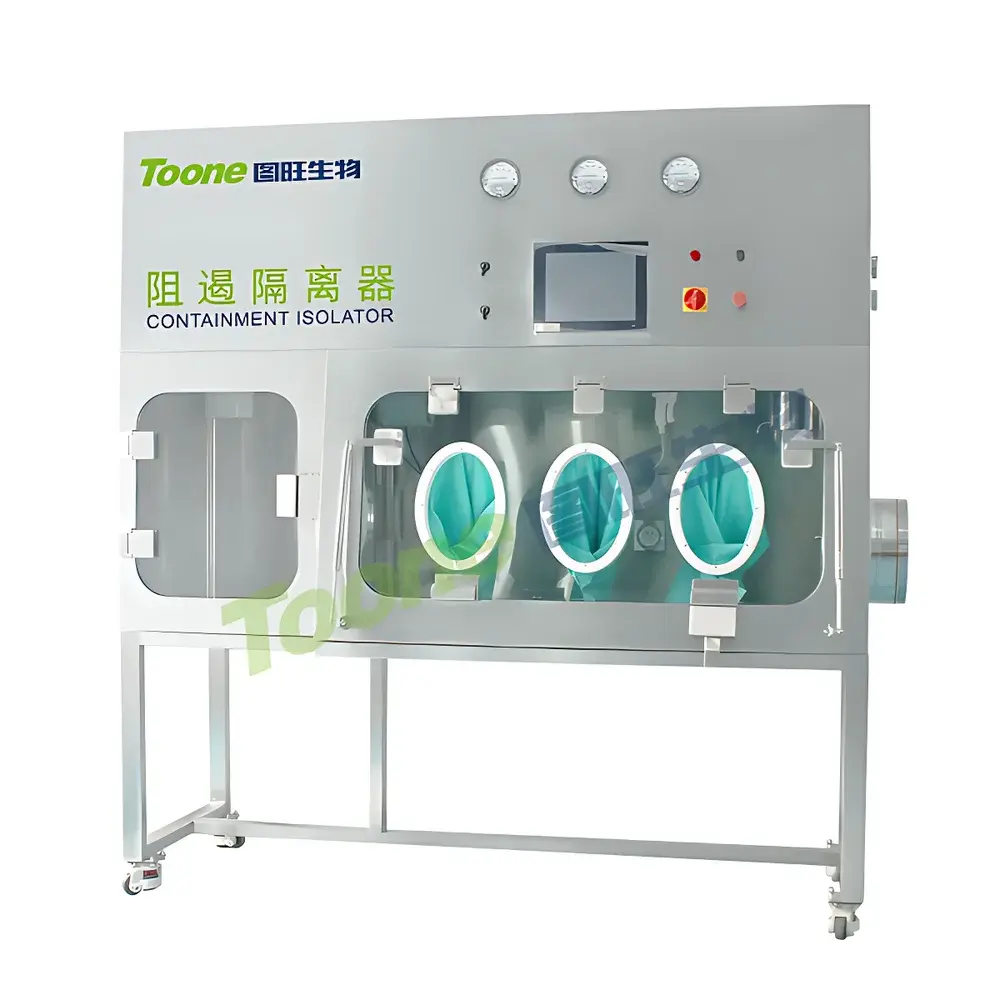
Toone TW-FGL2134 Negative-Pressure Sterile Test Isolator
| Brand | Toone |
|---|---|
| Origin | Zhejiang, China |
| Manufacturer Type | Direct Manufacturer |
| Country of Origin | China |
| Model | TW-FGL2134 |
| Pricing | Upon Request |
Overview
The Toone TW-FGL2134 Negative-Pressure Sterile Test Isolator is an engineered containment solution designed for handling highly potent, cytotoxic, allergenic, or pathogenic compounds under strict biosafety and aseptic conditions. It operates on the principle of sustained negative pressure differential—maintaining internal chamber pressure below ambient by means of a dedicated, balanced air-handling system with dual HEPA filtration (supply and exhaust). This pressure-controlled architecture prevents unidirectional airborne escape of hazardous agents while preserving ISO Class 5 (dynamic Grade A) cleanroom conditions inside the work area. The isolator complies with core international standards governing containment integrity, including ISO 14644-1 (cleanroom classification), ISO 10648-2 (leakage rate requirements for containment devices), and EU GMP Annex 1 (2022) provisions for isolator qualification and operational control.
Key Features
- Robust Hard-Wall Construction: Fabricated from electropolished 316L stainless steel frame and 19 mm tempered borosilicate glass panels, providing structural rigidity, chemical resistance, and long-term dimensional stability under repeated sterilization cycles.
- ISO Class 5 Internal Environment: Achieved via laminar airflow (0.36–0.54 m/s) supplied through H14 HEPA filters (≥99.995% @ 0.1 µm), validated by PAO scanning leak testing per ISO 14644-3.
- Precision Pressure Control: Siemens S7-1200 PLC-based automation regulates chamber pressure within ±80 Pa range with real-time feedback loop; includes audible/visual loss-of-pressure alarm and automatic shutdown protocol upon deviation beyond set thresholds.
- Leak Integrity Verified: Overall chamber leakage rate ≤0.5% vol/hour at +80 Pa overpressure—validated per ISO 10648-2 Annex B using mass flow measurement techniques.
- Integrated VHP Decontamination: Supports full-cycle hydrogen peroxide vapor (VHP) bio-decontamination achieving ≥6-log reduction of Geobacillus stearothermophilus spores, compliant with ISO 15759 and PDA TR#50.
Sample Compatibility & Compliance
The TW-FGL2134 accommodates a broad scope of sterile processing workflows involving APIs, monoclonal antibodies, viral vectors, and live attenuated vaccines. Its design enables compatibility with glove ports (ISO 14644-7 compliant), rapid transfer ports (RTPs), and interlocked airlocks for material ingress/egress without compromising internal classification. All critical process parameters—including pressure, temperature (±0.1 °C resolution), relative humidity (±0.1 %RH resolution), airflow velocity, and filter status—are continuously monitored and logged in accordance with 21 CFR Part 11 requirements. The system supports audit-ready electronic signatures, user-level access control, and immutable data storage for GLP/GMP-regulated environments.
Software & Data Management
Control and monitoring are executed via a validated NetSCAD industrial HMI platform deployed on a 12.1-inch ruggedized touchscreen panel, meeting EU Annex 11 and FDA 21 CFR Part 11 validation criteria. The software provides real-time visualization of all environmental and mechanical parameters, configurable alarm thresholds, automated trend reporting, and exportable CSV/Excel logs. Event-driven data capture includes timestamps for every operator action, parameter change, alarm activation, and VHP cycle phase transition. Data retention is configurable up to 12 months locally, with optional integration into enterprise LIMS or MES systems via OPC UA or Modbus TCP protocols.
Applications
- Aseptic filling and lyophilization support for high-potency oncology drugs
- Containment during formulation development of peptide-based therapeutics
- Microbial challenge testing and sterility assay execution under Grade A conditions
- Handling of genetically modified organisms (GMOs) in biosafety level 2+ research settings
- Stability studies requiring controlled environmental exposure under ISO Class 5
- Validation of sterilization processes (e.g., dry heat, steam, VHP) for primary packaging components
FAQ
What is the maximum allowable pressure differential range?
The isolator maintains stable operation across a programmable pressure range of –80 Pa to +80 Pa relative to ambient, with default negative operating setpoints typically configured between –30 Pa and –60 Pa.
Is the H14 HEPA filter certified to EN 1822-1?
Yes—each supply and exhaust H14 filter is individually tested and certified per EN 1822-1:2019, with full test reports provided upon delivery.
Can the system be integrated into a facility’s BMS?
Yes—the isolator features native Modbus TCP and optional OPC UA interfaces for seamless integration with building management systems and centralized monitoring platforms.
Does the VHP decontamination cycle include post-cycle aeration and catalyst-based residual decomposition?
Yes—the integrated VHP generator includes catalytic destruction units and programmable aeration phases to reduce residual H2O2 to <1 ppm prior to operator entry, verified by electrochemical sensor feedback.
What validation documentation is supplied with the unit?
Factory Acceptance Testing (FAT), Site Acceptance Testing (SAT), IQ/OQ protocols, and full traceable calibration certificates for all sensors (pressure, temp, RH, airflow) are delivered as part of standard commissioning.




