
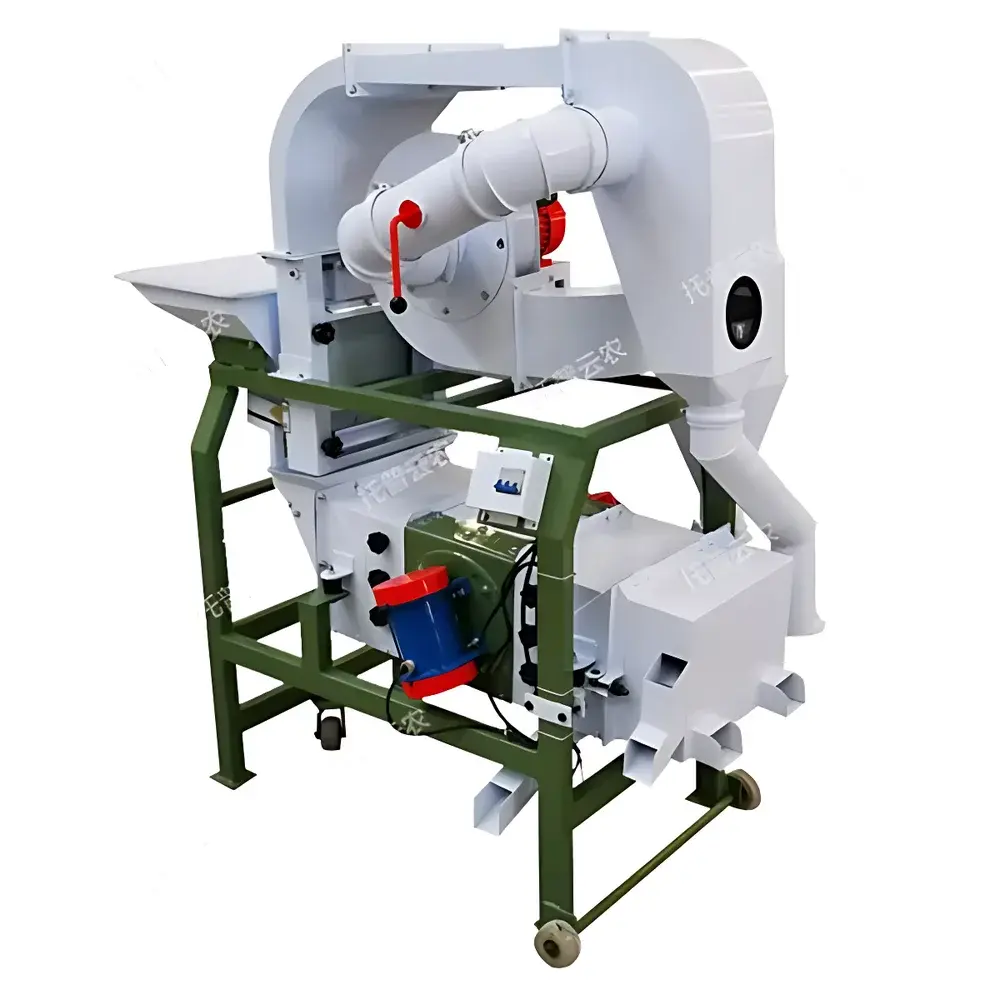
Top Cloud-agri 5S-200 Rice Seed De-awned Cleaning and Grading Machine
| Brand | Top Cloud-agri |
|---|---|
| Origin | Zhejiang, China |
| Manufacturer Type | Direct Manufacturer |
| Country of Origin | China |
| Model | 5S-200 |
| Maximum Throughput (wheat basis) | 200 kg/h |
| Dimensions (L×W×H) | 1625×850×1740 mm |
| Sieving Layers | 3-layer |
| Power Supply | 380 V, 50 Hz |
| Total Motor Power | 0.99 kW |
| Construction | Galvanized steel sieve plates, computer CNC-punched |
| Cleaning Media | High-resilience low-temperature rubber balls |
| Application Scope | Rice, wheat, vegetable seeds, and other small-grain agricultural seeds |
Overview
The Top Cloud-agri 5S-200 Rice Seed De-awned Cleaning and Grading Machine is an integrated post-harvest seed processing instrument engineered for precision cleaning, de-awning, and size-based grading of small-grain agricultural seeds—primarily rice, but also adaptable to wheat, barley, oats, and fine vegetable seeds (e.g., lettuce, carrot, brassica). Unlike general-purpose threshers or bulk grain cleaners, the 5S-200 implements a dual-stage separation principle: first, mechanical sieving via three independently adjustable, CNC-machined galvanized steel sieve decks; second, pneumatic aspiration using calibrated airflow to remove awns, chaff, dust, lightweight immature grains, and broken seed fragments. This two-phase architecture ensures high seed purity (>99.2% typical under standardized test conditions per GB/T 3543.3–1995 and ISO 6644:2021), minimal mechanical damage (<1.5% kernel fracture rate per ISTA Handbook Section 5.3), and consistent particle-size fractionation—critical for breeding trial reproducibility and certified seed lot preparation.
Key Features
- Three-tier modular sieve system with fully interchangeable, laser-calibrated galvanized steel plates—each deck precisely punched via CNC-controlled hydraulic press for uniform aperture geometry (standard apertures: 1.5–4.0 mm round, 2.0–5.0 mm oblong, customizable upon request)
- Low-temperature resilient rubber cleaning balls formulated with synthetic EPDM-SBR hybrid elastomer—maintains >92% rebound resilience at −15°C and exhibits <3% compression set after 1,000 h accelerated aging (ASTM D395 Method B), ensuring sustained sieve self-cleaning efficacy across seasonal storage and field-deployed operation
- Compact footprint (1.625 m × 0.85 m) optimized for confined spaces in breeding stations, seed certification labs, and university agronomy field stations—requires no foundation anchoring and operates on standard industrial 380 V / 50 Hz three-phase supply
- Integrated variable-airflow fan assembly with flow-regulating damper and differential pressure monitoring—enables precise tuning of aspiration velocity (range: 4.2–8.7 m/s at inlet duct) to match seed density and awn morphology without inducing seed abrasion or embryo injury
- Tool-free disassembly design: full access to all sieve decks, air chamber, and discharge chutes within ≤90 seconds—validated per GLP-compliant seed lab SOPs to prevent cross-contamination between genotypes during sequential processing
Sample Compatibility & Compliance
The 5S-200 accommodates dry seeds with moisture content ≤13.5% (w.b.), including paddy rice (Oryza sativa L.), japonica/indica subspecies, hybrid rice F1 lines, and small-seeded horticultural crops (e.g., tomato, onion, celery). It complies with national seed quality standards GB/T 3543.3–1995 (Seed testing procedures – Purity analysis) and aligns with ISO 6644:2021 (Cereals — Determination of impurities and foreign matter). Its mechanical design satisfies IEC 60204-1:2018 (Safety of machinery – Electrical equipment) and includes IP54-rated enclosures for motor and control panel. While not FDA-registered (as it processes non-food-grade raw agricultural commodities pre-milling), its construction materials meet EC 1935/2004 requirements for indirect food contact surfaces.
Software & Data Management
The 5S-200 operates as a standalone electromechanical unit with analog controls—no embedded firmware, touchscreen interface, or digital data logging. All operational parameters (fan speed, sieve inclination angle, feed rate) are manually calibrated and recorded in user-maintained logbooks per ISO/IEC 17025:2017 Clause 7.5.2 (Control of records). Optional integration with external IoT gateways (e.g., Modbus RTU output module) permits connection to centralized farm management platforms (e.g., Climate FieldView, Granular) for throughput tracking and maintenance scheduling—subject to third-party configuration.
Applications
- Pre-germination seed cleaning in national crop breeding programs (e.g., China National Rice Research Institute field trials)
- Generation advancement of elite lines in pedigree selection protocols requiring genotype-specific purity assurance
- Pre-packaging cleaning of certified seed lots prior to ISTA-certified germination testing
- Removal of glumes and sterile lemmas from indica rice panicles to improve sowing uniformity in mechanized direct seeding systems
- Size fractionation of heterogenous vegetable seed batches to isolate uniform cohorts for controlled-environment phenotyping studies
FAQ
Can the 5S-200 process wet or dew-moistened rice seeds?
No. Seeds must be dried to ≤13.5% moisture content (wet basis) prior to processing to prevent sieve clogging, rubber ball adhesion, and airflow turbulence-induced segregation errors.
Is calibration documentation provided with shipment?
Yes—each unit ships with a factory-verified sieve aperture tolerance report (±0.05 mm), fan static pressure curve chart (at 50 Hz), and electrical safety compliance certificate (GB/T 14048.1–2012).
What maintenance intervals are recommended for continuous lab use?
Rubber cleaning balls should be inspected every 200 operating hours and replaced if surface cracking or >15% diameter reduction is observed; sieve plates require visual inspection and aperture verification every 500 hours per ISO 565:2022 Annex B.
Does the machine support USDA-APHIS phytosanitary treatment protocols?
No—it performs only physical separation. Any required heat, fumigation, or chemical treatment must occur upstream or downstream of the 5S-200 in accordance with 7 CFR §319.11.
Related Products





