
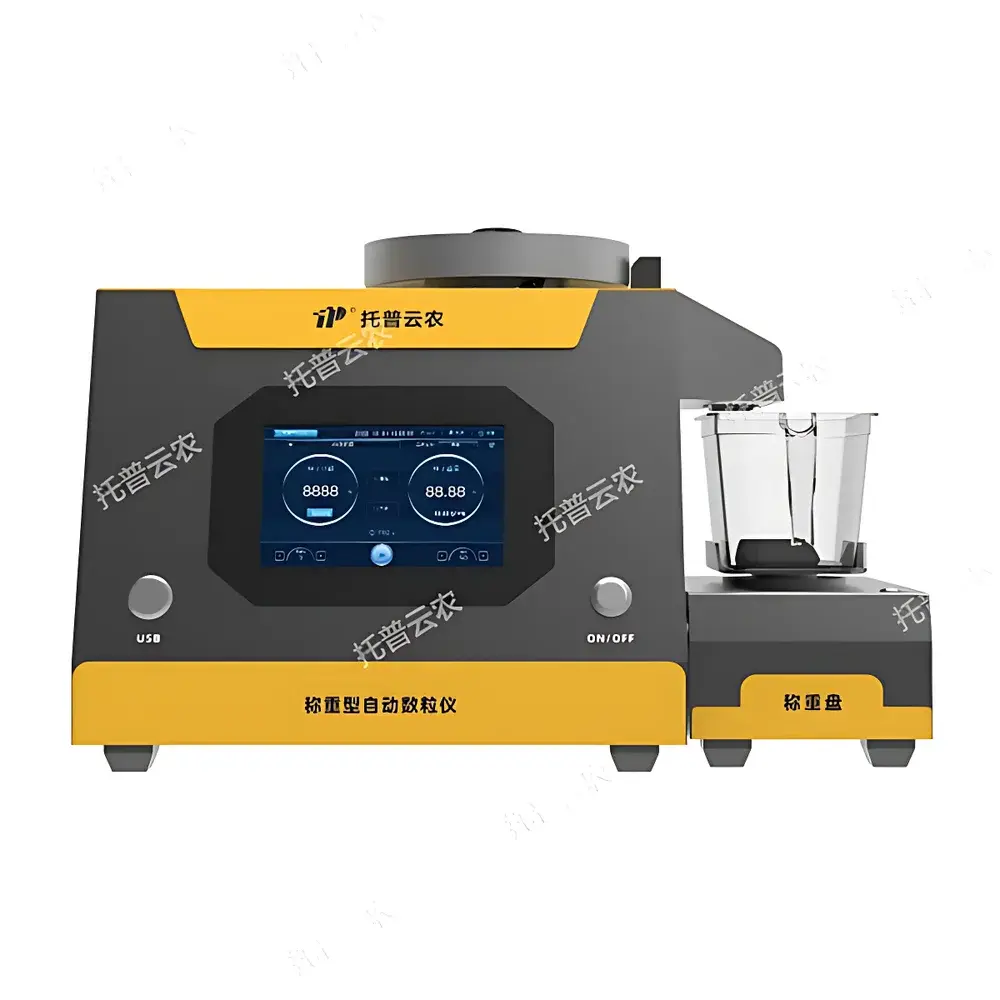
Top Cloud-agri SLY-E Gravimetric Automatic Seed Counter
| Brand | Top Cloud-agri |
|---|---|
| Origin | Zhejiang, China |
| Manufacturer Type | Direct Manufacturer |
| Model | SLY-E |
| Seed Length Range | 1–23 mm |
| Counting Accuracy | ±0.2% (±2‰) |
| Counting Speed | ≥1,000 seeds / 3 min (e.g., sesame) |
| Vibration Noise Level | ≤80 dB(A) |
| Counting Capacity | 1–99,999 seeds |
| Weighing Range | 0–1000 g |
| Weighing Accuracy | ±0.2 g |
| Dimensions (L×W×H) | 525 × 372 × 351 mm |
| Net Weight | 27.5 kg |
| Power Supply | Dual-voltage compatible — 220 VAC/50 Hz or 110 VAC/60 Hz |
| Power Consumption | 20 W (220 V), 14 W (110 V) |
| Operating Environment | −10 °C to +50 °C |
Overview
The Top Cloud-agri SLY-E Gravimetric Automatic Seed Counter is an integrated laboratory instrument engineered for high-throughput, metrologically traceable seed quantification in agricultural research, seed certification, quality control (QC), and breeding programs. Unlike optical or volumetric counters, the SLY-E employs a dual-mode gravimetric–mechanical counting principle: it combines precision mass measurement with controlled mechanical seed dispensing and real-time weight-based validation. This hybrid methodology ensures robustness across heterogeneous seed morphologies—particularly critical when processing irregularly shaped, elongated, or surface-textured seeds where optical obscuration or rolling instability compromises single-mode systems. The device is calibrated per ISO 5725 (accuracy and precision of measurement methods) and supports traceable calibration verification using certified reference masses. Its architecture complies with GLP-aligned operational requirements for seed testing laboratories seeking audit-ready documentation workflows.
Key Features
- 7-inch full-color capacitive touchscreen interface: Enables intuitive parameter configuration, real-time status monitoring, and multi-language UI support (English, Spanish, French, Arabic)—optimized for field-deployed and lab-based operators.
- Infinitely variable feed-disc speed control: Motorized disc rotation adjusts dynamically from 15 to 120 rpm, allowing optimization for fragile seeds (e.g., maize kernels) versus dense, high-density grains (e.g., soybean or wheat).
- Adjustable discharge chute geometry: Mechanical aperture tuning restricts passage to target size classes (length- and diameter-filtered), minimizing interference from chaff, broken seeds, or inert debris without requiring pre-sieving.
- Gravimetric validation loop: Integrated 0.2 g resolution load cell cross-verifies count totals against mass-derived theoretical counts (e.g., thousand-seed weight), flagging anomalies exceeding user-defined tolerance bands (default: ±0.5%).
- Deceleration-triggered precision counting: At 95% of the preset count threshold, motor speed reduces by 60%, enabling final enumeration at sub-10-rpm stability—critical for low-coefficient-of-friction seeds such as rice or flax.
- Auto-calculating thousand-seed weight (TSW): Derives TSW in real time using measured mass and validated count, outputting results in g/1000 seeds with uncertainty propagation per GUM (Guide to the Expression of Uncertainty in Measurement).
Sample Compatibility & Compliance
The SLY-E accommodates six defined morphological categories per ISTA Rule 5.3: large elongated (e.g., sunflower), large round (e.g., pumpkin), medium elongated (e.g., barley), medium round (e.g., pea), small elongated (e.g., carrot), and small round (e.g., lettuce). It maintains ±0.2% counting accuracy across all categories within the 1–23 mm length range. Instrument validation aligns with ISTA Accreditation Standard 2023 and supports compliance with national seed testing regulations including USDA-FGIS Directive 71-2, China’s NY/T 440-2021, and EU Regulation (EU) No 2019/1202. All firmware operations retain immutable timestamps and operator IDs, satisfying ISO/IEC 17025:2017 clause 7.7.1 (data integrity) and enabling Part 11–compliant audit trails when paired with optional networked data management software.
Software & Data Management
Onboard firmware stores up to 1,000 test records with full metadata: date/time stamp, operator ID, seed lot ID, count result, mass reading, calculated TSW, environmental ambient temperature/humidity (via optional external sensor input), and pass/fail status relative to configured limits. Data export occurs via USB 2.0 port in CSV format—structured for direct ingestion into LIMS platforms (e.g., LabWare, STARLIMS) or statistical analysis tools (R, JMP, Minitab). Optional Ethernet/Wi-Fi module enables remote firmware updates and scheduled automated backups to secure cloud storage (AES-256 encrypted), meeting FDA 21 CFR Part 11 requirements for electronic records and signatures when deployed with validated access controls.
Applications
- Official seed certification testing per ISTA, AOSA, or national regulatory protocols
- Thousand-seed weight determination for germination rate modeling and sowing rate calibration
- QC screening of breeder seed lots prior to field trials
- Post-harvest processing yield verification in seed conditioning facilities
- Research on seed dormancy, viability, and stress-response phenotyping where precise cohort sizing is essential
- Teaching laboratories for hands-on metrology training in agricultural biophysics
FAQ
Does the SLY-E require periodic recalibration?
Yes. Annual verification against NIST-traceable mass standards is recommended. Internal zero-point drift compensation occurs automatically at power-on; however, full span calibration using two certified weights (e.g., 100 g and 500 g) is required after any mechanical impact or ambient temperature shift >15 °C.
Can the instrument count mixed-species samples?
No. The SLY-E is designed for homogenous seed lots. Mixed-species or blended seed batches must be pre-sorted by size or density prior to counting to maintain accuracy and avoid mechanical jamming.
Is the device compatible with humid or dusty field environments?
It meets IP54 ingress protection rating—dust-resistant and splash-proof—but is intended for indoor laboratory or sheltered post-harvest facility use. Continuous operation above 85% RH or ambient particulate concentration >1 mg/m³ may affect weighing stability and disc motor longevity.
What maintenance intervals are specified?
Daily: wipe feed disc and chute with lint-free cloth; weekly: inspect rubber gasket integrity and clean sensor housing vents; annually: replace feed-disc bearing assembly and validate load cell linearity across full 0–1000 g range.
How does the gravimetric validation improve reliability over optical counters?
Optical systems fail with translucent, clustered, or overlapping seeds; gravimetric validation provides orthogonal confirmation—detecting undercounting due to double-layer stacking or overcounting from static adhesion—thereby reducing false acceptance/rejection in certified seed lots.
Related Products






