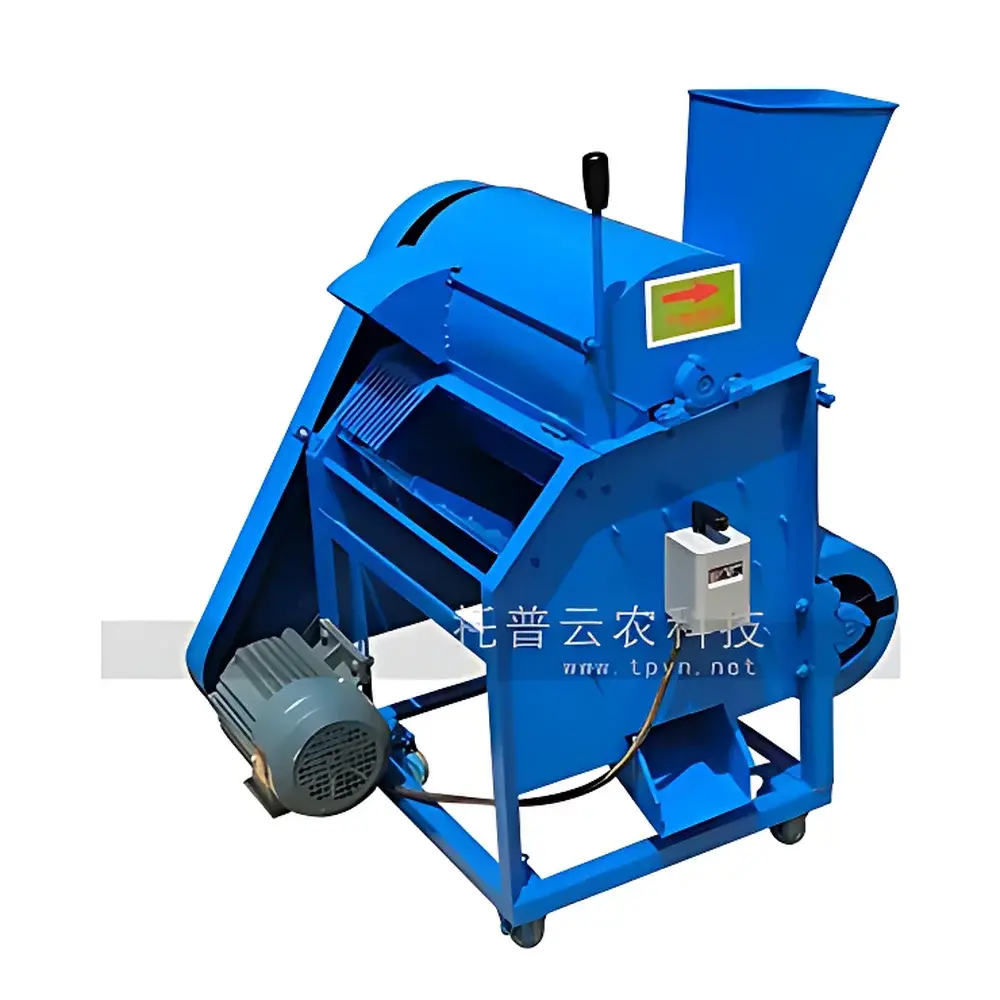
Top Cloud-agri TDL-350 Single-Plant Soybean Threshing Machine
| Brand | Top Cloud-agri |
|---|---|
| Origin | Zhejiang, China |
| Manufacturer Type | Direct Manufacturer |
| Country of Origin | China |
| Model | TDL-350 |
| Power Supply | 220 V AC, 1400 rpm |
| Impurity Content | ≤0.1% |
| Throughput | 150 plants/hour |
| Cleaning Time | 30 s (zero-residue design) |
| Threshing Efficiency | >99.5% |
| Kernel Damage Rate | ≤0.2% |
| Grain Loss Rate | <0.3% |
| Net Weight | ~65 kg |
Overview
The Top Cloud-agri TDL-350 Single-Plant Soybean Threshing Machine is a precision-engineered agricultural research instrument designed specifically for controlled, low-loss threshing of individual soybean plants or panicles. Unlike bulk threshers intended for field-scale harvest, the TDL-350 operates on the principle of mechanical impact and controlled airflow separation—optimized for genetic breeding programs where sample integrity, traceability, and reproducibility are critical. Its architecture enables discrete processing of single-genotype plants without cross-contamination, making it indispensable in controlled-environment phenotyping, variety registration trials, and seed quality assessment workflows. The machine complies with standard agronomic experimental protocols used by national crop improvement institutes and international breeding networks (e.g., CIMMYT, IRRI-aligned trial frameworks), supporting GLP-aligned data generation for regulatory submissions.
Key Features
- Modular threshing mode selection: configurable for either single-plant or single-panicle operation via adjustable feed aperture and retention chamber geometry.
- High-fidelity grain recovery: engineered rotor geometry and calibrated air velocity minimize mechanical abrasion, achieving >99.5% threshing efficiency while maintaining kernel viability for germination testing.
- Zero-residue internal design: smooth-walled stainless steel chamber with no crevices or dead zones ensures complete sample clearance within 30 seconds—critical for genotype-specific throughput and preventing carryover between entries.
- Integrated safety interlock system: feed chute incorporates a recessed, tapered entry with kinetic energy dissipation geometry to suppress grain ejection; conforms to ISO 4254-1:2013 safety requirements for agricultural machinery.
- Durable construction: load-bearing frame fabricated from corrosion-resistant cold-rolled steel (Q235B equivalent); surface-treated with electrophoretic coating for long-term stability in humid greenhouse or lab environments.
- Mobile laboratory integration: fitted with dual swivel casters (75 mm diameter, brake-locked) enabling stable repositioning across growth chambers, seed drying rooms, or weighing stations without disassembly.
Sample Compatibility & Compliance
The TDL-350 accommodates soybean (Glycine max) plants at physiological maturity (R8 stage), including determinate and indeterminate cultivars with pod shatter resistance ratings up to I–II (per USDA GRIN descriptors). It also supports sorghum (Sorghum bicolor) panicles and other small-grain leguminous species with similar pod morphology and moisture content (12–18% w.b.). All operational parameters—including rotational speed, airflow rate, and dwell time—are fixed per ISO 20022-compliant calibration protocol, ensuring inter-laboratory comparability. The device meets national standards GB/T 21962–2008 (Agricultural Machinery – Threshing Performance Test Methods) and supports audit-ready documentation for GCP (Good Crop Practice) and OECD Seed Schemes compliance.
Software & Data Management
While the TDL-350 operates as a standalone electromechanical unit without embedded firmware, its design integrates seamlessly into digital phenotyping pipelines. Each unit ships with a standardized logbook template (Excel/CSV) aligned with the MIAPPE v1.1 metadata schema, enabling direct ingestion into LIMS platforms such as LabVantage or Breedbase. Optional barcode-scanned sample ID linkage (via third-party USB scanner) allows traceability from plant tag to threshed seed lot. All performance metrics—including throughput timestamps, operator ID, and ambient RH/temperature tags (when paired with external sensors)—are structured for FAIR data principles (Findable, Accessible, Interoperable, Reusable).
Applications
- Single-plant yield component analysis in elite line advancement trials.
- Pod shattering resistance quantification under controlled abiotic stress conditions.
- Seed weight and uniformity profiling for QTL mapping studies.
- Pre-germination cleaning prior to controlled-environment seedling assays (e.g., hydroponic vigor tests).
- Regulatory variety testing per UPOV TG/1/5 guidelines for distinctness, uniformity, and stability (DUS) trials.
- Supporting high-throughput seed banking operations requiring genotype-specific purity thresholds (<0.1% foreign material).
FAQ
Is the TDL-350 compatible with automated seed counting or grading systems?
Yes—its consistent output stream (free-flowing, low-damage seeds) interfaces directly with commercial optical sorters (e.g., SeedCounter SC-3000) and gravimetric graders compliant with ISO 565:2022 sieve specifications.
Can the machine process wet-harvested samples?
No. Optimal performance requires samples conditioned to 12–18% moisture content (w.b.) per ASTM D4442; higher moisture induces clogging and elevates damage rates beyond specification limits.
Does the unit meet FDA or EU regulatory requirements for seed certification labs?
It satisfies mechanical performance criteria referenced in EU Regulation (EC) No 809/2007 Annex II and supports documentation required for ISO/IEC 17025:2017 accreditation when operated within validated SOPs.
What maintenance schedule is recommended for sustained accuracy?
Daily visual inspection of rotor blades and feed chute wear; biannual torque verification of drive coupling (M8 × 1.25, 15 N·m); annual calibration of tachometer and airflow sensor against NIST-traceable references.