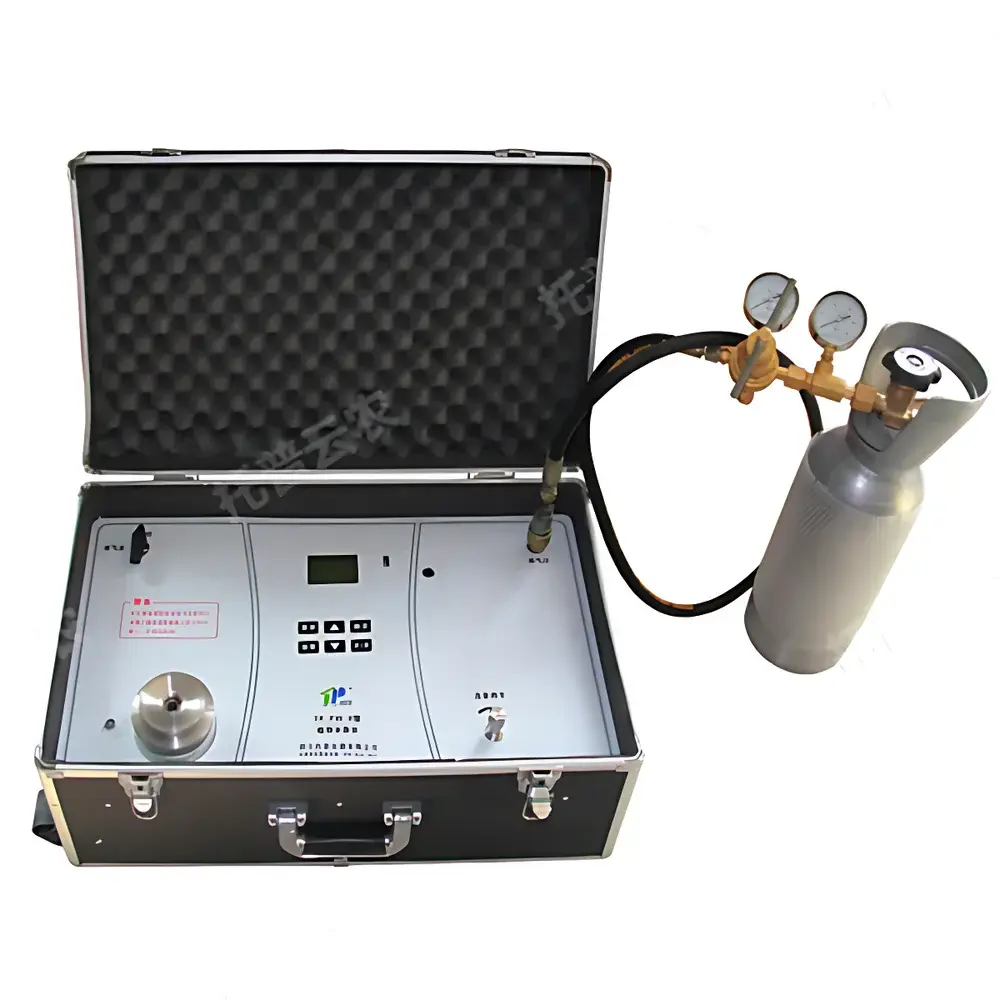
Top Cloud-agri TP-PW-II Plant Water Potential Analyzer (Pressure Chamber Method)
| Brand | Top Cloud-agri |
|---|---|
| Origin | Zhejiang, China |
| Manufacturer Type | OEM Manufacturer |
| Country of Origin | China |
| Model | TP-PW-II |
| Measurement Range | 0–3.5 MPa |
| Display | LCD with Chinese menu interface |
| Resolution | 0.01 MPa |
| Units | MPa and bar selectable |
| Data Storage | 4,000 records |
| Power Supply | 12 V / 2.5 Ah rechargeable lithium battery with real-time clock |
| Dimensions (Case 1) | 560 × 400 × 280 mm |
| Dimensions (Case 2) | 630 × 400 × 310 mm |
| Data Export | USB interface for PC transfer |
| Operating Environment | Field-deployable, indoor/outdoor use |
Overview
The Top Cloud-agri TP-PW-II Plant Water Potential Analyzer is a portable, pressure chamber–based instrument engineered for direct, non-destructive quantification of plant water potential (Ψleaf) in situ or under controlled laboratory conditions. It operates on the Scholander pressure chamber principle: a leaf or small shoot segment is sealed in a pressurized chamber, and nitrogen gas is incrementally applied until xylem sap emerges from the cut surface—indicating the point at which the applied external pressure balances the negative water potential of the sample. This equilibrium pressure, measured in MPa, corresponds directly to the plant’s water potential. Designed for rigorous field ecology and crop physiology research, the TP-PW-II supports quantitative assessment of plant water status across gradients of soil moisture, atmospheric vapor pressure deficit (VPD), and drought stress intensity. Its robust mechanical architecture, integrated lithium battery, and dual-case transport configuration ensure operational reliability across remote field sites—from orchards and vineyards to alpine meadows and arid-steppe rangelands.
Key Features
- High-resolution digital pressure transduction with ±0.01 MPa readout precision, enabling detection of subtle physiological shifts during diurnal cycles or irrigation response trials.
- Dual-unit display (MPa and bar) with intuitive, full-Chinese LCD interface—optimized for bilingual technical users without compromising metrological clarity.
- Flexible measurement mode selection: automated pressure ramping with endpoint detection or manual stepwise pressurization for operator-controlled validation.
- Onboard data logging capacity for up to 4,000 timestamped measurements, each tagged with date, time, and user-defined sample ID.
- USB 2.0 interface compliant with Windows-based desktop software for automated data ingestion, statistical summarization, and export to CSV/Excel formats.
- Real-time clock synchronization ensures traceable temporal metadata—critical for longitudinal studies requiring alignment with environmental sensor networks (e.g., soil moisture probes, weather stations).
- Field-hardened design: sealed pressure vessel rated for repeated cycling up to 3.5 MPa; ergonomic dual-case packaging facilitates transport over rough terrain without component misalignment.
Sample Compatibility & Compliance
The TP-PW-II accommodates a broad spectrum of herbaceous and woody plant tissues—including detached leaves, petioles, stems, and small branch segments—provided the cut surface is clean and free of embolized vessels. Optimal sample size ranges from 2–8 cm in length with diameters ≤15 mm. The system complies with standardized methodologies outlined in ASTM D7291-21 (Standard Practice for Determining Plant Water Potential Using Pressure Chambers) and aligns with ISO 10262:2022 (Soil quality — Determination of plant-available water by pressure plate apparatus), supporting methodologically defensible comparisons across multi-site agronomic trials. While not certified for GLP/GMP-regulated environments, its data structure and audit-ready export logs meet minimum requirements for FAO-recommended crop water productivity assessments and national agricultural extension protocols.
Software & Data Management
The bundled PC application provides calibrated pressure curve visualization, automatic outlier flagging based on user-defined thresholds (e.g., >±0.1 MPa deviation from rolling 5-point mean), and batch-report generation with customizable headers (site ID, species code, treatment group). All exported datasets include embedded metadata fields: measurement timestamp (UTC+8), chamber temperature (recorded via internal thermistor), operator initials, and optional GPS coordinates (manually entered). Data files conform to FAO’s AQUACROP input schema conventions, facilitating direct integration into irrigation scheduling models. No cloud storage or proprietary file locking is implemented—raw .csv exports retain full editability and interoperability with R, Python (pandas), or MATLAB workflows.
Applications
- Drought tolerance screening in breeding programs—quantifying genotypic variation in midday water potential under controlled stress imposition.
- Irrigation scheduling optimization for high-value horticultural crops (e.g., grapes, almonds, blueberries) using threshold-based deficit irrigation triggers (e.g., Ψleaf ≤ −1.2 MPa).
- Eco-physiological studies of stomatal regulation across elevational or latitudinal transects, paired with concurrent leaf gas exchange and chlorophyll fluorescence measurements.
- Validation of remote-sensing–derived vegetation water stress indices (e.g., TCI, CWSI) through ground-truth calibration campaigns.
- Teaching laboratories in plant physiology and environmental botany—demonstrating cohesion-tension theory, cavitation resistance, and hydraulic segmentation concepts.
FAQ
What sample preparation is required prior to measurement?
Samples must be excised rapidly with a sharp razor blade, immediately covered with moist tissue, and measured within 60 seconds to minimize evaporative artifact. Petiole or stem ends should be recut underwater to remove air-blocked vessels.
Can the TP-PW-II be used for root or soil water potential measurements?
No—it is specifically validated for aboveground plant tissues. Soil or root water potential requires thermocouple psychrometry or tensiometric methods per ISO 11275:2021.
Is calibration traceable to NIST or other national standards?
The pressure transducer is factory-calibrated against a deadweight tester with documented uncertainty of ±0.005 MPa (k=2); end-user recalibration is not supported but drift verification is possible using zero-pressure and 1.0 MPa reference checks.
Does the instrument support Bluetooth or wireless data transfer?
No—data transmission is exclusively via USB cable to ensure signal integrity in electrically noisy field environments and eliminate pairing latency.
What maintenance is required between field deployments?
After each use, purge residual moisture from the chamber seal groove with lint-free cloth; inspect O-ring integrity quarterly; store battery at 40% charge in climate-controlled conditions (10–25°C).